


Albert Deak is a British visual artist whose practice unfolds at the intersection of colour, light, abstraction, and philosophical inquiry. Rooted in a diverse creative background that spans graphic arts, ceramics, and digital experimentation, Deak’s work resists categorization within a single medium or tradition. Instead, it operates as a fluid visual language that adapts, evolves, and expands in response to both emotional intuition and intellectual curiosity.
From an early stage, Deak demonstrated an affinity for visual systems and material exploration. His foundation in graphic arts instilled a sensitivity to composition, balance, and visual rhythm, while his experience with ceramics introduced a tactile understanding of form, surface, and transformation. These formative disciplines continue to inform his contemporary practice, even as his work has increasingly moved toward acrylic painting and digital abstraction.
Today, Deak’s art reflects a synthesis of these influences, resulting in vibrant compositions that feel at once spontaneous and deliberate. His works are charged with expressionist energy while remaining grounded in conceptual depth.
The Language of Colour and Light
At the core of Albert Deak’s artistic inquiry lies colour, not merely as an aesthetic device, but as an emotional and metaphysical force. His compositions often pulse with chromatic intensity, using colour to convey psychological states, cosmic phenomena, and unseen dimensions of experience. Light functions as both structure and symbol, guiding the viewer’s eye while suggesting illumination beyond the physical realm.
Deak approaches colour intuitively, yet with philosophical intent. Each hue carries resonance, acting as a bridge between internal emotion and universal presence. In his work, colour becomes a language through which complex ideas such as existence, time, and consciousness are expressed without the need for literal representation.
This sensitivity to colour and light situates Deak within a lineage of artists who have explored abstraction as a spiritual and intellectual pursuit, while maintaining a distinctly contemporary visual vocabulary.
Influences and Artistic Lineage
While Albert Deak’s visual language is unmistakably his own, his work engages in a quiet dialogue with influential figures in modern and contemporary art. The spiritual abstraction of Wassily Kandinsky, the gestural freedom of Jackson Pollock, the conceptual ambiguity of Gerhard Richter, and the surreal metaphysics of Salvador Dalí each leave subtle traces within his practice.
From Kandinsky, Deak draws an understanding of abstraction as an expressive and spiritual act. Pollock’s influence emerges in the dynamic movement and layered energy of his compositions. Richter’s oscillation between clarity and obscurity echoes in Deak’s treatment of form and depth, while Dalí’s fascination with science, time, and the subconscious resonates in his thematic explorations.
Rather than mimicking these influences, Deak transforms them by filtering historical reference through contemporary concerns such as cosmology, digital space, and the philosophical implications of modern science.
Art as Inquiry: Science, Cosmos, and Consciousness
Albert Deak’s work is deeply informed by an engagement with scientific concepts and cosmic imagery. His practice reflects a fascination with theoretical physics, multidimensional space, gravitational systems, and the nature of reality beyond human perception. These interests do not manifest as literal illustrations of science, but rather as abstract interpretations that function as visual meditations on the unknown.
Time, existence, and consciousness are recurring themes throughout his body of work. Deak views art as a means of inquiry, a way to explore questions that science and philosophy approach through different languages. His compositions often feel like fragments of a larger cosmic map, suggesting systems, energies, and forces that extend beyond the visible.
This integration of scientific thought and artistic intuition gives Deak’s work a contemplative quality, encouraging viewers to reflect not only on what they see but on their own place within a vast and interconnected universe.
“Salvator Mundi: The Cosmic Episode”
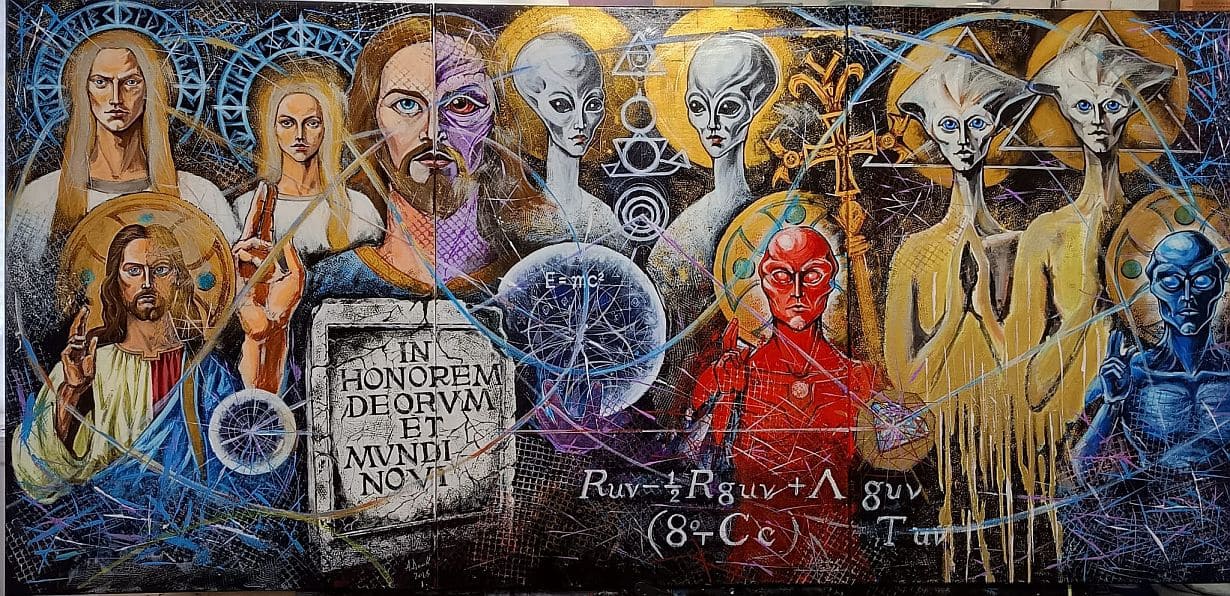
One of Albert Deak’s most conceptually ambitious works, Salvator Mundi: The Cosmic Episode, exemplifies his ability to merge historical symbolism with contemporary thought. The piece reimagines the iconic figure of Salvator Mundi not as a fixed religious image, but as a conduit of cosmic evolution and multidimensional consciousness.
In this work, sacred symbolism intersects with theoretical physics and extraterrestrial geometry. Latin inscriptions, gravitational equations, and metaphysical forms coexist within the composition, creating a visual field dense with meaning and suggestion. The familiar spiritual icon is transformed into a universal archetype that transcends time, culture, and physical limitation.
The artwork explores the concept of metempsychosis, or the transmigration of the soul, proposing continuity of consciousness across space time. Rather than presenting salvation as a singular event, Deak reframes it as an ongoing cosmic process, an evolution of awareness unfolding across dimensions.
Salvator Mundi: The Cosmic Episode invites viewers to contemplate humanity’s spiritual trajectory within an expansive, multidimensional universe. It challenges conventional boundaries between faith and science, suggesting that both are expressions of the same fundamental search for meaning.
The Viewer’s Experience
Engaging with Albert Deak’s work is an immersive experience. His layered compositions demand time and attention, revealing new relationships and symbols with prolonged viewing. There is no singular narrative or fixed interpretation. Instead, viewers are encouraged to bring their own questions, beliefs, and emotions into dialogue with the artwork.
This openness is central to Deak’s philosophy. He does not seek to impose answers, but rather to create spaces for reflection and inquiry. His art functions as a threshold between the known and the unknown, and between the material and the metaphysical.
Continuing a Journey of Exploration
Based in the United Kingdom, Albert Deak continues to develop a growing body of work that bridges abstraction, philosophy, and cosmic imagination. His practice remains dynamic and exploratory, driven by curiosity and a commitment to visual experimentation.
As contemporary art increasingly engages with questions of existence, technology, and consciousness, Deak’s work stands as a thoughtful contribution to this discourse. Through colour, light, and abstract form, he invites us to consider realities beyond the visible, reminding us that art, at its most powerful, is not only something we see, but something we contemplate.
