


Deena Capparelli is an artist and art educator based in Pasadena, California, whose work is deeply rooted in the landscapes of her upbringing. Raised in Rancho Cucamonga during a time when the area was still largely agricultural, Capparelli developed an early and enduring fascination with both wild and cultivated environments. The physical experience of living close to farmland, open space, and shifting ecosystems left a profound imprint on her visual language and conceptual concerns. These formative surroundings instilled an awareness of land not merely as scenery, but as a living archive shaped by natural processes, human intervention, and time.
This early connection to place continues to inform Capparelli’s work today. Her art reflects a sustained engagement with how landscapes evolve, how they remember, and how they adapt or fail to adapt under environmental and cultural pressures. Rather than presenting nature as static or idealized, Capparelli approaches it as a dynamic, contested space layered with history, science, and imagination.
An Interdisciplinary Artistic Practice
Capparelli’s practice is notably interdisciplinary, drawing from art, environmental science, geography, and botany. This breadth of inquiry allows her work to operate at the intersection of observation and speculation. Her paintings, installations, and collaborative projects often function as visual investigations, combining empirical research with poetic interpretation. By engaging multiple fields of knowledge, Capparelli expands the traditional scope of landscape art, transforming it into a site for ecological reflection and narrative possibility.
Since the mid-1980s, her work has been exhibited nationally, including long-term collective projects in the Mojave Desert and the Inland Empire. These extended, place-based collaborations underscore her commitment to sustained observation and community-oriented practice. Working within these environments over time has enabled Capparelli to witness subtle ecological changes and to respond to them thoughtfully through her art. The desert, in particular, has served as both a subject and a conceptual framework, an environment where fragility, resilience, and adaptation coexist in stark and compelling ways.
From Observation to Speculative Landscape
In recent years, Capparelli has turned her focus toward landscape paintings that merge ecological histories with imaginative, speculative fiction. These works move beyond documentation, offering instead visual propositions about how landscapes might be perceived, remembered, or transformed. Her paintings often feel suspended between what is known and what is imagined, inviting viewers to consider alternative narratives embedded within familiar terrain.
This speculative dimension does not abandon reality. Rather, it amplifies it. By weaving scientific understanding with symbolic and fictional elements, Capparelli creates landscapes that are emotionally resonant and intellectually layered. Her paintings suggest that adaptation, whether environmental or cultural, is not linear or guaranteed. Instead, it is fragmented, uneven, and deeply influenced by human presence.
The Language of Atmosphere and Space
A defining characteristic of Capparelli’s work is her focus on atmosphere. Rather than privileging fixed perspectives or singular focal points, she allows space to fracture and reassemble across the canvas. Shifting stylistic treatments create visual rhythms in which forms dissolve, reappear, and overlap. This approach mirrors the complexity of natural systems, where boundaries are porous and constantly in flux.
Her use of glazing techniques intensifies color and light, producing layered passages that evoke movement and depth. These translucent layers encourage slow looking, as viewers trace subtle transitions between forms and hues. The result is a sense of spatial ambiguity that feels both immersive and contemplative, drawing the viewer into an environment that is simultaneously familiar and uncertain.
Slow to Adapt (2025): A Poetic Reflection on Change
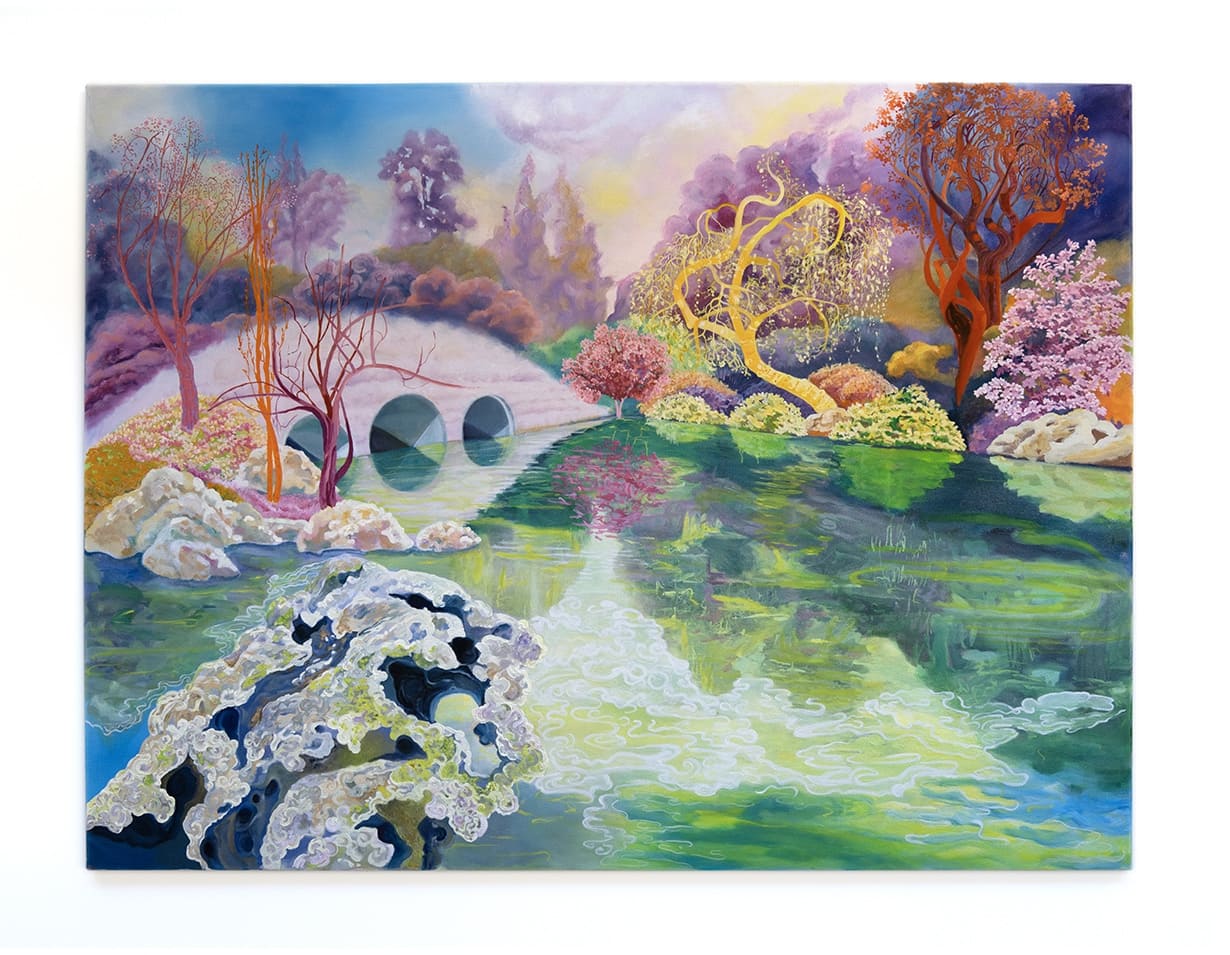
In Slow to Adapt (oil on canvas, 2025), Capparelli brings these concerns into sharp focus. The painting centers on atmosphere, drawing from the symbolic and historical language of clouds within landscape traditions. Historically, clouds have served as carriers of emotion, omens of change, and metaphors for the sublime. Capparelli reclaims this legacy while reimagining it through a contemporary ecological lens.
The clouds in Slow to Adapt appear mostly as gentle, welcoming forms, resisting the drama often associated with turbulent skies. Yet beneath this softness lies a complex spatial structure. Bridges, rocks, foliage, shrubs, and water reflections fracture and merge, dissolving and reappearing across the surface. These shifting elements destabilize any single reading of the scene, suggesting a landscape in transition.
Through careful glazing, Capparelli heightens the painting’s luminosity, allowing light to pulse through layers of color. The surface feels alive, animated by subtle movements and tonal shifts. This visual dynamism reinforces the emotional resonance of the work, evoking both beauty and unease. The title, Slow to Adapt, underscores this tension, pointing to delayed or insufficient responses, human and ecological, to ongoing environmental change.
Landscape as Inquiry and Invitation
Capparelli’s landscapes do not offer conclusions. They pose questions. What histories are embedded in the land we inhabit? How do ecosystems register human intervention over time? What does adaptation look like when viewed not as progress, but as a fragile negotiation? By blending observation with speculation, her work invites viewers to engage with these questions on both intellectual and emotional levels.
As an artist and educator, Capparelli’s influence extends beyond the studio. Her commitment to interdisciplinary thinking and long-term engagement with place models a way of making art that is responsive, responsible, and deeply attuned to the world it inhabits. In an era marked by environmental uncertainty, her work offers not only visual richness but also a space for reflection, one where landscape becomes a lens through which to reconsider our relationship with the natural world.
