


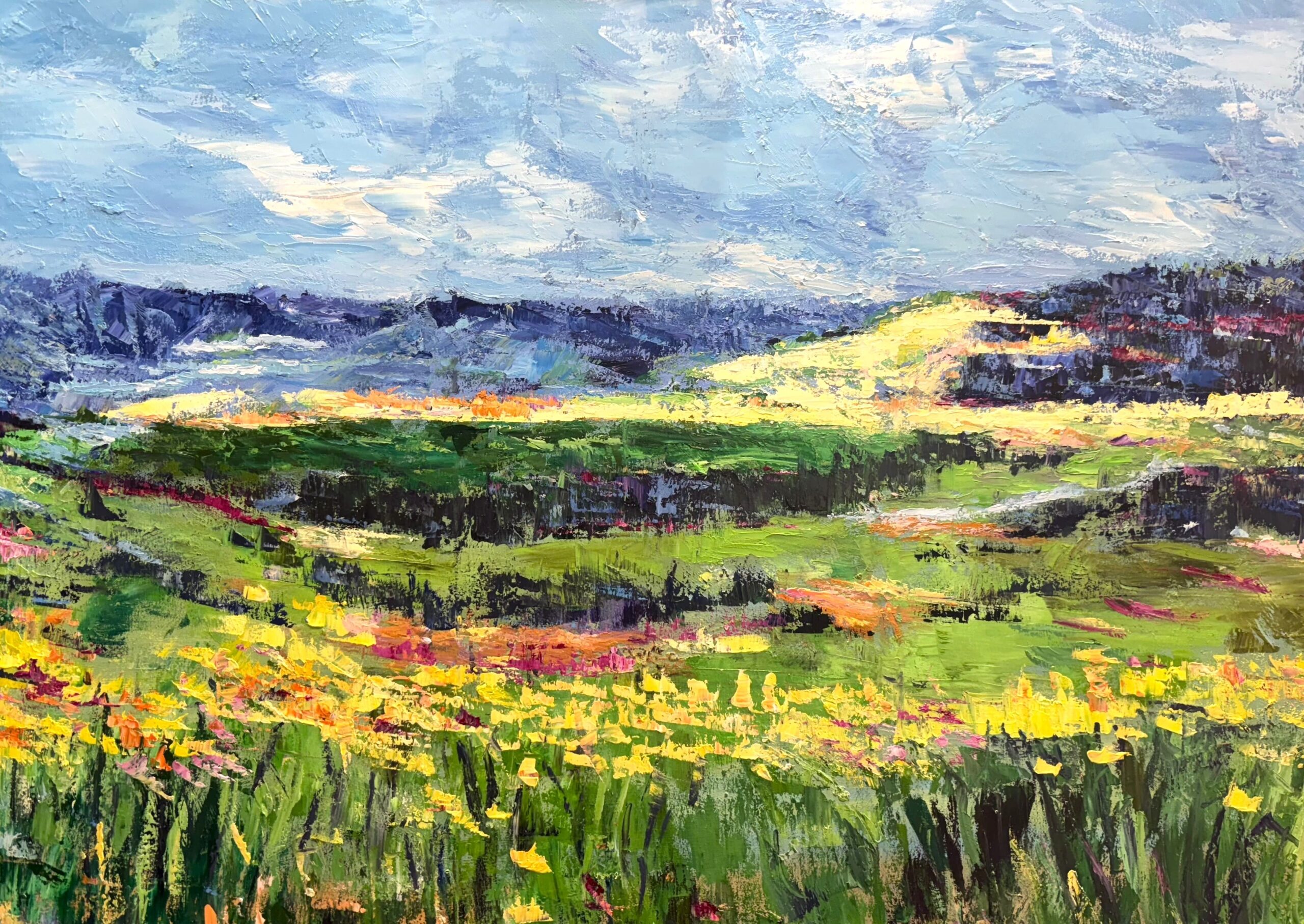
Kris Laping is a Boston-based painter whose work delves into the complex interplay of emotion, memory, and place. Raised and rooted in the vibrant cultural landscape of New England, Laping has developed a visual language that transcends mere representation, creating paintings that invite reflection and sensory engagement. Working primarily in oil, her practice balances intuition with structure, giving her compositions both spontaneity and thoughtful design. Through her layered mark-making and careful attention to color, Laping constructs spaces that feel alive, evocative, and immersive.
Over the years, Laping has exhibited extensively across New England. Her work has been featured in prestigious venues such as the School of the Museum of Fine Arts Annual Art Show and Sale, Boston City Hall Art Galleries, Galatea Fine Arts, and TAG – The Art Gallery/New England Art Center. Beyond the region, her art has reached international audiences through online exhibitions, and it is included in private collections throughout the United States. As an active member of Boston’s contemporary art community and the National Association of Women Artists, Laping continues to contribute to the cultural discourse while mentoring emerging artists and collaborating on interdisciplinary projects.
Artistic Philosophy
For Kris Laping, painting is a primary language, a medium through which she communicates what words cannot. She sees each canvas as a space where personal history and emotional experience converge, translating fleeting moments into enduring visual narratives. Her work explores the intersection of memory, emotion, and place, creating compositions that feel both intimate and expansive.
Laping draws inspiration from a wide spectrum of influences. French Impressionism informs her sensitivity to light and color, while American Abstract Expressionism contributes to her bold mark-making and energetic textures. This unique combination has been described by critics as Jackson Pollock meets Claude Monet, an unexpected yet fitting metaphor for Laping’s ability to balance structure and spontaneity. Her paintings are not about literal depiction; they are about essence, the lingering impressions of a moment, its emotional resonance, and the subtle ways in which it evolves over time.
Working intuitively, Laping allows her materials to guide her. Each stroke, texture, and hue emerges organically, creating layered compositions that invite viewers to inhabit the emotional landscape of the work. Movement and light are central to her practice, and she approaches painting as a sensory experience rather than a purely visual one. Her art is an offering, a meditation, a celebration, and an invitation to connect.
The Process: From Intuition to Form
Laping’s creative process is both deliberate and improvisational. She begins with an emotional impulse or memory and allows it to inform her choice of color, texture, and form. Layers of paint accumulate over time, responding to the canvas, the surrounding environment, and her internal state. The process is as important as the finished work, with each mark contributing to the depth and energy of the composition.
Her intuitive approach does not preclude structure. While she embraces spontaneity, Laping also considers balance, rhythm, and visual harmony. This careful negotiation between freedom and control is what gives her paintings their distinct resonance, dynamic yet cohesive, complex yet approachable. The result is art that feels alive, inviting viewers to experience both the immediacy of emotion and the contemplative qualities of memory.
Notable Work: The Hills Lift Up the Sky 2025
One of Laping’s most evocative works, The Hills Lift Up the Sky, exemplifies her ability to fuse place, memory, and spirit. Painted in 2025, the work draws inspiration from the Galilee region of Israel, which Laping visited in 2023. The painting is not a literal depiction of the landscape; rather, it seeks to capture the emotional essence of the region, its rolling hills, dense greens, bursts of wild color, and the ethereal quality of its light.
The Galilee in Laping’s painting is both external and internal. It represents a physical place, rich with history and natural beauty, and an internal landscape shaped by memory, reflection, and imagination. The work embodies contradictions, serenity and intensity, fertility and stone, intimacy and vastness. Through layered textures and vibrant hues, Laping creates a sense of light that moves across the canvas, lingering and shifting in a way that mirrors the experience of being present in the landscape itself.
The Hills Lift Up the Sky is also a meditation on belonging and inheritance. It reflects on how landscapes influence identity and continue to resonate long after one has left them. In capturing these subtleties, Laping demonstrates her ability to transform personal experience into universal emotion, creating work that invites deep engagement and contemplation.
Engagement and Community
Beyond her studio practice, Kris Laping is deeply embedded in Boston’s contemporary art community. She regularly participates in exhibitions, collaborative projects, and educational initiatives, fostering dialogue between artists and audiences. Her involvement with the National Association of Women Artists further underscores her commitment to supporting the visibility and advancement of women in the arts.
Through her work, Laping encourages viewers to pause, reflect, and connect. Her paintings act as both personal and shared spaces, places where emotion, memory, and imagination converge. Whether experienced in a gallery or a private collection, her art leaves a lasting impression, inviting an ongoing dialogue between the viewer and the canvas.
Conclusion
Kris Laping’s work exemplifies the power of painting to convey emotion, memory, and presence. With a unique blend of intuition, structure, and vibrant expression, she transforms ordinary materials into extraordinary visual experiences. From her Boston studio to international exhibitions, Laping continues to explore the depths of human experience, crafting paintings that resonate long after the viewer has left the gallery. Her art is not just seen, it is felt, remembered, and shared, making her one of New England’s most compelling contemporary painters.
