


Thomas Torak stands among a distinguished group of contemporary painters who have dedicated their lives to preserving and advancing the classical tradition in art. At a time when much of the art world often gravitates toward conceptual or purely contemporary expressions, Torak’s work is a testament to the enduring power of representational painting. His art bridges past and present, combining time-honored techniques with a fresh, perceptive eye, resulting in paintings that feel both historically grounded and vibrantly alive.
Known for their breadth and luminosity, Torak’s paintings captivate viewers through rich color harmonies and confident, lively brushwork. His works do not merely imitate classical methods; they reinvigorate them. Each canvas reflects a deep understanding of light, atmosphere, and form, qualities that have defined master painters for centuries. Yet within this discipline, Torak’s personality and vision are unmistakably his own.
A Career Rooted in Craft and Teaching
A significant milestone in Torak’s career came in 2008 when he was invited to join the staff of the Art Students League of New York as an instructor of portraiture and figure painting. The Art Students League is one of the most respected art institutions in the United States, known for fostering generations of accomplished artists. An invitation to teach there is not simply a job offer; it is a recognition of mastery.
As an instructor, Torak contributes to the continuation of classical painting traditions by mentoring emerging artists. Teaching portraiture and figure painting requires more than technical proficiency. It demands clarity of vision, patience, and the ability to articulate complex visual concepts. Through his role, Torak helps shape the next generation of painters, passing on knowledge that might otherwise be lost in an increasingly digital world.
His dual identity as both practitioner and teacher strengthens his work. The act of teaching often refines an artist’s own understanding, and in Torak’s case, it reinforces his commitment to disciplined observation and craftsmanship.
Recognition and Honors
Thomas Torak’s dedication to excellence has been widely recognized by major art organizations. He has received some of the most respected awards in representational art, including:
- The American Artists Professional League Medal of Honor
- The Audubon Artists Gold Medal of Honor
- The Allied Artists of America Silver Medal of Honor
- The Academic Artists Gold Medal
These honors are not easily won. They are awarded by peer organizations that value technical skill, artistic integrity, and contribution to the field. Collectively, they signal Torak’s standing among the leading realist and classical painters of his generation.
Beyond awards, his paintings have been exhibited in prominent museums such as the Butler Institute of American Art, the Gilcrease Museum, the Springfield Museum of Fine Art, the Huntsville Museum of Art, the Bergstrom-Mahler Museum, the San Diego Art Institute, and the National Academy Museum. Exhibition in such institutions places an artist within the broader narrative of American art history and affirms the cultural value of their work.
The Language of Light and Color
One of the defining qualities of Torak’s painting is luminosity. His surfaces seem to breathe with light, achieved through careful layering, sensitive value relationships, and a nuanced understanding of color temperature. Rather than relying on photographic realism, Torak interprets what he sees, translating reality into a poetic visual language.
His brushwork is lively but controlled. Strokes are visible enough to convey energy, yet unified enough to maintain the illusion of form. This balance between precision and vitality gives his paintings a sense of immediacy, as if the subject has just come into being on the canvas.
Color plays a central role as well. Torak’s palette is rich without becoming heavy, vibrant without turning artificial. He uses color to model form, set mood, and guide the viewer’s eye. In doing so, he aligns himself with a lineage of painters who see color not as decoration but as structure.
Dialogue with Modernism: Still Life with Matisse’s Red Studio
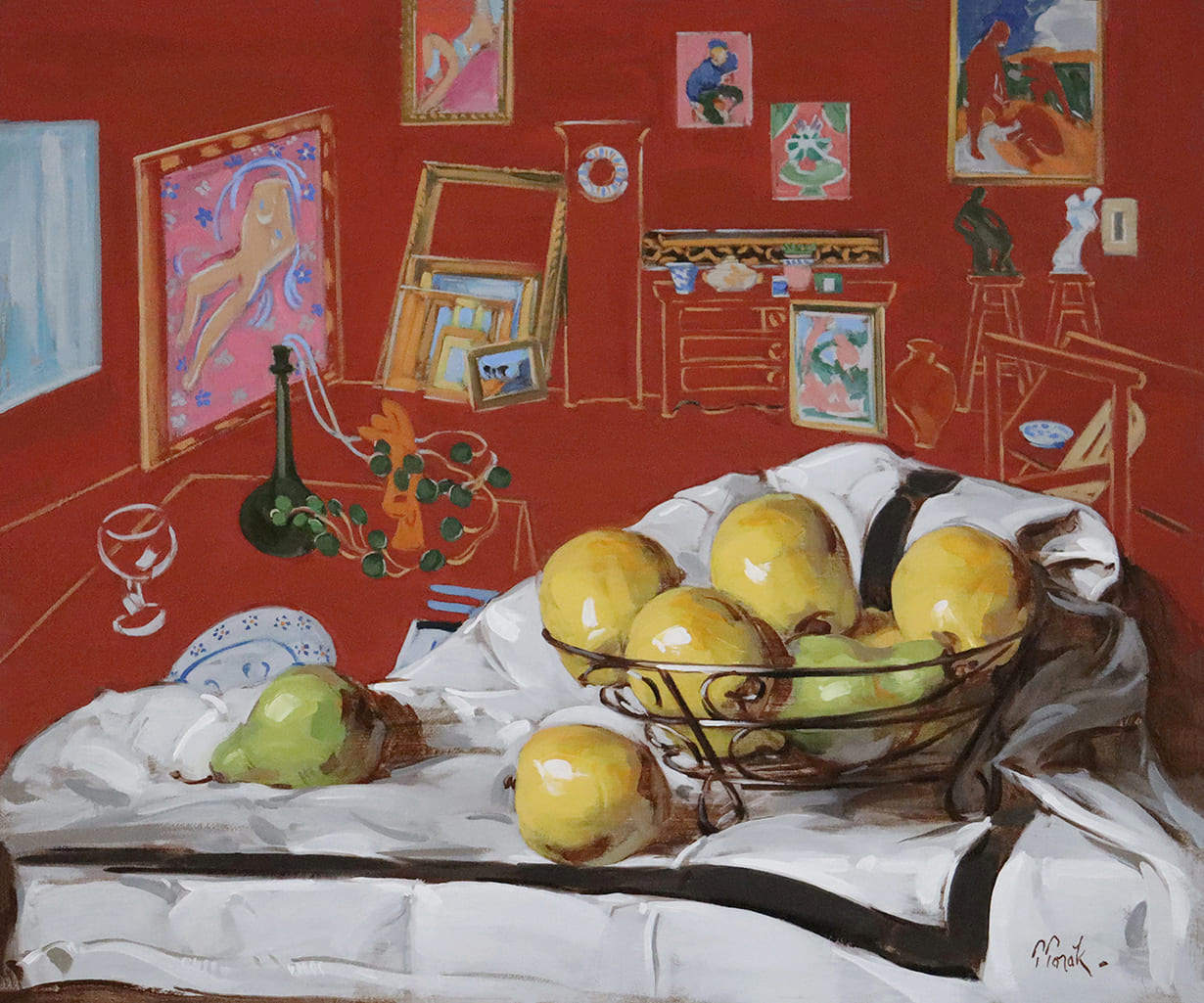
An especially compelling example of Torak’s artistic depth is his painting Still Life with Matisse’s Red Studio, an oil on linen work that engages in a visual dialogue with one of modern art’s most iconic images. Henri Matisse’s The Red Studio is celebrated for its radical flattening of space and bold, immersive color. For a classically trained painter like Torak, responding to such a work presents both conceptual and technical challenges.
Torak approached this challenge by integrating his classical, atmospheric style with Matisse’s flattened forms and vivid color sensibility. Rather than attempting to outdo or overwrite Matisse’s vision, he used the flat image as a backdrop for his own still life. This decision allowed him to maintain his spatial concepts while respecting the integrity of Matisse’s modernist language.
The result is more than a stylistic experiment. It is also a philosophical conversation. Torak himself notes that what he finds most compelling is the dialogue about the nature of reality created by the competing artistic philosophies within the painting. On one hand, there is the classical pursuit of depth, volume, and atmosphere. On the other, the modernist embrace of flatness and design. By placing these approaches in the same visual field, Torak invites viewers to reflect on how art constructs reality rather than simply recording it.
Reality, Interpretation, and Artistic Philosophy
At the heart of Torak’s work lies a question that has occupied artists for centuries: What is reality in painting? Is it the faithful recreation of the three-dimensional world, or is it the artist’s interpretation of visual experience?
Torak’s career suggests that he sees realism not as rigid imitation but as a flexible, evolving language. His engagement with Matisse shows openness to dialogue with modernism, even while remaining rooted in classical values. This openness prevents his work from feeling nostalgic or backward-looking. Instead, it feels engaged and intellectually alive.
His paintings remind viewers that classical techniques are not limitations; they are tools. When used by a thoughtful artist, they can explore contemporary questions just as effectively as any modern medium.
A Lasting Contribution
Thomas Torak’s contribution to art extends beyond his individual paintings. Through teaching, exhibiting, and consistently producing high-level work, he helps sustain a tradition that values observation, skill, and visual poetry. In an era of rapid change, such continuity is invaluable.
Yet Torak is not simply preserving the past. He is participating in an ongoing conversation about what painting can be. By engaging with different philosophies and maintaining a high standard of craftsmanship, he ensures that classical painting remains relevant and dynamic.
For collectors, students, and viewers alike, Torak’s work offers both beauty and thoughtfulness. It demonstrates that mastery of tradition can coexist with curiosity and dialogue. In this balance lies the mark of a true modern master, an artist who honors history while continuing to explore new dimensions of seeing and understanding the world.
