


Kerrie Smith is an English artist living and working on the Central Coast of California whose practice bridges geography, history, and lived experience. With formal training from Central Saint Martin’s School of Art in London, where she earned a B.A. with Honors in 3-Dimensional and Theater Design, Smith developed a strong foundation in spatial thinking, materiality, and narrative environments. Her early professional career as a theater set designer in Europe sharpened her ability to build immersive worlds and to think of space as a carrier of story and emotion.
Yet Smith’s trajectory did not remain confined to the stage. Over time, she returned to a studio-based, multidisciplinary practice, carrying with her the theatrical sensitivity to atmosphere, scale, and symbolism. Today, her work spans installation, photography, and mixed media, often combining research-driven concepts with poetic visual language. Her art does not simply depict landscapes or histories; it investigates how they are inhabited, remembered, and transformed.
Roots in Somerset, Expansion in California
Smith’s visual sensibility is deeply rooted in her rural upbringing in Somerset, England. The agricultural rhythms, textures of farmland, and close relationship between people and land in Somerset formed an early template for how she understands place. These formative experiences continue to echo through her work, particularly in her attentiveness to farming cultures and ecological systems.
Relocating to California introduced a new set of visual and conceptual influences. The expansive light, dramatic environmental contrasts, and layered histories of the American West opened fresh lines of inquiry. Now based on the Central Coast, Smith finds constant inspiration in the region’s wilderness, shorelines, and agricultural zones. The Californian landscape is not just a backdrop in her work; it is an active participant and a source of narrative.
She describes her practice as a way to create and record stories where the land informs us of its past history and what remains unspoken. This orientation positions her as both artist and listener, someone attuned to subtle traces of memory embedded in environments.
Environmental Shifts as Creative Catalyst
A recurring theme in Smith’s work is environmental change. Her observations of shifting climates, evolving ecosystems, and human interventions in nature shape both her subject matter and her conceptual frameworks. Rather than treating climate and environment as abstract issues, she approaches them through specific sites, plants, and communities.
Her walks through the Central Coast wilderness and along its shorelines serve as a form of field research. During these excursions, she documents patterns, plant forms, and atmospheric conditions. These observations later surface in her studio as works that hover between documentation and imagination. The result is art that feels grounded in reality yet open to speculation.
Smith’s sensitivity to environmental transformation aligns with a broader contemporary discourse on ecology and sustainability. However, her approach remains distinctly personal and narrative-driven, focusing on stories and relationships rather than statistics or didactic messages.
Mother Palm: A Living Archive
One of Smith’s most compelling recent projects is her installation and self-led residency at the Coachella Organic Date Farm, titled Mesopotamia to Coachella California, Mother Palm Phoenix Dactylifera. This project centers on the Medjool date palm, one of the oldest cultivated fruit trees in human history.
For Smith, the date palm operates as a form of living archive. When reflecting on the project, she associates it with archaeology, particularly cultural archaeology. The trees become vessels of memory, linking contemporary agricultural practices in California’s Coachella Valley to ancient Mesopotamian civilizations from six thousand years ago. In this sense, the project is transhistorical, connecting distant eras through a single species of plant.
Mother Palm is both an offering and a practice. Smith describes it as a steady tending to a 6000-year-old story that carries histories of nourishment, labor, and resilience. By focusing on the date palm, she reveals how agriculture is never purely technical or economic; it is also cultural and historical.
A particularly significant aspect of the project is her decision to print images of women who work on date farms onto date sacks. This gesture foregrounds the human presence that often remains invisible in agricultural industries. The photographs highlight that date farming is not only an industry but also a site of gendered labor and lived experience. In doing so, Smith draws attention to the social dimensions of food production and to the workers whose contributions are frequently overlooked.
Connecting Past and Present
Smith’s interest in transhistorical connections allows her to weave together ancient and contemporary narratives. By linking Mesopotamian date cultivation with present-day labor in Coachella, she shows how global histories continue to shape local realities. Her work invites viewers to consider how migration, trade, and cultivation carry cultural knowledge across centuries.
This approach also challenges linear notions of time. In Smith’s work, past and present coexist. The ancient is not distant; it is embedded in today’s agricultural systems, foods, and landscapes. Such perspectives encourage a deeper awareness of continuity and responsibility, especially in relation to land use and environmental stewardship.
Flora Ficciones and the Poetics of Plants
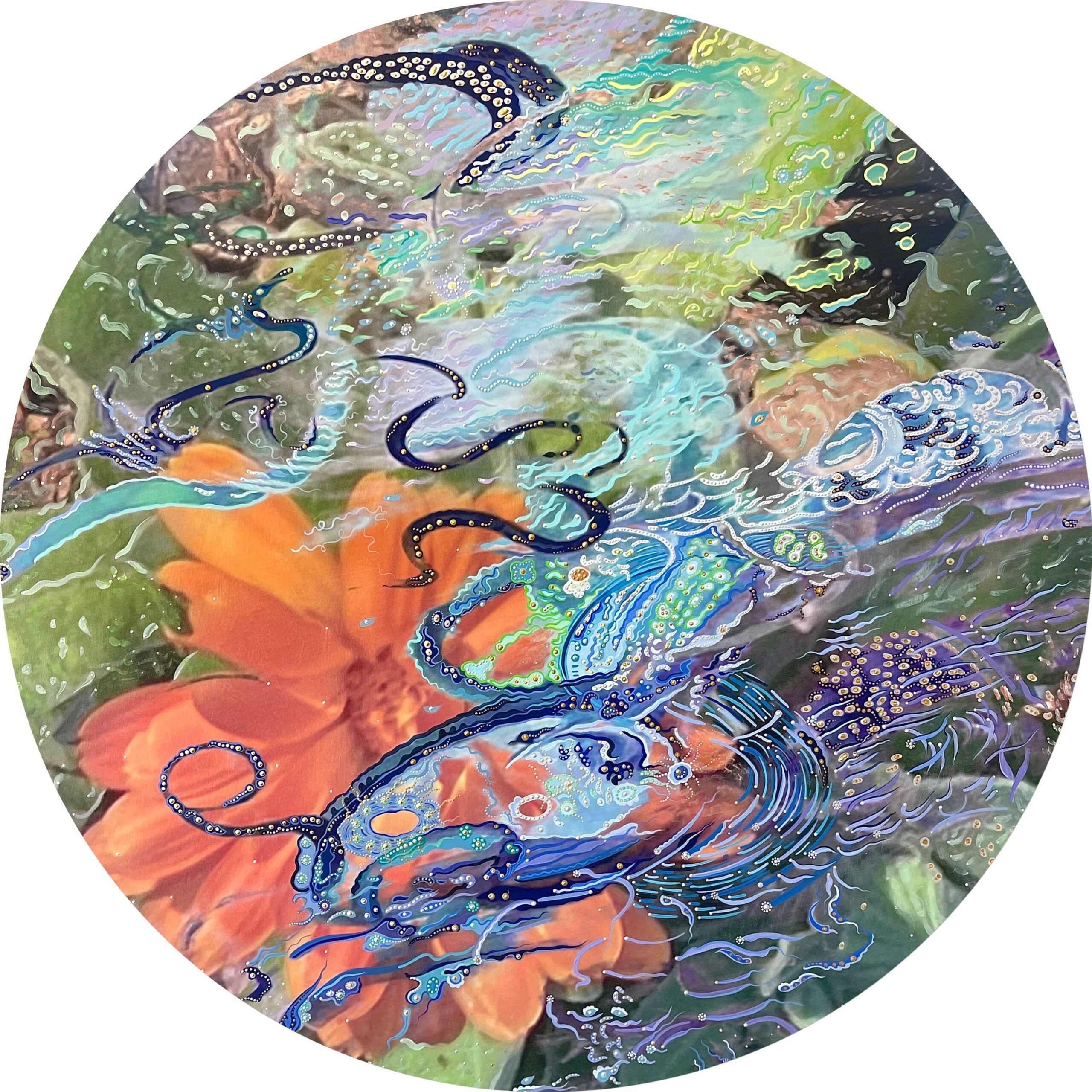
Another facet of Smith’s practice appears in her Flora Ficciones series, including the work Calendula Oceana. This series interprets plant patterns that appear vividly real yet slightly fantastic. Inspired by the Californian landscape and changing climate, these works blur the boundary between observation and invention.
In Calendula Oceana, plant forms become sites of imagination. The work draws from patterns Smith recorded during her walks, yet transforms them into something more speculative. The plants seem familiar but not entirely natural, suggesting adaptation, mutation, or future ecologies shaped by climate change.
Through such works, Smith explores how the perception of nature is mediated by memory, emotion, and cultural narratives. Plants are not only biological entities in her art; they are symbols, storytellers, and witnesses to change.
A Practice of Attention and Care
At the heart of Kerrie Smith’s work is a practice of attention. She pays close regard to landscapes, plants, and people whose stories might otherwise remain unnoticed. Her art is not loud or declarative; it is careful, layered, and research-informed.
There is also a strong ethic of care running through her projects. Whether tending to the story of the date palm or documenting subtle plant patterns, she approaches her subjects with respect and curiosity. This attitude resonates in an era when rapid consumption of images often replaces sustained looking.
Conclusion: Stories Carried by Land
Kerrie Smith’s multidisciplinary practice stands at the intersection of art, ecology, and cultural history. Drawing from her English rural roots and her life in California, she creates work that connects places and times, revealing hidden continuities. Her projects remind us that landscapes are not empty spaces but carriers of memory, labor, and survival.
By treating plants as archives, farms as cultural sites, and light as a shaping force, Smith expands how we think about environment and history. Her work ultimately asks viewers to slow down and consider what the land might be telling us if we choose to listen.
