


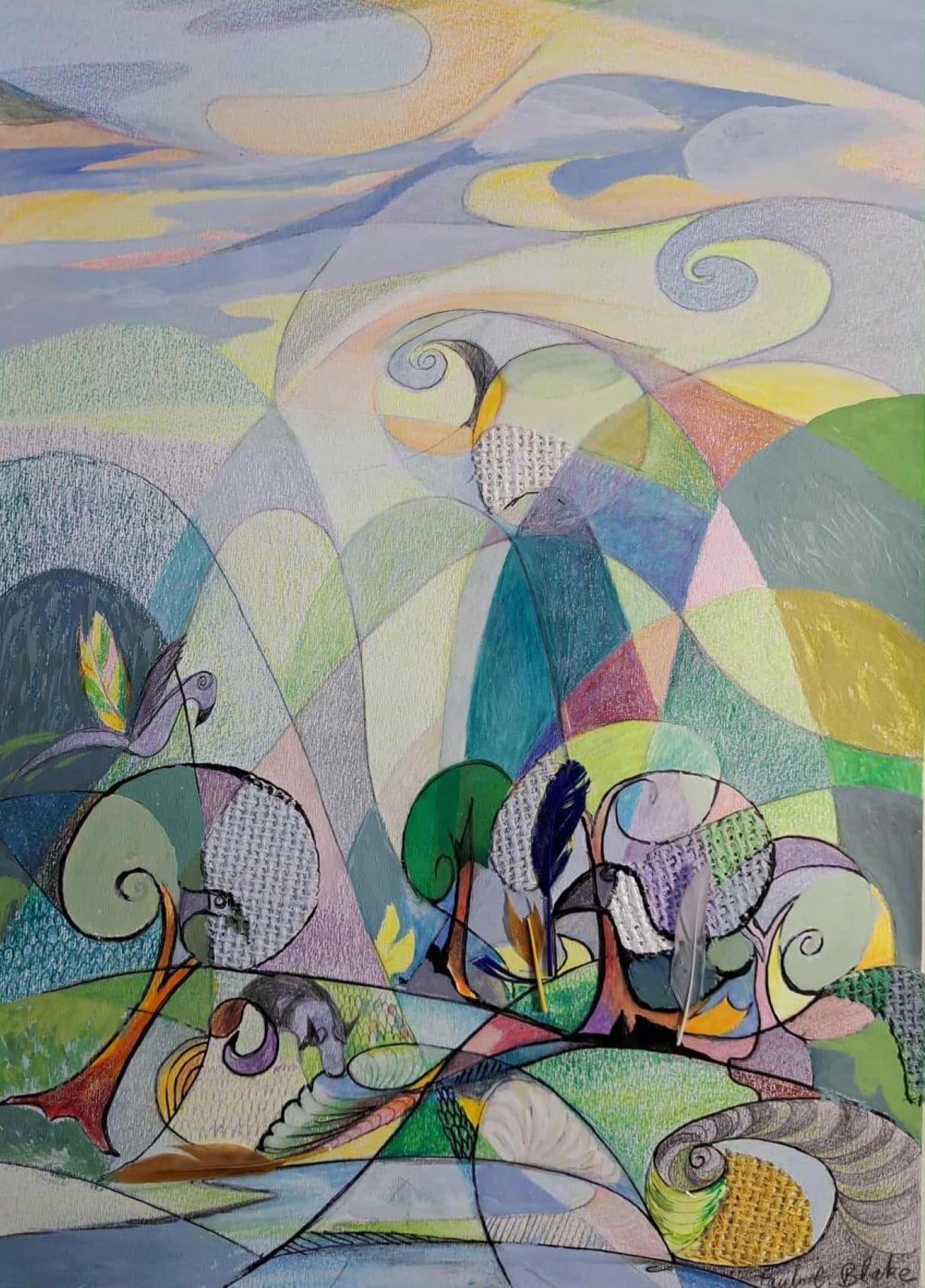
Paul C. Blake is a contemporary abstract and realist landscape painter, as well as a 3D artist, whose work bridges the visible and the invisible, the tangible and the transcendent. Born in the Parish of Manchester, Jamaica, Blake’s early experiences of Caribbean light, atmosphere, and terrain continue to echo through his artistic vision. In 1975, he emigrated to the United States, carrying with him not only memories of tropical landscapes but also a deep sensitivity to nature’s dynamic spirit.
His academic journey reflects his commitment to both art and education. Blake pursued studies in art education at City College in New York City, becoming an art teacher for several years. His dedication to intellectual and creative growth culminated in earning a Doctor of Arts degree from New York University in 1996. Now residing in the state of Georgia, he has recently retired from teaching, devoting himself fully to the continued evolution of his artistic career.
A Life Between Landscapes
Blake’s life journey from Jamaica to New York, and eventually to Georgia, mirrors the layered complexity found in his work. The lush vibrancy of the Caribbean, the architectural intensity of New York City, and the atmospheric expanses of the American South converge in his visual language.
His artwork has been presented in numerous solo and selected group exhibitions across the United States and internationally. Nationally, his work has been exhibited at esteemed institutions such as The Bronx Museum of the Arts, Viridian Artists Gallery in New York City, Bristol Art Museum in Rhode Island, and Edward Hopper House Museum & Study Center in Nyack, New York. His participation in exhibitions at The Atrium Gallery in Morristown, New Jersey; Arts Southeast in Savannah, Georgia; South Cobb Arts Alliance in Marietta, Georgia; Lyndon House Arts Center in Athens, Georgia; Dedo Maranville Fine Arts Gallery at Valdosta State University; Suwanee Arts Center; Webber Gallery in Florida; and the Academy Center for the Arts in Virginia demonstrates both the breadth and consistency of his engagement with diverse artistic communities.
Internationally, Blake’s work has reached audiences in Gothenburg, Sweden at S-Huset for Art@Climate 2030, Niğde, Turkey, Onil Gallery, and Burgerhaus Mahndorf in Bremen, Germany. These global exhibitions reinforce the universal relevance of his inquiry into nature, transformation, and identity.
The Paradox of Harmony
At the heart of Blake’s artistic philosophy lies a compelling paradox. Finding the true idea of harmony in nature is by its very essence discordant.
For Blake, harmony is not calm uniformity or static balance. Instead, it is born from tension, movement, and continuous transformation. Nature does not rest. It shifts, collides, erodes, regenerates, and reinvents itself. Within this perpetual flux lies its true equilibrium.
Blake’s paintings capture this restless harmony. His surfaces often reveal deep layering, with shapes emerging and dissolving, light filtering through translucent fields, and textures interacting in subtle friction. There is a sense of motion embedded within stillness, as if the landscape is caught in the act of becoming.
Nature #32: A Field of Becoming
One compelling example of Blake’s vision is Nature #32, a mixed media work on paper measuring 20 x 16 inches. Though modest in scale, the piece embodies the expansiveness of his conceptual approach.
The composition unfolds through transparent layers of color and form. Rather than presenting a literal depiction of nature, Blake constructs an intuitive landscape, an environment that feels both geological and emotional. Shapes interlock and overlap, creating visual rhythms that suggest growth, erosion, and atmospheric movement. Light seems to penetrate the surface, illuminating certain passages while allowing others to recede into shadow.
The layering process is central to Blake’s method. By building up translucent veils of pigment and texture, he mirrors the way natural systems accumulate over time, sediment forming rock, leaves decomposing into soil, clouds drifting and dispersing. Each mark carries the memory of previous marks, just as every landscape carries traces of its past.
In this sense, Nature #32 is not simply an image but an event. The painting feels alive, as though its forms are still evolving before the viewer’s eyes.
Intuition and Identity
Blake describes his process as intuitive, guided by an internal vision of nature’s inherent flow. This intuition is not random but informed by decades of observation, teaching, study, and lived experience. His approach balances intellectual awareness with instinctive gesture.
As someone who has migrated across cultures and geographies, Blake embraces his layered identities. These layers, Caribbean roots, American life, academic scholarship, and spiritual introspection, resonate within his art. The landscape becomes both external terrain and internal metaphor.
He speaks of a mystical connection between land and his inconspicuous self. Rather than placing himself at the center of the work, Blake situates himself within a larger ecological and cosmic framework. His presence is subtle, interwoven with the environment rather than dominating it.
The Flow of Transformation
In Blake’s vision, all forms are instantaneously evolving. Nothing is fixed. Every particle contains the suggestion of a larger whole, and every whole is subject to change. This philosophy aligns closely with natural processes, weather patterns shifting, ecosystems adapting, and landscapes reshaped by time.
His art becomes a meditation on impermanence. The tension within his compositions, the push and pull between abstraction and realism, solidity and transparency, reflects the fragile balance of the natural world. The viewer is invited to witness not a finished state but a moment within an ongoing transformation.
This perspective also carries contemporary relevance. In an era marked by environmental uncertainty and climate consciousness, Blake’s work quietly reminds us of both the vulnerability and resilience of nature. The discord he speaks of is not destructive chaos but generative friction, the very force that allows life to renew itself.
Beyond the Canvas
Although widely recognized for his painting, Blake’s practice extends into 3D art, further expanding his exploration of space, structure, and dimensionality. Whether working on paper, canvas, or in three dimensions, his focus remains consistent: to reveal the unseen energies that animate the natural world.
Now retired from formal teaching in Georgia, Blake continues to develop his artistic voice with renewed focus. Freed from institutional responsibilities, he channels his experience and scholarship into deeper experimentation and reflection. His career stands as a testament to lifelong learning, an artist who continues to grow, question, and evolve.
Ever Becoming
Paul C. Blake’s art is not about capturing nature as a static image but about participating in nature’s unfolding. Through layered surfaces, intuitive gestures, and philosophical depth, he creates works that breathe with tension and possibility.
Ever becoming may be the phrase that best defines both his art and his life. Just as the landscapes he paints are in constant transformation, so too is his creative journey. In embracing discord as the pathway to harmony, Blake offers viewers a profound reminder that beauty lies not in perfection but in the vibrant, shifting dance of existence itself.
