


Corinne Chaix was born in Paris, a city long associated with artistic innovation and cultural richness. Growing up in this vibrant environment, she developed an early appreciation for visual storytelling and creative exploration. Chaix pursued formal studies in both Fine Arts and Computer Graphics, an educational path that reflects her interest in combining traditional artistic techniques with contemporary visual thinking.
Today she lives and works in Venice, California, a coastal community known for its eclectic artistic culture and its strong connection to the Pacific Ocean. The move from historic Paris to the relaxed, oceanfront landscape of Southern California has deeply influenced her artistic perspective. The sea, its mysteries, and its symbolic possibilities frequently appear throughout her work.
Over the years, Chaix’s paintings have been exhibited internationally, bringing her imaginative visual narratives to audiences across different cultures. Each exhibition invites viewers to enter her symbolic worlds and engage with images that often feel both playful and contemplative.
Inspirations from Exploration and Imagination
Chaix draws inspiration from figures who expanded humanity’s sense of wonder about the natural world. One of her most significant influences is the visionary French author Jules Verne, whose novels introduced readers to extraordinary journeys through unknown realms. Verne’s adventurous spirit and imaginative storytelling resonate strongly within Chaix’s work, particularly in her fascination with underwater exploration.
Another major influence is the legendary ocean explorer Jacques Cousteau. Through his pioneering underwater expeditions and films, Cousteau revealed the beauty and fragility of marine ecosystems to the world. His work helped inspire generations to appreciate and protect the ocean.
British natural historian and broadcaster David Attenborough also plays an important role in shaping Chaix’s outlook. Attenborough’s documentaries emphasize the intricate relationships that exist within the natural world, highlighting both the wonders of biodiversity and the urgent need for environmental awareness.
Together, these influences inform Chaix’s artistic language. Her paintings blend adventure, ecological reflection, and imaginative storytelling, creating scenes that feel both fantastical and meaningful.
A Topsy-Turvy Marine Universe
Much of Chaix’s work unfolds in surreal underwater environments. Instead of depicting the ocean realistically, she constructs imaginative worlds where familiar elements appear slightly altered or unexpected.
These watery landscapes often contain drifting vessels, unusual creatures, and dreamlike settings that challenge the viewer’s sense of normal reality. The result is a topsy-turvy universe where the boundaries between human civilization and the natural world seem fluid.
Within these scenes, Chaix sometimes explores the strange and often contradictory relationship between humans and their environment. Certain paintings hint at humanity’s passive or destructive behavior toward nature, portraying individuals who seem detached from the consequences of their actions.
In other words, however, the tone shifts toward a more hopeful vision. Humans and natural elements coexist in poetic harmony, suggesting the possibility of collaboration and mutual adaptation. These contrasting perspectives reflect the complexity of modern environmental concerns while leaving room for imagination and optimism.
Symbolism and Open Interpretation
A defining characteristic of Chaix’s paintings is their deliberate ambiguity. Rather than presenting clear narratives, she constructs visual metaphors that invite interpretation.
Symbolic imagery frequently appears in her work. Boats, ocean currents, hybrid creatures, floating landscapes, and glowing horizons all function as metaphorical elements rather than literal depictions. Because these symbols remain open-ended, viewers are encouraged to bring their own experiences and emotions into the interpretation.
This openness makes her art highly personal for each viewer. One person may interpret a scene as a hopeful adventure, while another might see a quiet warning about environmental imbalance or human behavior.
By allowing these multiple readings to coexist, Chaix ensures that her work remains dynamic and evolving. Each encounter with a painting can reveal something new depending on the perspective of the viewer.
A Surreal Ocean World in Tokyo
Chaix’s upcoming exhibition in Tokyo will further immerse audiences in her imaginative marine universe. The exhibition will transport viewers into a surreal underwater realm where themes of coexistence, adaptation, and symbiosis take center stage.
Tokyo’s vibrant cultural landscape offers a fitting environment for Chaix’s imaginative work. The city is known for embracing both tradition and innovation, qualities that resonate strongly with her approach to art.
Visitors to the exhibition will encounter dreamlike scenes where nature and human presence intersect in surprising ways. Some works may evoke curiosity or wonder, while others quietly prompt reflection about the relationship between humanity and the natural world.
Rather than presenting a single narrative, the exhibition encourages viewers to interpret each image in their own way. Just as in real life, meaning emerges through personal perspective.
The Painting “Journey”
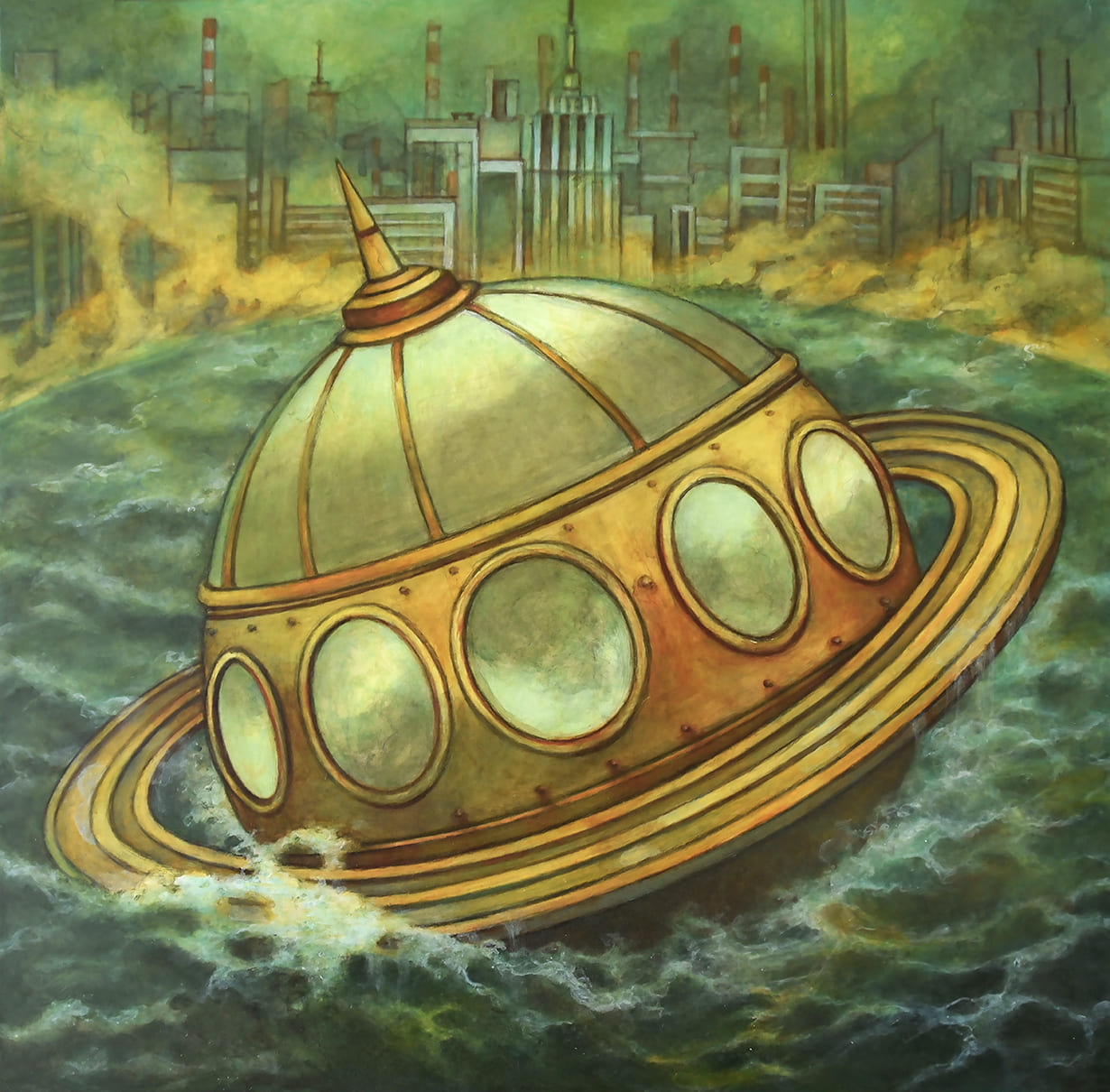
One of Chaix’s recent works, titled Journey (2026), beautifully illustrates the layered storytelling that defines her artistic practice. The piece is created with acrylic, pastels, and ink on a 12 by 12 inch wood panel.
Despite its relatively small scale, the painting carries a strong emotional presence. At the center of the composition is a delicate vessel navigating turbulent waters while a city burns behind it.
One interpretation views the scene as a powerful symbol of resilience. The fragile boat presses forward through stormy seas, leaving chaos behind and moving toward the possibility of renewal. In this reading the painting becomes a visual metaphor for courage and perseverance during times of crisis.
Another interpretation suggests a more complicated narrative. The golden ship might represent privilege, carrying only a select few individuals away from danger while others remain behind. This perspective introduces questions about inequality, survival, and who is able to escape difficult circumstances.
The vessel could also symbolize escapism. Instead of confronting the burning city, the passengers may be fleeing from reality altogether, seeking refuge elsewhere.
Chaix intentionally leaves the meaning unresolved. By doing so she transforms the painting into a reflective space where viewers project their own interpretations and emotional responses.
An Artistic Voyage Without Fixed Destinations
Corinne Chaix’s paintings function much like voyages through imaginative oceans. Each artwork offers a starting point, but the final destination is determined by the viewer’s own perspective.
Through surreal imagery and symbolic storytelling, she explores themes of environmental awareness, human behavior, and the possibility of harmony between people and nature. Her work encourages curiosity, reflection, and emotional engagement.
Much like the fragile vessel in Journey, Chaix’s art moves forward through uncertain waters, inviting viewers to travel alongside it and discover meanings that shift with each new encounter.
