


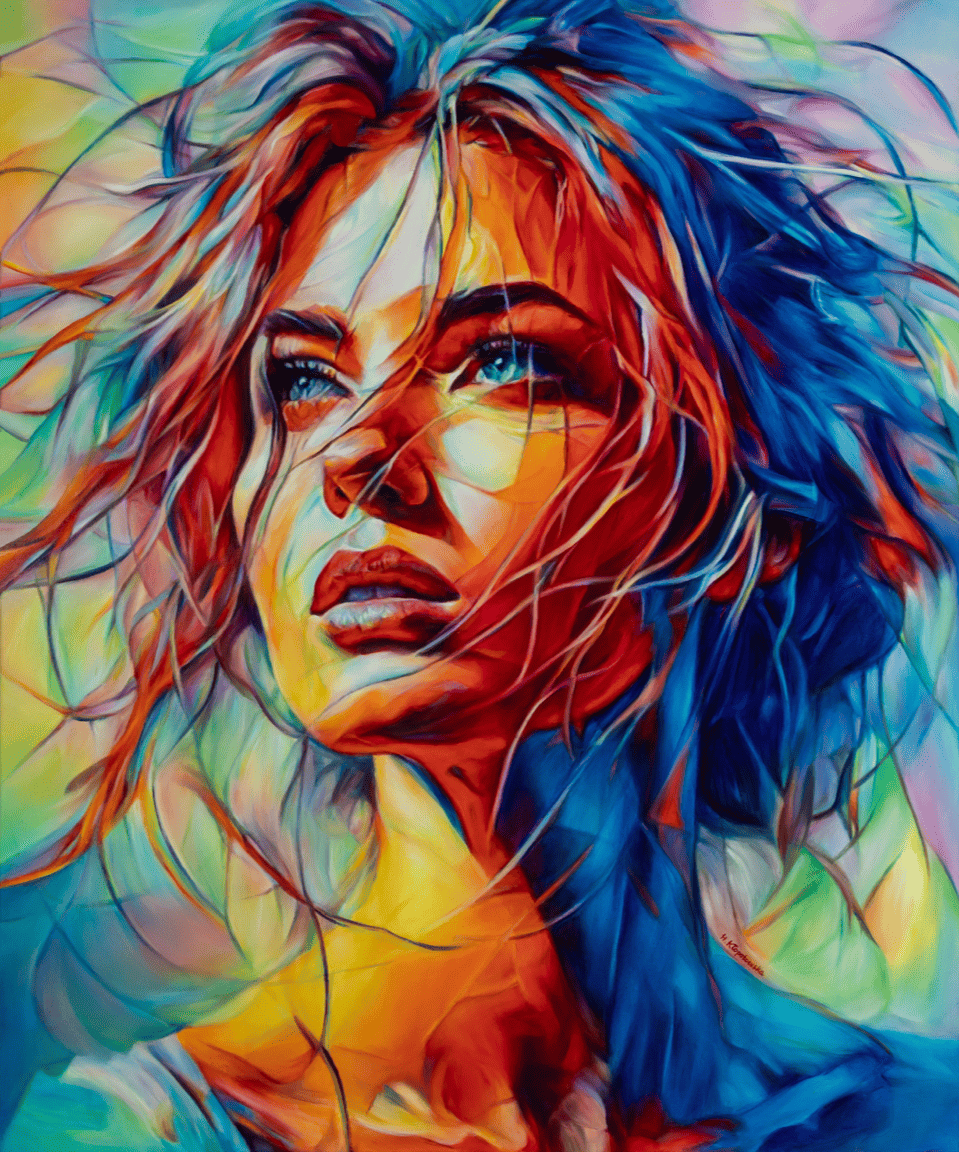
Hanna Kłopotowska is a contemporary painter whose work bridges classical portrait traditions with a bold, modern exploration of color. Educated at the Faculty of Graphics and Painting at the Academy of Fine Arts in Łódź, she has developed a distinctive visual language rooted in strong chromatic contrasts and expressive portraiture. Her paintings are instantly recognizable for their electrifying color palettes and a rare technique of colored chiaroscuro, where light and shadow are expressed through vibrant hues rather than traditional tonal values.
Kłopotowska’s art reflects a deep dialogue with European and Polish painting traditions while simultaneously pushing those traditions into a contemporary context. Through her portraits and figurative compositions, she creates emotional spaces where color, light, and personality interact in powerful and unexpected ways.
Academic Foundations and Artistic Development
The Academy of Fine Arts in Łódź has long been known as an important center for artistic education in Poland, and it played a significant role in shaping Hanna Kłopotowska’s creative identity. During her studies at the Faculty of Graphics and Painting, she developed a strong technical foundation that allowed her to experiment confidently with both classical and contemporary artistic methods.
Although trained within a structured academic environment, Kłopotowska’s artistic voice gradually evolved into something deeply personal. Rather than adhering strictly to academic realism, she embraced expressive approaches to painting, particularly through the use of color as a primary vehicle of emotion and meaning.
In addition to traditional painting techniques, the artist also works with pastels. This medium allows her to explore softness, texture, and immediacy while maintaining the vivid intensity that characterizes her visual style.
The Power of Color and Colored Chiaroscuro
One of the most distinctive elements of Hanna Kłopotowska’s work is her use of colored chiaroscuro. Traditionally, chiaroscuro refers to the contrast between light and dark used to create depth and volume in painting. Kłopotowska transforms this classical concept by replacing neutral shadows with saturated colors, creating luminous contrasts that energize the entire composition.
In her paintings, shadows may appear in deep blues, vibrant violets, or rich greens, while highlights may glow with warm yellows, oranges, or reds. The result is a dynamic visual rhythm where color itself becomes the architecture of the image.
This method produces a striking tension between warm and cool tones. The polarity between these colors forms the foundation of her compositions, generating both emotional intensity and visual harmony. Rather than simply depicting a subject, Kłopotowska uses color to reveal psychological and atmospheric dimensions of the portrait.
Her electrifying palette transforms traditional portraiture into something more expressive and contemporary, inviting viewers to engage with the work on both visual and emotional levels.
Portraiture and the European Tradition
Portraits form the central theme of Hanna Kłopotowska’s artistic practice. However, her portraits are not mere representations of individuals. Instead, they function as explorations of identity, presence, and emotional atmosphere.
Her work reflects a thoughtful engagement with the long tradition of European and Polish portrait painting. Classical portraiture often focused on realism, social status, and formal composition. Kłopotowska acknowledges this heritage but reinterprets it through her modern sensibility.
In her paintings, the human face becomes a stage for color interactions and psychological expression. The figures often appear contemplative, introspective, or suspended in a quiet emotional state. The surrounding space is simplified so that color and form can emphasize the personality and mood of the subject.
Through this approach, Kłopotowska creates portraits that feel timeless while remaining unmistakably contemporary.
Influences from the Masters of Light and Color
Hanna Kłopotowska openly acknowledges several historical artists who have influenced her thinking about color and light. Among the masters she admires are Rafael Santi, Paul Gauguin, and Zofia Stryjeńska.
From Rafael Santi, often celebrated for the harmony and balance of his compositions, Kłopotowska draws inspiration from the classical ideals of structure and beauty. While her style is far more modern in its color use, the compositional discipline seen in many of her works reflects an awareness of Renaissance painting principles.
Paul Gauguin’s influence is visible in Kłopotowska’s fearless approach to color. Gauguin revolutionized painting by using bold, non-naturalistic colors to express emotion and symbolism. Kłopotowska extends this legacy by pushing chromatic contrasts even further, allowing color to become the emotional core of her paintings.
Zofia Stryjeńska, an important Polish artist known for her vibrant depictions of folklore and culture, represents a significant connection to Poland’s artistic heritage. Stryjeńska’s dynamic color schemes and expressive forms resonate with Kłopotowska’s own exploration of national artistic traditions.
These influences do not overshadow Kłopotowska’s originality; rather, they provide a foundation from which she constructs her own contemporary visual language.
Exhibition Activity and Collector Interest
Throughout her career, Hanna Kłopotowska has participated in numerous group and individual exhibitions. These exhibitions have introduced her work to a broad audience and helped establish her reputation among collectors and art enthusiasts.
Her paintings have attracted the attention of a growing network of collectors who appreciate the intensity and individuality of her style. The relationship between artist and collector is particularly meaningful in her case, as many of her works are held in private collections where they continue to inspire dialogue and appreciation.
Kłopotowska’s active exhibition presence reflects both her commitment to sharing her work and the strong interest her paintings generate within contemporary art circles.
“Poza Horyzontem”: A Journey Beyond the Horizon
One of Hanna Kłopotowska’s notable works is the painting Poza Horyzontem (Beyond the Horizon), measuring 120 × 100 centimeters. The title itself suggests a sense of exploration, inviting viewers to consider what lies beyond the visible or familiar.
In this painting, Kłopotowska’s signature use of electrifying color and colored chiaroscuro creates a sense of depth that goes beyond physical space. The horizon becomes both a literal and symbolic boundary, a place where perception, imagination, and emotion converge.
The composition likely emphasizes the interplay between light and color, guiding the viewer’s gaze across the canvas and encouraging contemplation. As with many of her works, the subject is not simply what is depicted but also the atmosphere created through color relationships.
Poza Horyzontem embodies the artist’s broader philosophy: painting as a means of reaching beyond surface appearances to explore deeper emotional and visual realities.
Conclusion
Hanna Kłopotowska stands out as an artist who skillfully merges tradition with experimentation. Her work honors the legacy of European and Polish portrait painting while introducing a powerful contemporary approach centered on color and expressive light.
Through her distinctive use of colored chiaroscuro, bold chromatic contrasts, and psychologically rich portraits, she has developed a visual language that is both recognizable and deeply personal. Influenced by historical masters yet firmly rooted in the present, Kłopotowska continues to expand the possibilities of portraiture and color in modern painting.
Her artwork invites viewers to look beyond conventional representation and enter a world where color becomes emotion, light becomes movement, and portraiture becomes a journey beyond the horizon.
