


K.G. Ricci is a New York City–based, self-taught artist whose collage practice has unfolded steadily over the past seven years. Working outside the boundaries of formal academic training, Ricci has developed a distinctive visual language driven by intuition, experimentation, and an unfiltered engagement with imagery. His journey as an artist is marked not by adherence to a single format or style, but by continuous evolution, both in scale and conceptual depth.
Ricci’s early works were ambitious in size, often constructed as large 24 x 48 inch panels. These early collages allowed him to explore expansive visual narratives, layering fragments of imagery into compositions that felt cinematic and immersive. Over time, however, his practice began to shift inward. The scale of his work became more intimate, transitioning into 7 x 10 inch books that invited closer, slower engagement from the viewer. These books functioned almost like visual journals, private spaces where ideas could unfold sequentially rather than all at once.
Most recently, Ricci has arrived at a new body of work titled Incongruities, a series of 11 x 14 inch collages created on cardboard. This shift in material and format reflects not only a practical decision, but also a conceptual one. Cardboard, with its inherent imperfections and utilitarian associations, becomes an active participant in the artwork. It reinforces the tension Ricci often explores between the familiar and the unsettling, the ordinary and the enigmatic.
Collage as Visual Storytelling
At the core of Ricci’s practice is storytelling, not in a linear or literal sense, but through visual suggestion. His collages function as visual stories, fragments of narratives that resist complete explanation. Rather than guiding the viewer toward a fixed meaning, Ricci presents situations that feel suspended in time, open-ended, and psychologically charged.
This narrative quality has led to his work being featured in several literary magazines, where his images often appear alongside poetry and short fiction. The connection is fitting. Ricci’s collages operate much like written stories that begin in the middle of a sentence. They hint at what came before and what may follow, but never resolve fully. The viewer becomes an active participant, projecting their own interpretations onto the imagery.
His ability to create these ambiguous visual moments has also earned him recognition in gallery exhibitions across the United States, as well as numerous online exhibitions. Despite the diversity of platforms, his work maintains a consistent emotional tone that is quietly confrontational, introspective, and slightly disorienting.
The Language of Incongruity
The Incongruities series encapsulates many of the themes Ricci has been developing throughout his career. As the title suggests, these works are built around contrasts and contradictions. Familiar spaces are disrupted by unexpected objects. Recognizable forms are placed in illogical relationships. Geometry, architecture, and isolated figures coexist in ways that feel deliberate yet unresolved.
Rather than using collage to create harmony, Ricci often uses it to expose tension. His compositions rarely feel comfortable, yet they are never chaotic. There is a careful balance between structure and unease, creating a sense that everything is precisely where it needs to be, even if it defies rational explanation.
This tension mirrors the contemporary human experience, navigating environments that feel recognizable on the surface but increasingly alien beneath. Ricci’s collages do not offer commentary in a didactic way. Instead, they reflect emotional states such as uncertainty, anticipation, and confrontation that viewers intuitively recognize.
“Answer Your Questions”: A Moment of Confrontation
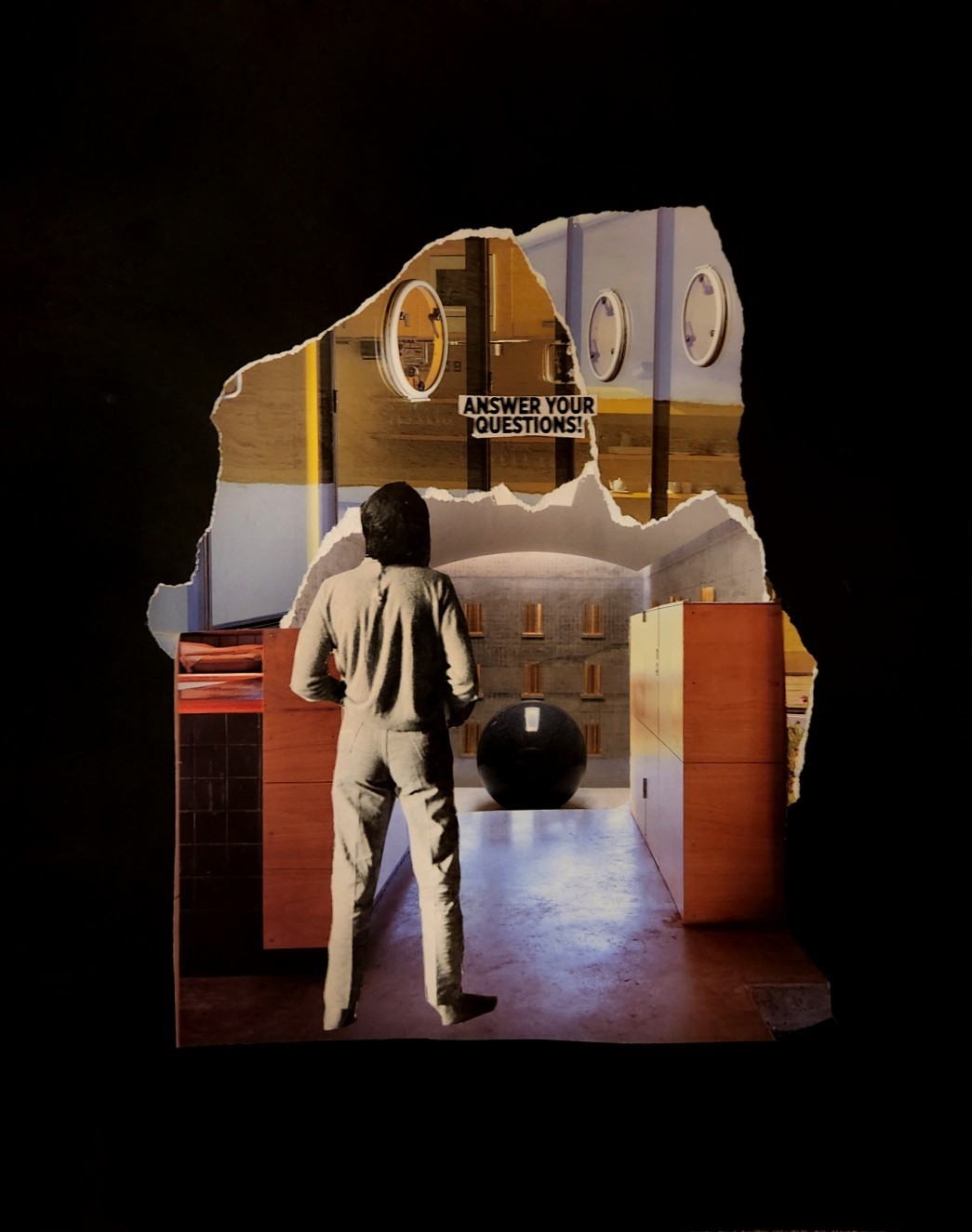
One of the most compelling works from this phase of Ricci’s practice is Answer Your Questions. The collage presents a solitary figure confronted by an enigma in the form of a black ball. The object is simple and almost minimal, yet it dominates the psychological space of the composition. Its smooth, opaque surface offers no clues and no reflections, only presence.
Surrounding this central encounter is a space defined by disturbing geometry. The environment feels strangely familiar, as though it echoes architectural forms we recognize, yet something is subtly wrong. Angles feel off. Perspective resists logic. The space neither fully encloses nor fully releases the figure within it.
The figure itself appears paused, caught in a moment of anticipation. There is no visible action, only the suggestion of one. He awaits his next move. This suspension is critical to the work’s impact. Rather than depicting resolution, Ricci captures the instant before decision, the moment when questions exist but answers have not yet formed.
The black ball becomes a potent symbol. It may represent uncertainty, knowledge, fear, or truth, yet Ricci refuses to define it. In doing so, he allows the object to function as a mirror for the viewer’s own internal questions. What are we confronting? What are we avoiding? And what does it mean to answer a question when the question itself is unclear?
Process Over Prescription
As a self-taught artist, Ricci’s process remains deeply personal and exploratory. He approaches collage not as a rigid methodology but as an ongoing conversation with materials and images. Found imagery, cut fragments, and compositional instincts guide the work more than premeditated plans. This openness allows unexpected relationships to emerge, relationships that often become the emotional core of the piece.
His evolution from large panels to books to cardboard collages reflects a willingness to let the work dictate its own direction. Rather than repeating what has proven successful, Ricci continuously recalibrates his approach and embraces uncertainty as part of the creative process.
An Open Invitation to the Viewer
K.G. Ricci’s work does not seek to instruct or explain. Instead, it invites viewers into a space of contemplation, one where discomfort and curiosity coexist. His collages ask us to sit with unanswered questions, to recognize the beauty in ambiguity, and to accept that meaning is often provisional.
In a world that increasingly demands clarity and certainty, Ricci’s visual stories offer something rare: permission to not know, to pause, and to confront the enigma without rushing toward resolution.
