


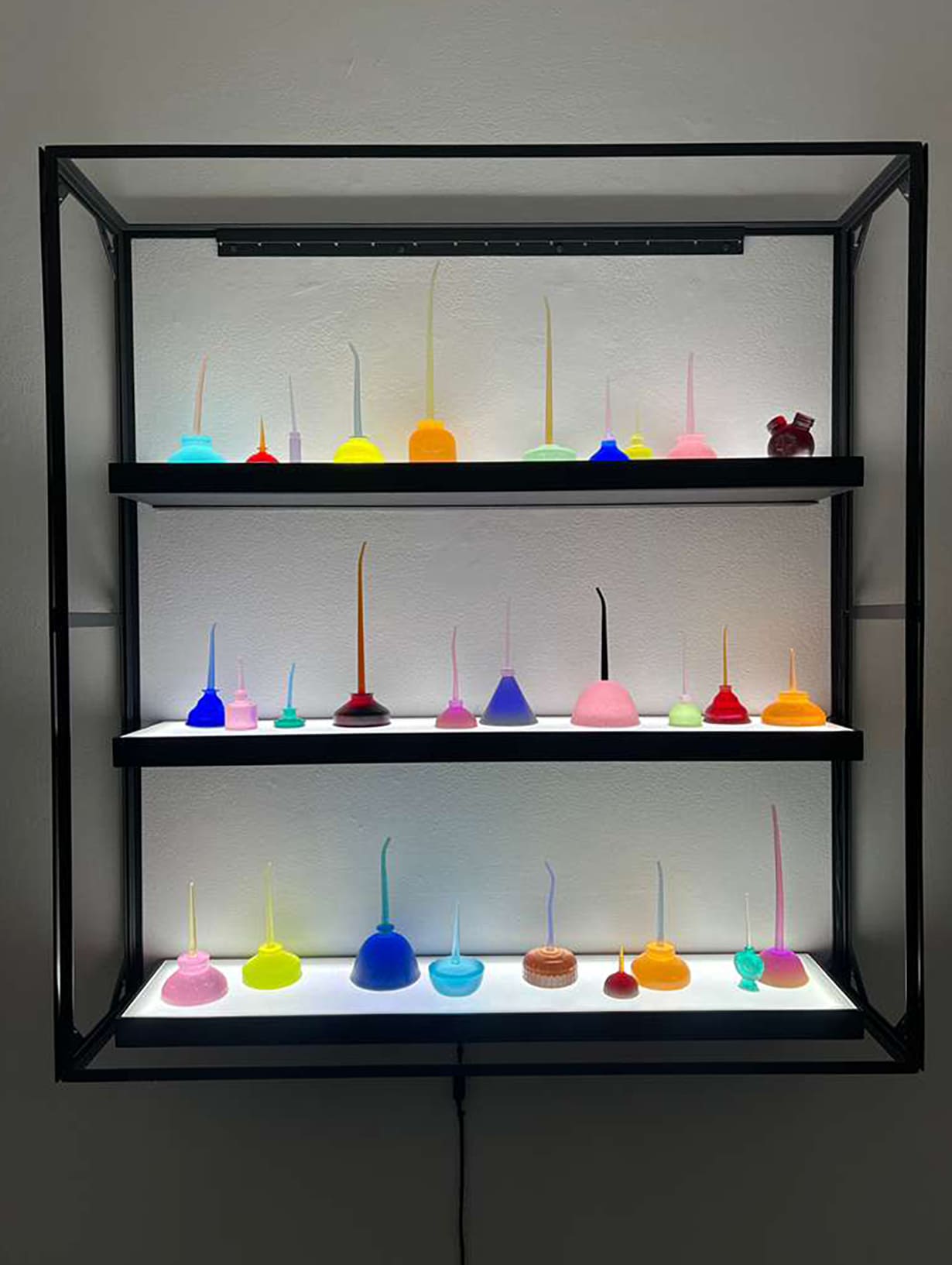
Katherine Jackson is a Brooklyn-based contemporary artist whose work bridges the worlds of glass, light, technology, and drawing. Over the years, she has developed a distinctive artistic language that merges traditional craftsmanship with conceptual inquiry. Her installations explore how light interacts with materials to reveal stories embedded in objects, architecture, and cultural memory. By transforming everyday artifacts into luminous sculptures, Jackson invites viewers to reconsider the relationship between the past and the present.
Working from Brooklyn, New York, Jackson has exhibited her work across a wide range of venues, including museums, galleries, universities, colleges, and public spaces. Her exhibitions have reached audiences not only throughout the United States but also internationally, including shows in Berlin, Rome, Venice, and Japan. This global presence reflects the universal themes within her work such as memory, transformation, and the passage of time, while her connection to New York City continues to influence much of her artistic practice.
A Career Rooted in Experimentation and Innovation
Throughout her career, Katherine Jackson has demonstrated an ongoing curiosity about materials and the ways technology can expand artistic expression. Glass and light, in particular, have become central to her practice. Glass possesses an inherent duality. It is both fragile and enduring, transparent yet capable of holding color and form. When paired with light, it becomes an expressive medium that changes depending on the viewer’s perspective and the surrounding environment.
Jackson’s installations often involve carefully arranged objects illuminated from within or beneath, creating subtle yet powerful visual effects. The glowing quality of her works not only enhances their physical beauty but also imbues them with symbolic resonance. Light becomes a metaphor for memory, discovery, and revelation, allowing familiar objects to appear newly significant.
Her commitment to experimentation has led to a diverse body of work that incorporates drawing, sculptural casting, and technologically integrated displays. Each piece reflects a thoughtful balance between craftsmanship and conceptual depth.
Celebrating New York’s Architectural Legacy
New York City has served as both inspiration and exhibition space for several of Jackson’s major projects. Two large-scale, long-term public exhibitions were created to commemorate the 100th anniversaries of two iconic structures: the 42nd Street New York Public Library and the Manhattan Bridge. These projects demonstrated her ability to connect art with history, architecture, and public engagement.
Through these installations, Jackson explored the cultural narratives embedded in the city’s infrastructure. By integrating light-based elements and sculptural forms into public spaces, she created works that resonated with the everyday experience of urban life while also honoring the historical significance of these landmarks.
Her work invites viewers to pause and reflect on the layers of time present in the built environment. In doing so, she transforms familiar city spaces into places of contemplation and renewed appreciation.
Art Addressing Social Histories
In addition to architectural themes, Jackson’s work often engages with social and cultural histories. One notable project involved a six-month light-and-glass exhibition in the windows of New York’s Tenement Museum. Supported by a grant, this installation addressed the theme of immigration, drawing attention to the countless personal stories that have shaped the city.
The Tenement Museum, dedicated to preserving immigrant history, provided an ideal setting for Jackson’s luminous glass installations. By placing glowing works within the museum’s windows, she created a dialogue between contemporary art and historical narratives. The installations served as visual reflections on migration, resilience, and the pursuit of opportunity.
Light in this context became a powerful symbol: a beacon of hope, memory, and human connection. Through this project, Jackson demonstrated how art can engage with complex historical subjects while remaining visually compelling and accessible.
International Exhibitions and Recognition
Katherine Jackson’s work has gained recognition through exhibitions at prominent international events and institutions. Her vitrine installations, glass-based displays often presented in illuminated cases, have appeared in several significant venues. Among them are the Venice Architectural Biennale in 2021 and the Venice Art Biennale in 2022, two of the most influential events in the global art world.
Her work has also been shown at Southern Connecticut State University, the Volta Art Fair in 2024, and the Brooklyn Museum’s 200th Anniversary Brooklyn Artists Exhibition. These exhibitions highlight both the diversity of her audience and the growing appreciation for her innovative approach to material and light.
Each exhibition context brings new dimensions to her installations. Whether displayed in a museum, an academic institution, or an international art fair, her works maintain their distinctive ability to capture attention through subtle illumination and evocative object forms.
The Vitrine Series: Objects Transformed by Light
One of the defining elements of Jackson’s practice is her series of vitrines, carefully composed installations that combine sculptural glass forms with illuminated displays. The vitrine format allows her to present objects in a manner reminiscent of museum collections or historical relics, encouraging viewers to reflect on their cultural significance.
Her most recent vitrine, created in 2026, continues this exploration. The installation contains solid glass casts of vintage oil cans, each one unique. The objects are placed on lightboxes so that they emit a soft internal glow. Through this illumination, the once utilitarian objects are transformed into sculptural presences.
Vintage oil cans evoke a particular era in industrial and technological history, an age defined by mechanical ingenuity and optimistic visions of progress. By casting these objects in glass, Jackson freezes them in time while simultaneously altering their meaning. What once served a practical function becomes a contemplative artifact.
Constellations of Memory and Metaphor
The arrangement of the glowing oil cans creates constellations of memory and metaphor. Each object stands alone yet contributes to a larger composition, much like stars forming patterns in the night sky. The vitrines encourage viewers to read the installation both visually and conceptually.
As relics of the Industrial Age, the oil cans carry associations with labor, invention, and technological advancement. Encased in luminous glass, they appear both familiar and otherworldly. Their glow suggests preservation and reverence, transforming ordinary objects into reliquaries that hold fragments of collective memory.
At the same time, the installation echoes the tradition of still life painting. Jackson refers to these compositions as being in oil, a subtle nod to both the material history of the objects and the painterly tradition of depicting everyday items. Through glass casting and light, she effectively converts the passage of time into a sculptural still life.
A Contemporary Voice in Light-Based Art
Katherine Jackson’s work stands out within contemporary art for its thoughtful integration of craft, technology, and historical reflection. Her installations demonstrate how materials such as glass and light can carry profound symbolic weight when placed within carefully constructed compositions.
By drawing attention to overlooked objects and histories, she invites viewers to reconsider the significance of everyday materials and the stories they contain. Whether commemorating architectural landmarks, exploring immigrant narratives, or reimagining industrial artifacts, Jackson’s art consistently reveals the poetic potential within the ordinary.
As her practice continues to evolve, Katherine Jackson remains a compelling voice in the field of light-based and installation art. Through her luminous works, she transforms fragments of the past into radiant reminders of memory, invention, and human experience.
