


Lou Grande is a trans masculine artist of Italian-American descent whose work stands at the intersection of identity, history, and social justice. Based in Kansas and deeply shaped by the cultural and physical landscapes of the American Midwest, Grande’s practice reflects a lifelong engagement with marginalized communities and an evolving understanding of selfhood. His art is not only a visual expression but also an act of documentation, preserving queer histories while imagining their futures through bold color, reference, and material experimentation.
Raised and educated in rural Kansas, Grande’s early life was rooted in environments often characterized by tradition, faith, and limited representations of gender diversity. He earned a Bachelor of Arts degree in English and theology from the University of Saint Mary, followed by a master’s degree in theological studies. This academic foundation instilled in him a sensitivity to narrative, symbolism, and moral inquiry, elements that continue to inform his visual language today. Before transitioning at the age of 30, Grande worked within the human rights office of the Catholic Church in Kansas City and later at a homeless shelter in Wichita. These roles exposed him to systemic inequalities and personal stories of displacement, reinforcing a commitment to advocacy that would later become central to his artistic voice.
From Theology to Art as Witness
Grande’s transition marked a pivotal shift, both personally and professionally. After transitioning, his work became increasingly focused on immigration and refugee resettlement, fields that mirror his broader concern for individuals navigating liminal spaces between belonging and exclusion. These experiences parallel the themes that surface in his art, particularly those of transition, survival, and visibility. Grande approaches art as a form of witness, a way to honor lived realities that are often overlooked or erased.
His theological background does not manifest through doctrine but through an ethical lens. Grande’s work asks fundamental questions about who is seen, who is protected, and who is allowed to exist freely. Rather than offering definitive answers, his paintings create space for reflection, inviting viewers to confront the complexities of gender, identity, and community.
Influences Rooted in Queer History and Pop Culture
Visually, Grande draws inspiration from 1970s pop art and the rich lineage of New York’s queer art history. This influence is evident in his use of bold compositions, iconic references, and a deliberate embrace of visibility as resistance. Pop art’s accessibility and immediacy allow Grande to communicate complex ideas without obscurity, while queer art history provides a framework for reclaiming narratives that have long existed at the margins.
Working primarily with acrylics and found materials, Grande builds textured surfaces that echo the layered nature of identity itself. The inclusion of found elements functions as both an aesthetic and a conceptual choice, referencing the pieced-together histories of queer communities whose stories are often fragmented or undocumented. Through these materials, Grande positions his work as both archival and forward-looking, a bridge between past struggles and future possibilities.
Gender Diversity and the Language of Non-Conformity
At the core of Grande’s practice is an exploration of gender diversity and non-conformity. His subjects often embody quiet strength rather than spectacle, challenging stereotypes that reduce queer and trans experiences to moments of crisis or performance. Instead, Grande portrays resilience as something lived daily, embedded in posture, gaze, and environment.
His figures are frequently situated in transitional spaces, roadsides, open landscapes, and urban edges, places that mirror the internal and external journeys of his subjects. These settings are not incidental; they function as metaphors for movement, uncertainty, and the ongoing search for freedom. Grande’s work insists that gender is not static but expansive, shaped by personal truth and collective history.
Freeway: An Homage to Movement and Becoming
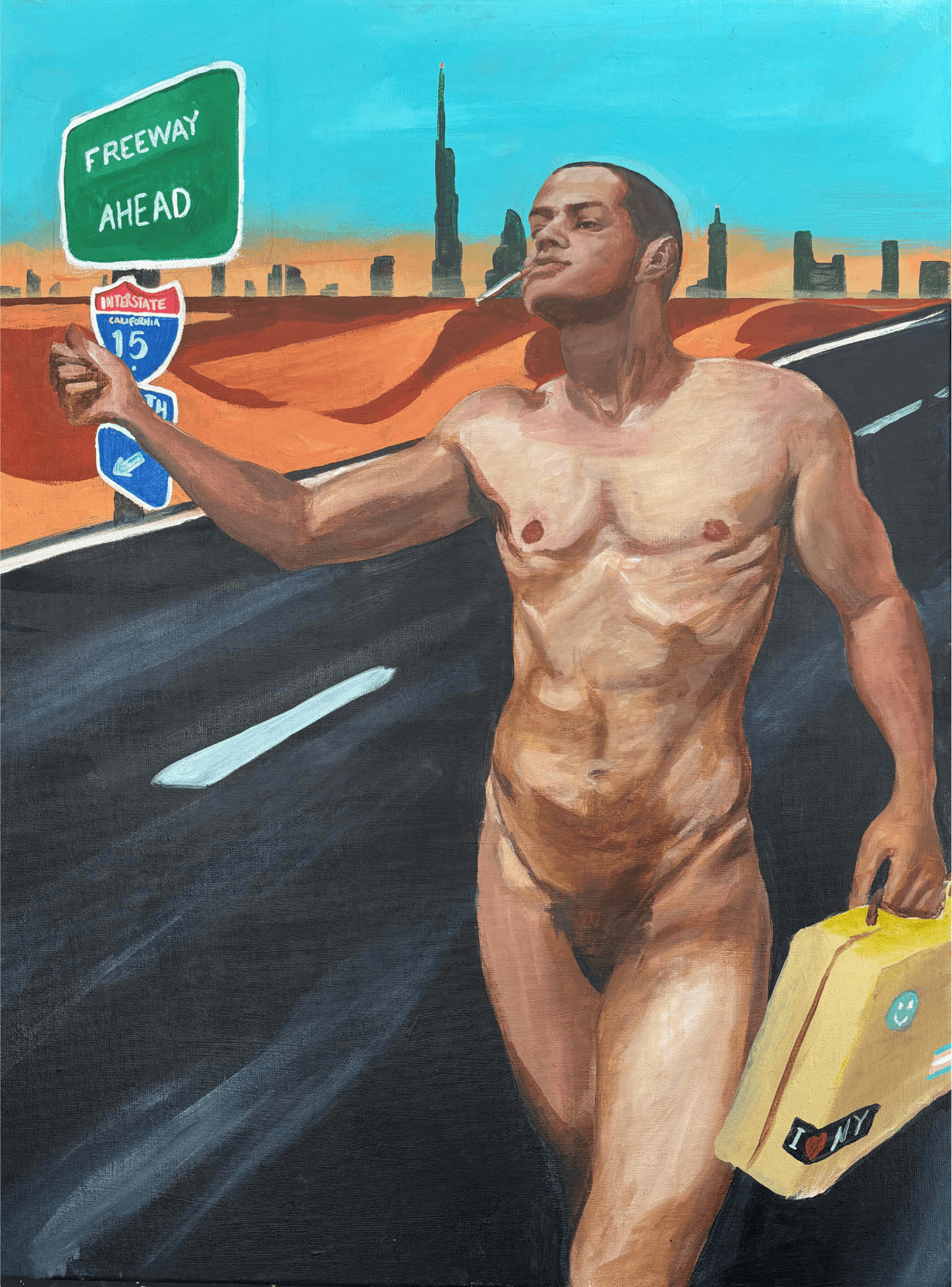
The painting Freeway exemplifies Grande’s ability to weave cultural references with a deeply personal narrative. The work depicts Tuck, a transmasculine model, standing beside a freeway sign and facing a dusty desert road. The composition echoes Madonna’s iconic 1992 hitchhiking pose, a deliberate homage that connects pop culture rebellion with contemporary trans visibility.
In Freeway, the distant city dissolves into a hazy backdrop, its contours softened as if suspended between presence and disappearance. This fading city suggests both a place left behind and one not yet reached, reinforcing the theme of transition that runs throughout the piece. The open road becomes a symbol of possibility, risk, and self-determination, while the desert landscape emphasizes isolation alongside freedom.
Tuck’s stance is neither passive nor overtly defiant. Instead, it conveys calm resolve, embodying a moment of pause within movement. By referencing Madonna, a figure long associated with reinvention and boundary-pushing, Grande situates transmasculine experience within a broader cultural lineage of self-authorship. The painting becomes a dialogue between past and present, celebrity and everyday life, myth and reality.
Art as Documentation and Future Vision
Grande’s work functions as both record and prophecy. By documenting queer bodies and stories with care and dignity, he contributes to a visual archive that affirms existence in the face of erasure. At the same time, his art looks forward, imagining futures in which gender diversity is not exceptional but integral to the human experience.
Through acrylics, found materials, and historically resonant imagery, Lou Grande creates work that is grounded, accessible, and emotionally resonant. His paintings do not demand attention through shock but earn it through sincerity and depth. Rooted in lived experience and informed by activism, his practice reflects a belief that art can be a tool for empathy, remembrance, and change.
In a world where visibility remains contested, Lou Grande’s art stands as a quiet but powerful assertion that queer lives, histories, and futures deserve to be seen, honored, and carried forward.
