


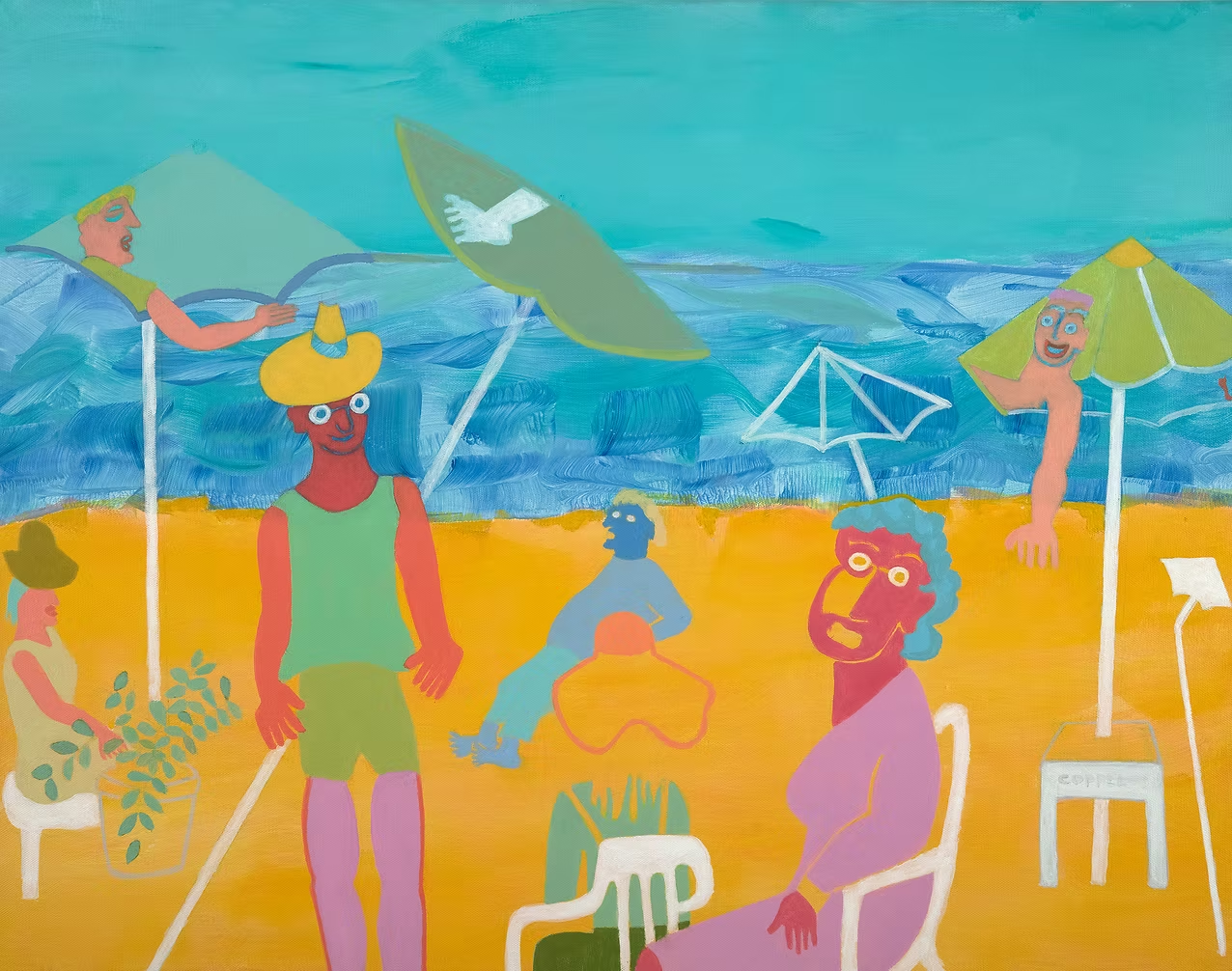
Marcia Coppel grew up in Washington, DC, a city rich with history, culture, and artistic legacy. As a child, she wandered through its museums, absorbing the colors, forms, and stories held within their walls. Those early visits quietly shaped her visual vocabulary. Surrounded by masterworks and diverse artistic traditions, she developed an intuitive understanding of how art can communicate emotion without uttering a single word.
The museums of Washington were more than institutions to her; they were classrooms of observation and imagination. Even before she considered herself an artist, she was learning how line, composition, and color could speak across time and place. These formative experiences planted the seeds for a creative journey that would later merge close observation with playful abstraction.
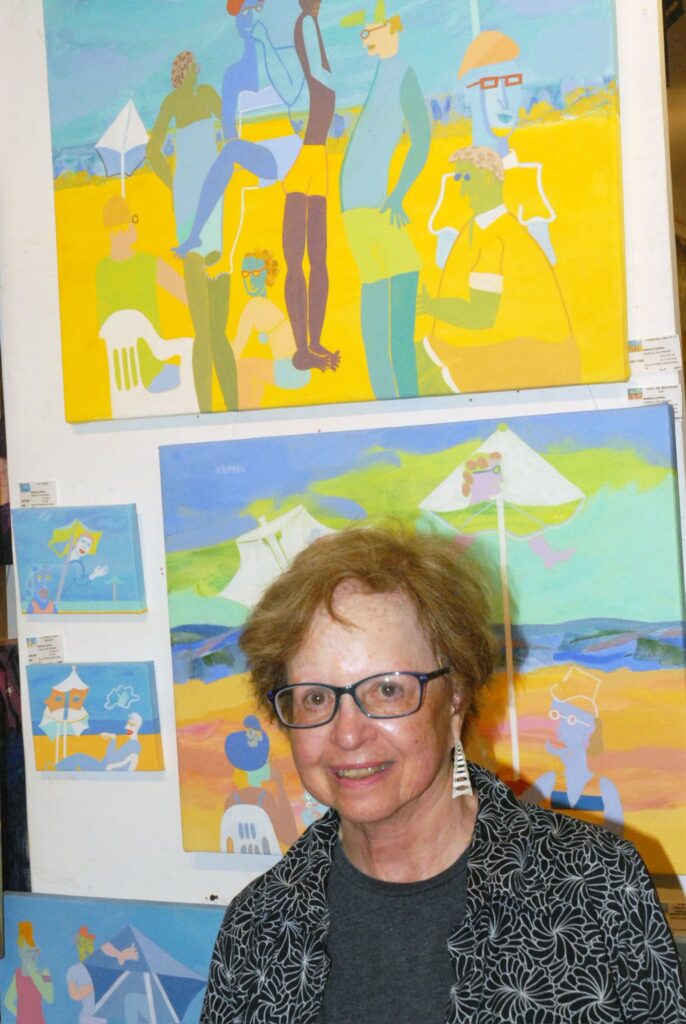
The Speech Pathologist as Observer
Before fully immersing herself in the art world, Coppel worked professionally as a speech pathologist. This career deeply influenced her artistic sensibility. In her daily practice, she became an acute observer of verbal and nonverbal communication. Facial expressions, gestures, posture, and silence all carried meaning. She learned to recognize subtle emotional cues, those fleeting moments when a glance or tilt of the head says more than language ever could.
This sensitivity to human expression became central to her artistic work. While helping others find their voices, she began to explore her own through painting and sculpture. Abstract forms emerged alongside her growing understanding of communication. Her studio became a space where gesture and color replaced speech, and where emotional nuance took visual form.
During the summers, she traveled widely and documented her experiences through ink line drawings. These drawings were not merely souvenirs; they were studies in movement and structure. Quick, confident lines captured landscapes, figures, and fleeting impressions. Travel sharpened her eye and reinforced the importance of line as a primary expressive tool.
San Miguel de Allende: Where Abstraction Met Travel
A transformative chapter in Coppel’s life unfolded in San Miguel de Allende, where she lived for nearly five years. Immersed in the vibrant culture of central Mexico, she found a landscape alive with saturated color, textured architecture, and expressive faces. The rhythms of daily life, markets, festivals, and conversations in shaded plazas became part of her creative fabric.
It was here that she began integrating abstraction with her travel drawings in a more profound way. The structured line work she had cultivated through years of sketching began to interact with expansive planes of color and open space. Abstraction was no longer separate from observation; it became a way of distilling experience.
Mexico’s rich palette, turquoise skies, terracotta walls, brilliant textiles, and lush greenery infused her paintings with warmth and vibrancy. Yet rather than reproducing scenes literally, she transformed them. Figures floated. Landscapes simplified. Space opened. She embraced negative space as an active participant in the composition, allowing emptiness to breathe and to frame emotion.
Line, Color, and the Power of Negative Space
Line, color, and negative space are the pillars of Coppel’s artistic language. Her lines are assured yet playful, defining figures without imprisoning them. They suggest movement and personality while leaving room for interpretation. The viewer is invited to complete the story.
Color, however, often takes center stage. Bold blues and luminous greens dominate many of her figures. Blue or green people float through her canvases, perched beneath beach umbrellas, suspended in sky, or partially submerged in imagined seascapes. These unconventional hues liberate her subjects from literalism. By shifting skin tones into unexpected territory, she invites us to see humanity symbolically rather than realistically.
Negative space in her paintings is not emptiness but possibility. Open areas allow the composition to breathe and amplify the emotional dialogue between figures. A vast expanse of sky may frame two individuals gazing into each other’s eyes. A simple horizon line can anchor a floating body, grounding whimsy with subtle structure.
Whimsy in the Face of Life’s Difficulties
Though life can be complex and difficult, Coppel’s paintings consistently offer a sense of lightness. Her work contains whimsy, a gentle humor that acknowledges vulnerability without denying joy. Some figures gaze intently at one another, their expressions filled with tenderness. Others appear bashful, isolated, startled, or surprised. Each emotional state is rendered with simplicity and compassion.
A cloud might carry a head with feet protruding, blending human presence with the natural world in a playful gesture. Such surreal touches evoke smiles without trivializing experience. Instead, they suggest that imagination is a necessary companion to reality.
This balance between difficulty and delight reflects the artist’s own outlook. Her paintings do not ignore the complexities of human interaction; rather, they soften them. The floating figures, the saturated colors, and the gentle absurdities remind viewers that levity and connection can coexist with struggle.
Love for Mexico and Its People
Coppel’s work radiates affection for Mexico, its people, landscapes, and cultural vibrancy. She now divides her time between Washington, DC, San Miguel de Allende, and Puerto Vallarta, carrying with her a deep emotional connection to each place. The beaches and umbrellas that populate her canvases echo the coastal spirit of Puerto Vallarta, while the chromatic intensity reflects the visual richness she experienced in central Mexico.
Her figures, though stylized, embody universal emotions. Their body language, leaning toward one another, averting their gaze, standing alone under an umbrella, speaks of intimacy, longing, curiosity, and play. The viewer may recognize themselves in these simplified silhouettes.
By transforming personal experiences into symbolic imagery, Coppel creates paintings that transcend geography. They celebrate specific places while remaining open to broader interpretation.
Exhibitions and Ongoing Practice
Today, Marcia Coppel continues to share her work through respected galleries. In Washington, she exhibits at Touchstone Gallery, a cooperative gallery known for showcasing contemporary artists. In Mexico, her paintings can be seen at Galería Dante, one of the largest and most established galleries in Puerto Vallarta.
These exhibition spaces reflect her bicultural artistic life, bridging the United States and Mexico. Through them, her whimsical figures and vibrant compositions reach audiences who respond to their warmth and humanity.
A Visual Language of Joy and Connection
At the heart of Marcia Coppel’s art lies communication, an extension of her early career and lifelong observations. She translates glances, gestures, and emotional subtleties into floating forms and radiant color fields. Her work reminds us that connection does not require complexity. A shared gaze, a playful cloud, a bold wash of blue; these elements can express what words sometimes cannot.
Her paintings invite viewers to pause, smile, and reflect. They offer a world where gravity loosens its hold, where color carries emotion, and where even in difficulty, whimsy survives. Through line, negative space, and luminous hues, Marcia Coppel continues to craft visual poems that celebrate humanity, landscape, and the enduring power of joy.
