


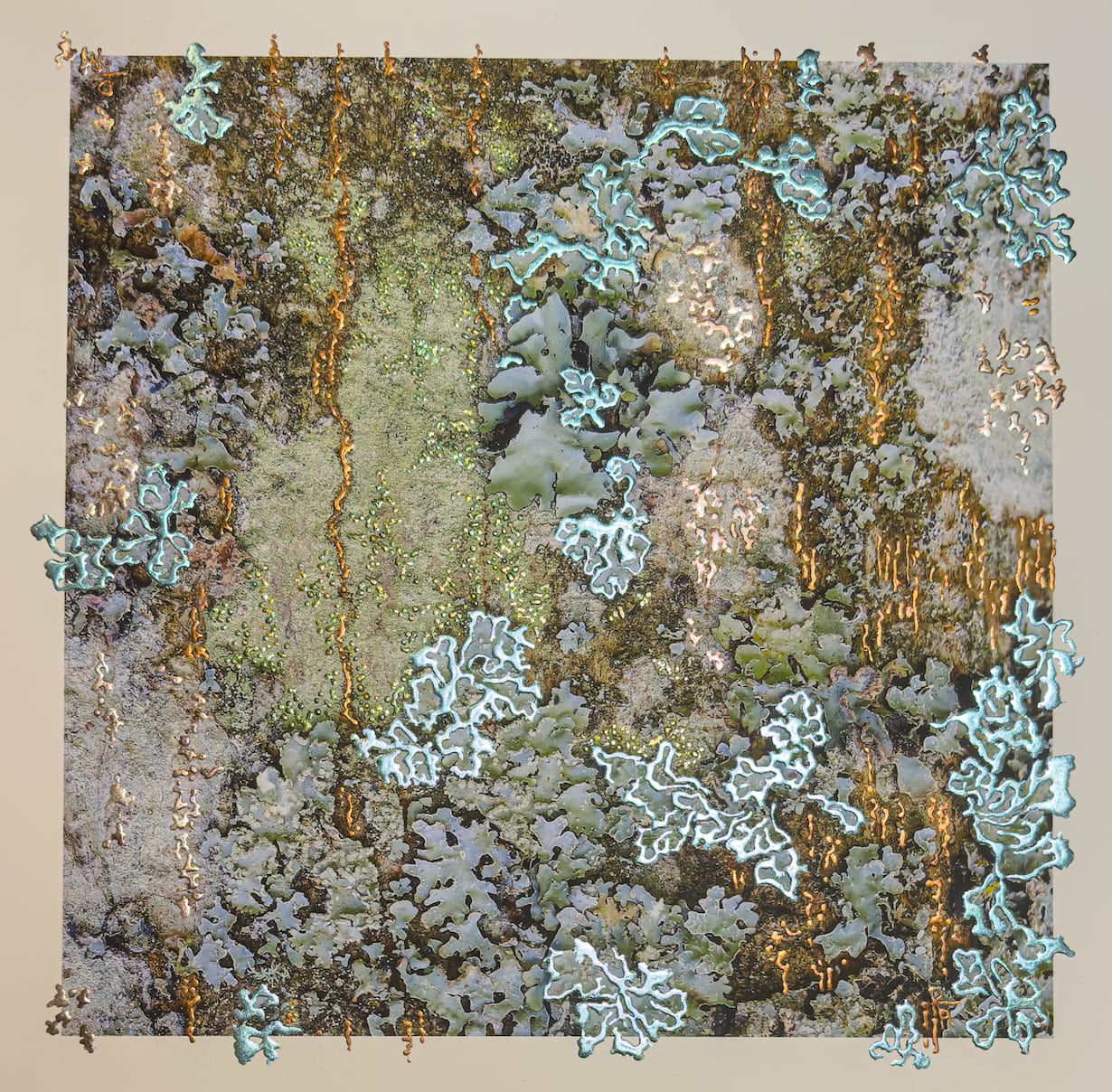
Pari Aazami is an Anglo-Iranian, self-taught artist based in Kent, whose mixed-media works combine photography with hand-gilded metal leaf. Her practice sits in a space often described as abstract realism, a territory where real, natural forms are transformed through scale, surface, and detail into something that feels both familiar and otherworldly.
At the heart of Aazami’s work is a simple yet profound belief: the world is layered with quiet beauty that often goes unnoticed. In an age of speed and distraction, she positions her art as an invitation to slow down. Each piece becomes a moment of pause, encouraging viewers to look longer, notice more, and reconnect with the subtle textures of the natural world.
Rather than seeking dramatic landscapes or obvious subjects, Aazami turns her gaze toward what is typically overlooked. She studies lichen spreading across stone, the ridges of tree bark, and organic growth reclaiming built surfaces. These fragments of the environment, easy to pass by without a second thought, become the foundation of her visual language.
From Observation to Transformation
Aazami’s creative process begins with photography, but it does not end there. Her photographs are not presented as straightforward representations of reality. Instead, they are carefully selected and enlarged, often to a scale that removes familiar reference points. A patch of lichen can become an expansive landscape. A section of bark can resemble a topographical map or an aerial view of terrain.
By altering scale and isolating details, she disrupts immediate recognition. The viewer is no longer certain what they are looking at, and in that uncertainty, curiosity emerges. This shift from recognition to exploration is central to her work. It encourages a different kind of seeing, one that is less about labeling and more about experiencing.
Once the photographic base is established, Aazami introduces one of her most distinctive elements: hand-applied gold and silver leaf. This stage transforms the work from image to object. The metal leaf is not merely decorative; it interacts with light, creating a dynamic surface that changes depending on the viewer’s position and the surrounding environment.
Light becomes an active collaborator. Metallic areas catch, reflect, and soften illumination, revealing layers and depth that cannot be captured in a single glance. The work subtly shifts throughout the day, rewarding sustained attention.
The Language of Layers
Layering operates on multiple levels in Aazami’s art: material, visual, and conceptual. Physically, there are layers of photographic print and metal leaf. Visually, there are layers of texture, detail, and reflective surface. Conceptually, there are layers of meaning about perception, time, and the relationship between humans and the natural world.
Her work suggests that nothing is as flat or simple as it first appears. A wall carries traces of weather and growth. A stone records years of quiet transformation. A tree’s bark maps its life. By highlighting these surfaces, Aazami draws attention to slow processes that unfold beyond human timelines.
There is also a poetic tension between the organic and the precious. Lichen and moss, humble and often ignored forms of life, are paired with gold and silver, materials historically associated with value and reverence. In doing so, Aazami subtly asks what we choose to value and why. Her work proposes that beauty and worth exist in the modest and the marginal, not only in the grand or rare.
A Self-Taught Path
As a self-taught artist, Aazami’s journey has been guided by experimentation, intuition, and sustained observation. Without the constraints of a formal academic framework, she has developed a practice that feels personal and exploratory. This independence is visible in the way she blends disciplines such as photography, mixed media, and traditional gilding techniques into a cohesive voice.
Her growing recognition reflects the strength of that voice. Aazami has exhibited at respected venues and platforms including Mall Galleries, The Other Art Fair (TOAF), and Flux. She has also been long-listed for Women in Art and VAO 2024, as well as ArtAvol 2025. These acknowledgments point to a practice that resonates with contemporary audiences while remaining deeply rooted in quiet observation.
Despite this recognition, her work retains an intimate quality. It does not demand attention through spectacle; it draws viewers in through subtlety.
“I Become Spring”: A Quiet Awakening
One of Aazami’s notable works, I Become Spring, now held in a private collection, beautifully encapsulates her approach. The piece combines photography with gilded metal leaf to evoke the delicate transition from winter to spring.
Soft lime greens and misted tones flow across the surface, suggesting water, moss, and the first tentative shoots of new growth. The palette is gentle yet alive, capturing that moment when the world begins to stir but has not fully awakened.
The gilded elements introduce a fragile metallic light that shifts as the viewer moves. This three-dimensional quality gives the work a living presence. It does not remain static; it responds. As light glances across the surface, certain areas glow while others recede, echoing the rhythms of nature itself.
Conceptually, I Become Spring speaks to renewal and subtle transformation. It is not about dramatic bloom but about the quiet signals of change, the almost imperceptible signs that a new cycle is beginning. True to Aazami’s ethos, it asks for contemplation rather than quick consumption.
Art as an Invitation to Slow Down
In a fast-paced visual culture dominated by instant images and rapid scrolling, Pari Aazami’s work offers a counterpoint. Her pieces resist being fully understood at a glance. They ask the viewer to linger, to adjust their eyes, and to notice nuance.
This is where the power of her practice lies. By magnifying the overlooked and layering it with reflective surfaces, she reintroduces wonder into the everyday. She reminds us that the natural world is not separate from daily life. It is embedded in the textures around us, waiting to be seen.
Ultimately, Aazami’s art is about attention: how we give it, where we place it, and what happens when we slow down enough to truly look. In revealing the extraordinary within the ordinary, she opens a space for reflection, connection, and quiet awe.
