


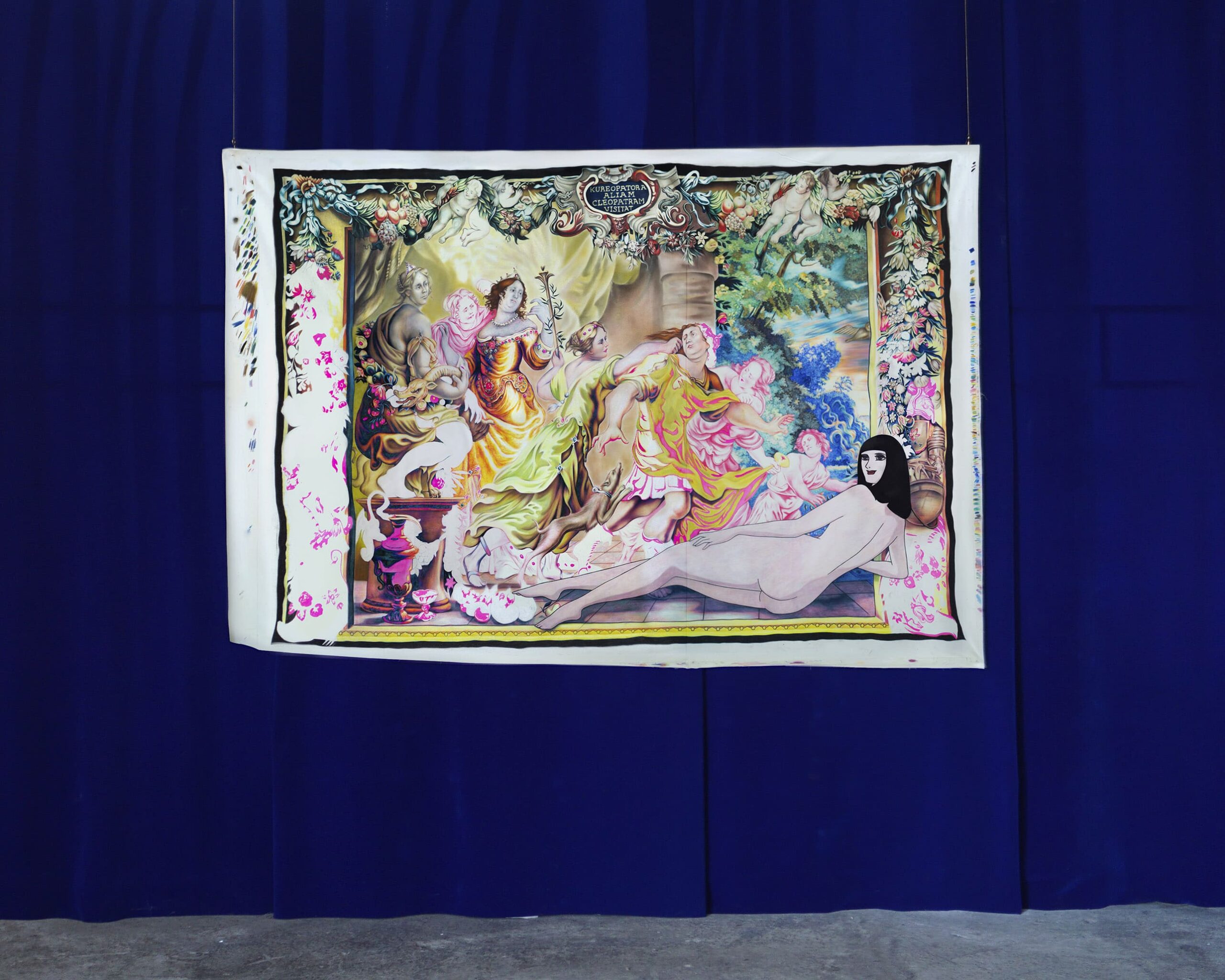
Paula Martínez is part of a generation of Latin American artists who navigate identity not as a fixed element but as a fluid and ever-shifting terrain shaped by images, narratives, and cultural memory. Her practice draws from archives both formal and informal, including classical tapestries, cinema, internet imagery and mass media, to explore how identity is constructed and reconstructed across time. Through layering, recontextualizing and juxtaposing references, she creates works that exist between fact and fiction, past and present. Her 2025 drawing Kureopatora Visits Another Cleopatra illustrates how a single historical figure can proliferate endlessly through representation.
Biography: A Practice Built on Image Archaeology
Born in 1997 in Chile, Paula Martínez is a visual artist whose work is rooted in the study of identity as a mutable construction. She investigates how stories, images and icons evolve as they move through history, reshaped by culture, technology and interpretation. She holds a BA in Art from the Pontificia Universidad Católica de Chile and expanded her theoretical framework through Estudios Independientes V with a focus on contemporary art and visual culture.
Beyond her individual practice, Martínez is also the cofounder of La Casa de las Recogidas, an artist collective that fosters experimentation and dialogue among emerging creators. Over the past years she has steadily built a strong exhibition trajectory in Chile. Her two solo exhibitions, including her most recent at OMA Galería in 2025, demonstrate her ability to blend conceptual rigor with material sensibility.
Her work has been featured in multiple group exhibitions at leading galleries and institutions such as Oficina Viceversa in 2025, Feria FAST in 2024, MAVI UC in 2024, Galería Espacio O in 2023, Centro Cultural Matucana 100 in 2023 and Museo de la Educación Gabriela Mistral in 2023. In 2025 Martínez completed a residency at HANGAR Lisboa, a period that deepened her interest in the circulation of images and their ability to shape identity narratives. She currently lives and works in Santiago and is represented by OMA Galería.
An Artist in Dialogue With Histories of Representation
Across her practice, Martínez navigates the intersections between media, history and fiction. Her works often function like visual essays, maps of references where diverse image traditions meet. Rather than choosing between high and popular culture, she embraces both, bringing together threads from Flemish tapestries, early animation, film memorabilia and digital archives.
Her process mirrors research yet resists academic closure. Instead she works with fragmentation, drift and reinterpretation. Images overlap, merge and collide, forming new constellations. In this way Martínez challenges the idea of identity as a coherent narrative. Her artworks propose that identity, whether personal, cultural or historical, is an unstable accumulation of the images we inherit, reinterpret and project.
Kureopatora Visits Another Cleopatra: A Meeting Across Centuries
Her 2025 work Kureopatora Visits Another Cleopatra encapsulates this ongoing investigation into the fluidity of representation. Created during her residency at HANGAR Lisboa, the drawing stages an uncanny encounter between two radically different Cleopatras. One originates from a seventeenth century Flemish tapestry, pale skinned, red haired and rendered through intricate weaving. The other emerges from a 1970 Japanese erotic science fiction animated film directed by Eiichi Yamamoto and Osamu Tezuka, a Cleopatra filtered through fantasy, futurism and pop aesthetics.
Placed together on curtain fabric, these two figures become parallel versions of the same icon, each shaped by the time and culture that produced them. Martínez uses soft pastel pencils and gouache to create an image that feels both material and ephemeral, like something resurfacing from memory or drifting across visual history.
The curtain fabric adds another conceptual layer. Instead of the rigid surface of canvas, the textile evokes domestic space, permeability and the idea of a threshold, something that divides yet can also be crossed. This material choice mirrors the artwork’s central encounter, a crossing of timelines, mythologies and visual languages.
A Cartography of Images
Martínez describes the work as a drifting cartography, a map without a fixed destination. In Kureopatora Visits Another Cleopatra this drift takes the form of overlapping cultural histories. The woven Cleopatra carries the legacy of European craftsmanship, colonial fascination and seventeenth century aesthetic codes. The animated Cleopatra embodies the freedom of fiction, eroticism and the playful hybridity found in twentieth century Japanese animation.
By allowing these two depictions to meet, Martínez reveals how icons travel across time, continuously remade through new interpretations. Cleopatra becomes not a single historical figure but a living and evolving image, a symbol claimed by different cultures to express different fantasies, ideals and anxieties.
In Martínez’s drawing, these versions do not compete. Instead they coexist in an unresolved dialogue. The artwork becomes a space where contradictions and multiplicities are acknowledged rather than erased.
Materiality and Technique
The work measures 165 by 230 centimeters, a scale that envelops the viewer and emphasizes its theatrical and almost cinematic quality. The use of soft pastel pencils and gouache allows for subtle gradations, delicate lines and luminous transitions. Against the woven like texture of the curtain fabric, the pigments rest lightly, creating a sense of both presence and impermanence.
This interplay between medium and imagery reflects Martínez’s interest in how materials carry meaning. Thread, fiber and textile echo the history of tapestry, while pastel and gouache gesture toward drawing and illustration. The subject matter bridges historical realism with animation aesthetics.
Installation Context
The work was exhibited as part of Cleopatra Visits Kleopátra curated by Gabriel Godoi at OMA Galería in June 2025 in Santiago, Chile. Within this thematic framework, the drawing became part of a larger conversation about representation, myth and the global circulation of images. Its scale and materiality allowed it to function as both an object and a narrative space, inviting viewers to consider how images shape cultural memory and how artists like Martínez intervene in those visual systems.
Conclusion
With Kureopatora Visits Another Cleopatra, Paula Martínez continues to develop a practice that is both research driven and deeply intuitive. By bringing together disparate image traditions, she challenges viewers to reconsider the stability of icons and the stories they carry. Her work suggests that identity, whether personal or historical, is a tapestry woven from countless representations, each shaped by its moment, material and cultural lens.
Martínez’s ability to navigate these complexities with clarity, playfulness and visual sophistication positions her as a significant voice in contemporary Chilean art. As her practice evolves, so too does her exploration of the images that define us, revealing the layered, shifting and often contradictory nature of identity in a visually saturated world.
