


Rute Ventura (b. 1982, Lisbon) is a Portuguese multidisciplinary visual artist working across painting, performance, poetry, and video. Her practice moves fluidly between mediums, combining visual language, bodily presence, and written word into a cohesive exploration of the inner life. For Rute, art is not confined to one format or tradition. It is an evolving field where personal reflection, symbolism, and experimentation meet.
She holds both a BFA in sculpture and an MFA in Fine Arts from the School of Art and Design in Caldas da Rainha, Portugal, an institution that prioritizes conceptual development over technical training. This background provided her with strong speculative practices; her artistic voice has grown primarily through sustained introspection and psychological inquiry, provided by lived experience and inner investigations.
Now based in Ridgewood, Queens, New York, Ventura works within a global contemporary art environment while maintaining a deeply personal approach. Her work has been featured in publications including Beautiful Bizarre, Suboart, Untitled–Art Edition, JPAS Penn University, and Women United Art Movement. These features reflect increasing international recognition, but the core of her practice remains rooted in personal process rather than external validation.
Central to understanding her work is the concept she defines as Psychogenic Figuration, a term that frames her art as imagery generated from psychological and emotional states.
Psychogenic Figuration: Art as Inner Process
Rute Ventura describes her creative process as connected to therapeutic and psychogenic mechanisms. In her view, images can originate from internal tensions, memories, and subconscious material. Psychogenic Figuration refers to figures and scenes that emerge from the psyche, not simply from observation of the external world.
Her work shares affinities with art brut in its emotional directness and raw symbolic force. However, Rute’s practice is not accidental. It is informed by art history and critical awareness. She consciously channels subconscious material into composed visual narratives.
Painting becomes a space where control and intuition coexist. Some elements are carefully structured, while others arise more spontaneously. This balance allows her to access imagery that feels dreamlike yet intentional. Figures often inhabit ambiguous environments that suggest memory, fantasy, and emotional states at once.
Her multidisciplinary approach strengthens this inquiry. Performance allows embodiment of psychological themes, poetry introduces linguistic intimacy, and video incorporates time and motion. Across all formats, the consistent focus is on the complexity of the human mind.
Contemporary Surrealism and Emotional Reality
Rute’s visual language connects to surrealist traditions, yet her goals differ from historical surrealism. Instead of aiming to shock or rebel against rationality, her work leans toward introspection and healing. Her surrealism functions as a map of emotional reality.
Her imagery frequently brings together innocence and discomfort, beauty and tension. Animals, symbolic figures, and anatomical references appear as carriers of meaning. These symbols do not come with fixed explanations. She intentionally leaves interpretive space so viewers can project their own experiences onto the work.
Color also plays a psychological role. Shifts in palette influence emotional tone, moving from quiet contemplation to dramatic intensity. The viewer is invited into an immersive experience that encourages reflection rather than passive viewing.
Inner Work (2025): A Baroque Mental Landscape
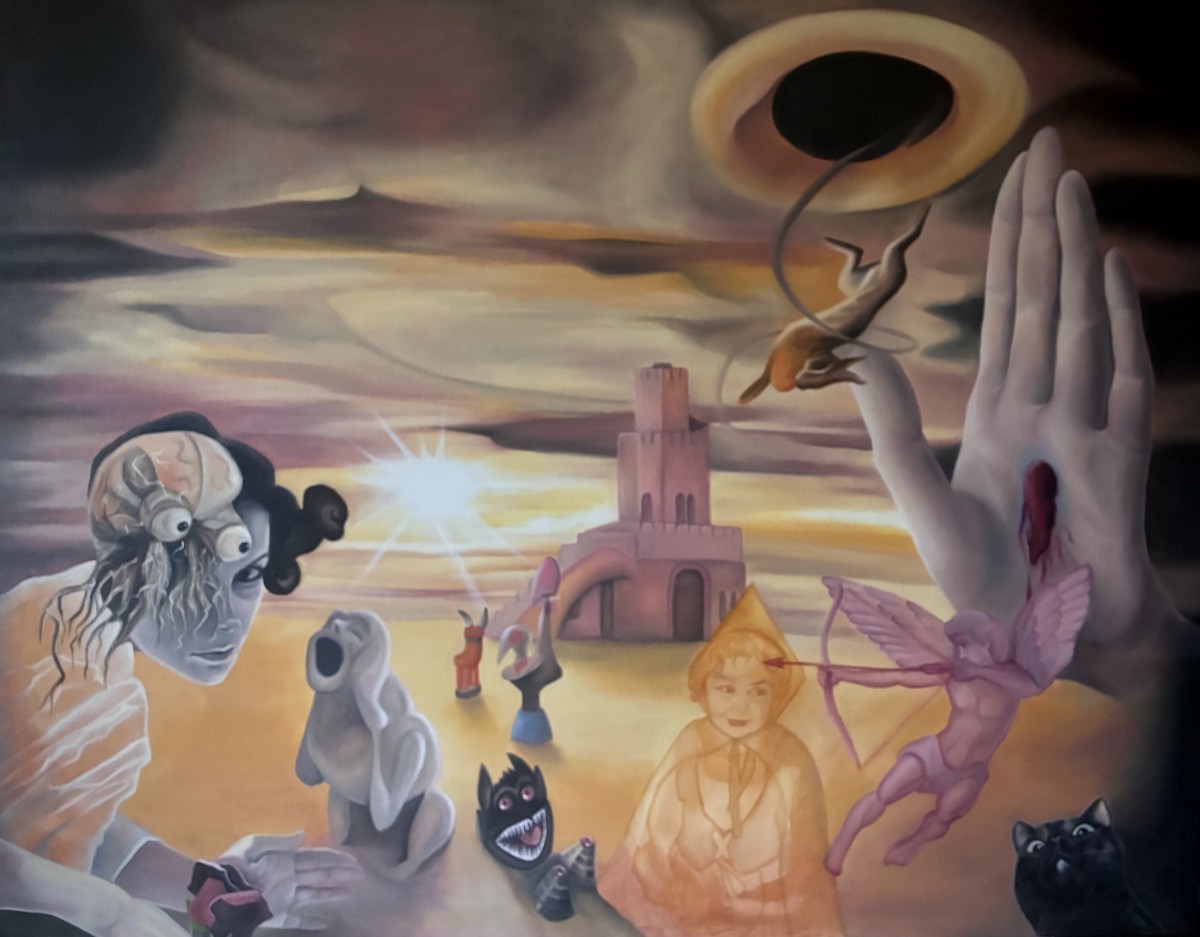
Her 2025 oil painting Inner Work exemplifies her conceptual and visual concerns. The piece is described as a Baroque-inspired mental landscape that stages a symbolic drama within the mind.
The painting includes the memory of a young girl beside a devil-like figure, a woman revealing an overlaid nervous system, and a rabbit drifting toward a void. Each of these elements functions as a psychological symbol.
The young girl suggests innocence and formative memory. Her proximity to a devil-like figure introduces tension between vulnerability and shadow aspects of the psyche. This relationship does not read as a simple moral contrast. Instead, it reflects how innocence and fear can coexist in personal development.
The woman displaying an overlaid nervous system introduces anatomical symbolism. By making the nervous system visible, Rute highlights sensitivity, perception, and emotional exposure. It is a metaphor for self-awareness and the courage to confront one’s own internal wiring.
The rabbit drifting toward a void evokes curiosity, transition, and the pull of the unknown. Rabbits often symbolize passage into alternate realities or new states of awareness. Here, the movement toward emptiness may represent a journey into the unconscious or a surrender to uncertainty.
The Baroque influence appears in the dramatic composition and layered symbolism. Like Baroque art, the painting embraces emotional intensity and theatrical arrangement. However, Ventura directs this intensity inward, toward psychological space rather than religious or historical narrative.
Memory, Time, and the Uncanny
A central theme in Inner Work is the constant activity of the mind. Ventura presents memory as layered and dynamic. Past experiences, present awareness, and future projections interact simultaneously.
This layering produces a sense of the uncanny. Elements feel familiar yet slightly displaced. Figures appear intimate but symbolic. This quality mirrors mental experience itself, where recollection and imagination blend.
Rute Ventura does not attempt to resolve these tensions. Instead, she sustains them. Innocence and awareness, comfort and unease, clarity and ambiguity remain in dialogue. The viewer is invited to reflect rather than to decode a single meaning.
Relevance in a Psychologically Aware Era
In a cultural moment where mental health and self-reflection are openly discussed, Rute’s work feels particularly resonant. She does not illustrate psychology in a literal or didactic manner. She embodies psychological states through image and process.
Her art encourages slow engagement. Viewers are prompted to consider their own memories, fears, and emotional landscapes. The work becomes a meeting point between personal and collective experience.
Working from Queens while carrying her Portuguese background and education, Rute Ventura represents a transnational contemporary artist engaged with universal themes. Her concept of Psychogenic Figuration offers a framework for thinking about how art can serve as a tool for self-exploration.
Painting the Invisible
Rute’s work can be understood as an attempt to give form to the invisible. Thoughts, emotions, and memories become visual landscapes populated by symbols and figures. Through paintings like Inner Work, she demonstrates that painting remains a powerful medium for psychological exploration.
Her practice suggests that the mind itself is a vast terrain filled with tension, mystery, and revelation. By mapping this terrain, Ventura offers viewers experiences that extend beyond aesthetics. She invites introspection and emotional recognition.
In doing so, her work affirms that art can still function as a space for inner discovery. Rute does not simply create images. She creates encounters with the layered complexity of being human.
