


Yooyeon Nam is a Korean-born, Brooklyn-based oil painter whose work navigates the emotional terrain of displacement, cultural translation, and psychological tension. With an O-1 artist visa recognizing her extraordinary ability, Nam’s journey into the art world reflects both discipline and transformation. Originally studying business at Yonsei University in Seoul, she redirected her path toward painting, earning a BFA in Painting with highest honors from Pratt Institute in New York. This shift from commerce to creative expression continues to inform her practice, where structure and intuition meet in compelling ways.
Nam’s career has steadily gained recognition through solo exhibitions at A Space Gallery and ChaShaMa, as well as group exhibitions at Hal Bromm, Caelum Gallery, and Sims Contemporary. Her participation in international art fairs such as The Other Art Fair and ASYAAF in Seoul further situates her within a global dialogue. Accolades including the Arthouse.Z Grand Prize and residencies at Ma’s House, AnkhLave Arts Alliance, Woodstock Byrdcliffe, ChaNorth, and the School of Visual Arts underscore her growing influence. Alongside her studio work, Nam contributes to the artistic community as Co-Director of Office Space Gallery, a Guest Artist at Pratt Institute, and facilitator of Assemble Your Alien workshops.
Between Presence and Absence: A Distinct Visual Language
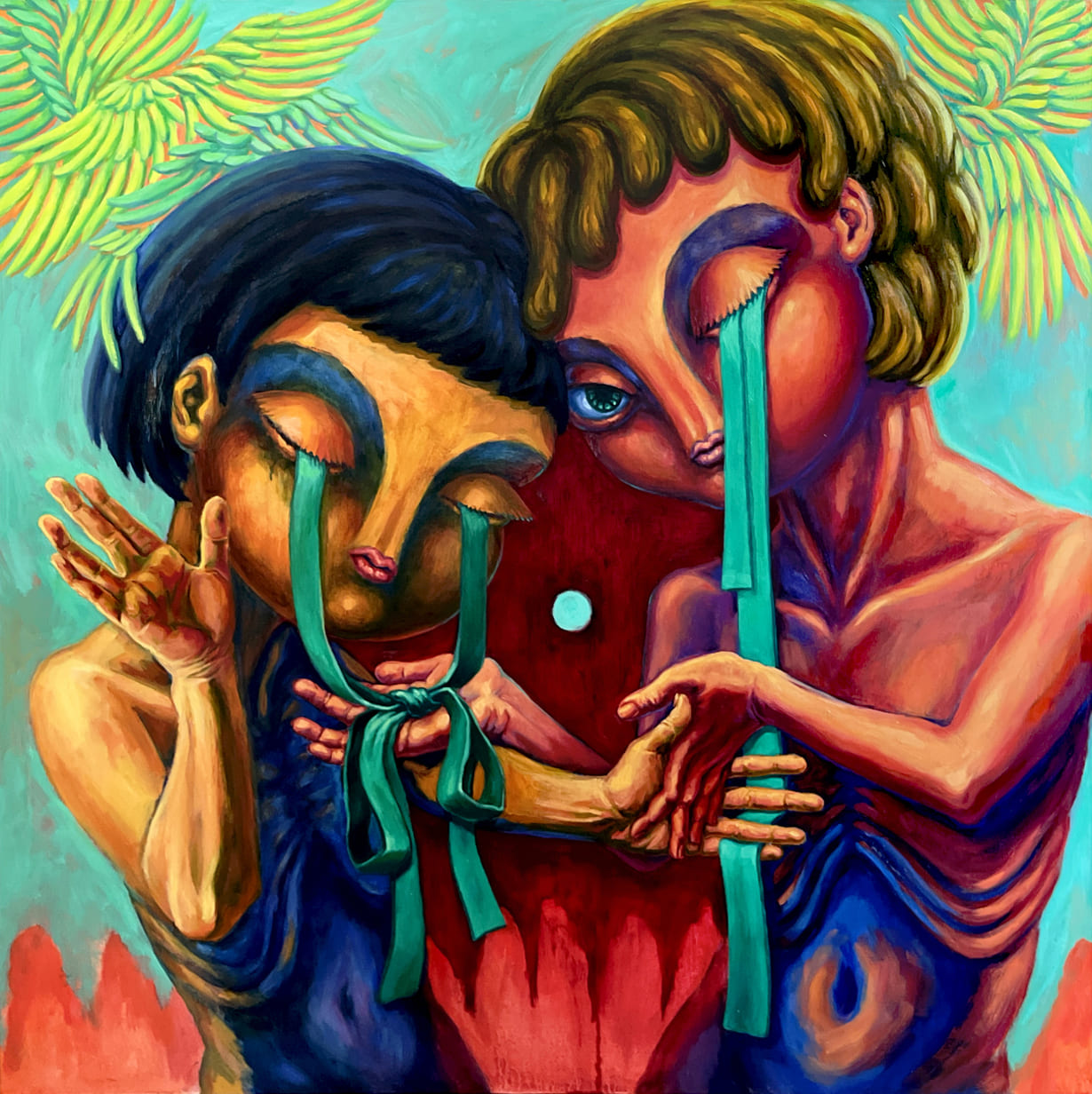
At the heart of Yooyeon Nam’s paintings lies a unique visual vocabulary shaped by ambiguity and contradiction. Her figures, often characterized by round faces and the striking absence of noses, exist in a state of suspended emotion. These characters feel both familiar and alien, embodying the complexities of identity in a cross-cultural context. Their simplified features evoke a sense of universality, yet their gaze carries an intensity that resists easy interpretation.
Nam’s approach draws subtle inspiration from traditional Korean Buddha sculptures, where anatomical distortions are used to convey idealized forms rather than literal representation. In her work, this influence is reimagined through a contemporary lens, blending cultural heritage with the lived realities of a Korean artist in New York City. The result is a body of work that reflects both reverence and disruption, bridging past and present while questioning fixed notions of identity.
Airless Lullaby: A World Without Breath
In her recent solo exhibition Airless Lullaby at A Space Gallery in New York, Nam constructs a psychological environment defined by tension and stillness. The concept of “airlessness” becomes central, representing not only a physical absence but also an emotional condition. Within this space, feelings accumulate without release, creating a quiet yet overwhelming intensity.
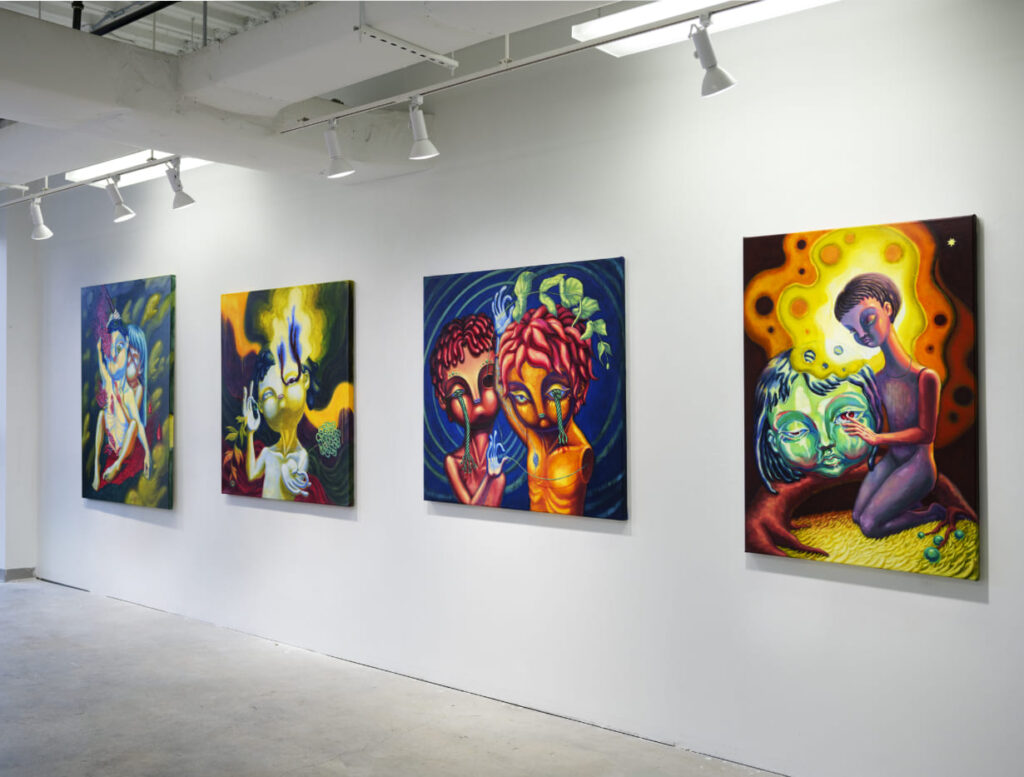
The figures in Airless Lullaby do not outwardly express emotion; instead, they contain it. This containment generates a powerful contradiction. On one hand, the characters appear gentle, almost childlike. On the other, their stillness suggests an underlying unease. Hands reach tentatively, bodies lean toward one another, and gestures blur the line between care and harm. This duality challenges viewers to reconsider the boundaries between intimacy and violence.
The environments surrounding these figures are equally significant. Rather than functioning as passive backgrounds, they erupt into swirling fields of saturated color. These chromatic storms suggest movement and chaos, yet they remain eerily silent. Without air, there is no medium for sound, no possibility for release. The viewer is left in a suspended state, confronting a silence that feels both oppressive and intimate.
The Language of Estrangement
Estrangement operates as a central theme in Nam’s work, not simply as subject matter but as a structural condition. Her figures exist within a cultural tension that reflects her own experience as a Korean artist living in a Western environment. The absence of noses, for instance, becomes more than a stylistic choice; it symbolizes a disconnection from conventional identity markers and a resistance to fixed definitions.
In many East Asian cultures, direct eye contact and overt emotional expression can be perceived as impolite or excessive. Nam’s characters, however, often stare directly outward, confronting the viewer with an unfiltered presence. This gaze introduces a friction between cultural norms, highlighting the challenges of navigating multiple social frameworks. The result is a visual language that feels both restrained and confrontational, inviting viewers into a space of discomfort and reflection.
Artwork Spotlight: Who Tied the Knot Must Untie It?
One of the defining works in Nam’s recent practice is Who Tied the Knot Must Untie It?, 2026, an oil on canvas measuring 36 by 36 inches. Inspired by the Korean proverb Gyeol-ja-hae-ji, the painting explores the paradox of responsibility. The proverb suggests that those who create problems should also resolve them, yet the reality often reveals a different story, where burdens are shifted onto others.
In this work, Nam’s signature figures become vessels for this critique. Their expressions, though minimal, carry a weight that speaks to unresolved tension and shared responsibility. The absence of noses reinforces their sense of estrangement, while their proximity within the composition suggests entanglement. The painting does not offer resolution; instead, it exposes the fragility of human relationships and the often-absurd nature of accountability.
Through this piece, Nam sharpens her exploration of existential themes. The figures appear caught in a moment of recognition, yet unable to act. This paralysis mirrors broader social dynamics, where systems of responsibility become diffuse and unclear. By translating a cultural proverb into a contemporary visual language, Nam bridges tradition and modernity while questioning the universality of moral expectations.
Color, Gesture, and Psychological Depth
Nam’s use of color and gesture plays a crucial role in shaping the emotional resonance of her work. Her palettes are often saturated and vibrant, yet they do not convey joy in a conventional sense. Instead, color becomes a vehicle for tension, amplifying the psychological atmosphere of each painting.
Her brushwork ranges from controlled precision in the rendering of figures to dynamic, almost chaotic movement in the surrounding environments. This contrast reinforces the duality present throughout her practice. The figures remain still, contained, and introspective, while the world around them appears restless and unstable. This interplay between control and chaos mirrors the internal conflicts experienced by her subjects.
Community, Teaching, and Expanding Practice
Beyond her individual practice, Yooyeon Nam actively contributes to the broader art community. As Co-Director of Office Space Gallery, she helps create opportunities for emerging artists and fosters a collaborative environment. Her role as a Guest Artist at Pratt Institute allows her to engage with the next generation of painters, sharing both technical knowledge and conceptual insights.
Her Assemble Your Alien workshops extend this engagement further, inviting participants to explore identity and creativity through playful yet meaningful exercises. These initiatives reflect Nam’s commitment to building connections and supporting artistic dialogue, emphasizing that her work extends beyond the canvas.
A Quiet Yet Powerful Presence
Yooyeon Nam’s paintings resist easy categorization. They do not rely on narrative clarity or dramatic expression. Instead, they operate within a space of quiet intensity, where meaning emerges through tension and contradiction. Her figures, suspended between presence and absence, invite viewers into an encounter that is both intimate and unsettling.
In Airless Lullaby and works like Who Tied the Knot Must Untie It?, Nam demonstrates a profound ability to translate complex emotional and cultural experiences into visual form. Her practice challenges viewers to sit with discomfort, to confront silence, and to recognize the fragility that underlies human connection.
As her career continues to evolve, Nam stands as a compelling voice in contemporary painting, one that bridges cultures while embracing the ambiguities that define them.
