


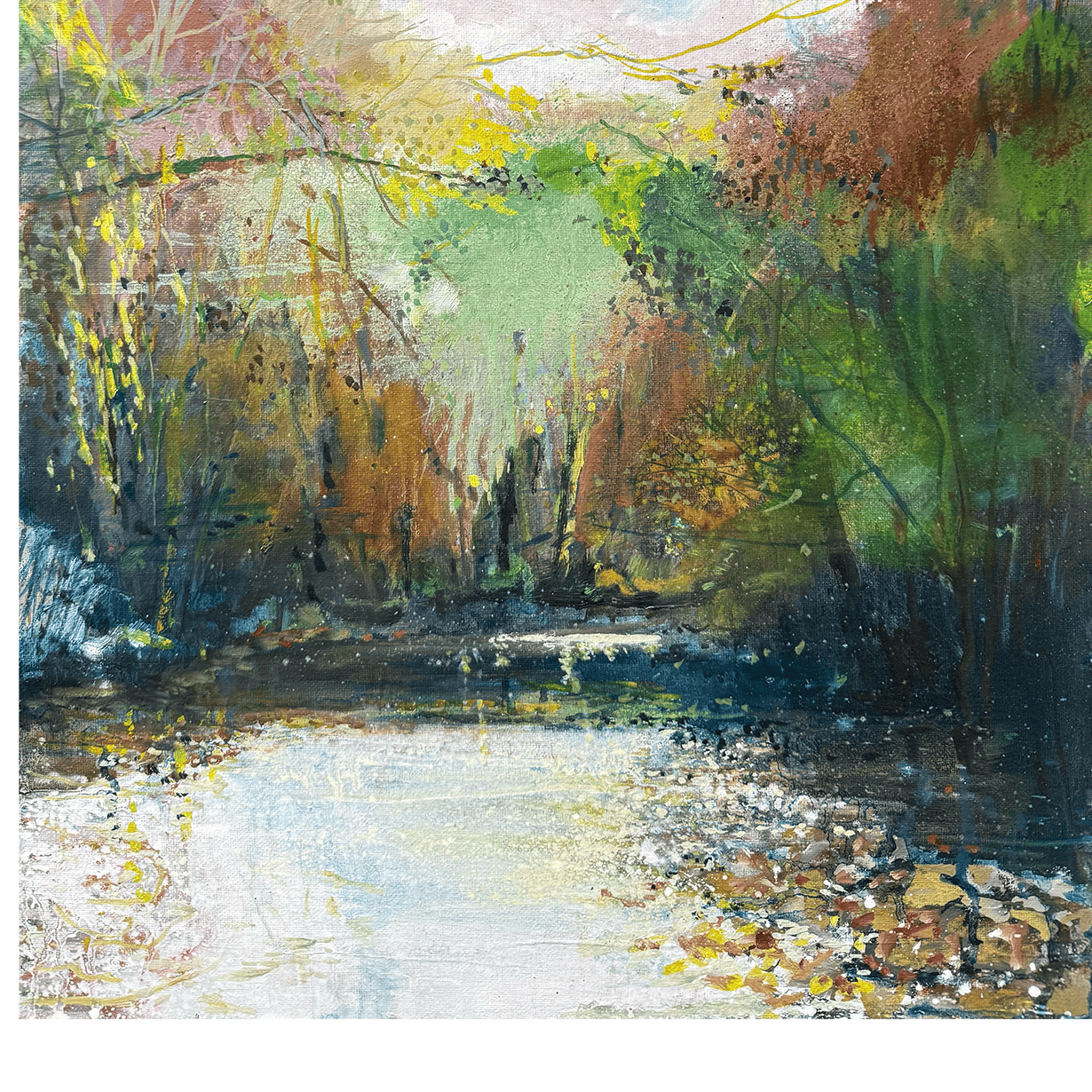
Simon Parker is a Chester based oil painter whose work is deeply connected to memory, geography, and lived experience. Originally from Liverpool, Parker has spent over 26 years living and working in Chester, where he has also dedicated much of his career to teaching art. His dual role as both educator and practicing artist has allowed him to cultivate a thoughtful and reflective approach to painting, one that is grounded in observation yet driven by emotion.
Parker’s formal artistic training began in the mid 1980s at the Wolverhampton School of Art, where he studied fine art painting and drawing. This period laid the technical and conceptual foundation for his future work. Following his studies, he became part of a major artist collective based in Liverpool’s Arena Studios. Over the course of 14 years, he developed a strong reputation within the local art scene, actively exhibiting and contributing to the creative energy of the North West.
The Influence of North East Wales
Central to Parker’s work is his enduring connection to the landscapes of North East Wales. His early experiences walking through its hills and mountains left a lasting impression, shaping both his artistic direction and personal identity. These environments are not merely subjects in his paintings; they are deeply embedded in his memory and emotional landscape.
Rather than depicting these places in a purely representational way, Parker seeks to evoke their atmosphere, the subtle shifts in light, the textures of the terrain, and the quiet presence of the unseen. His process involves revisiting the same locations repeatedly, walking the land in different seasons and weather conditions. This immersive approach allows him to absorb the nuances of each place, translating them into layered, expressive compositions.
A Practice of Observation and Return
Working predominantly in oils on a small scale, Parker’s technique is both intimate and deliberate. His paintings often reveal a careful balance between structure and spontaneity. Thick, textured brushstrokes build the surface, while subtle tonal variations create depth and movement.
A key aspect of his practice is repetition, not in the sense of duplication, but as a method of deepening understanding. By returning to the same landscapes over time, Parker captures not just their physical appearance, but their evolving character. Light changes, seasons shift, and memory itself transforms, all of which are reflected in his work.
This idea of return is central to Parker’s artistic philosophy. His paintings are not static records, they are moments within an ongoing dialogue between artist and environment.
A Renewed Artistic Momentum
After years of balancing teaching with creative practice, the past couple of years have marked a significant resurgence in Parker’s artistic output. This renaissance has seen him reconnect with painting in a more focused and personal way, revisiting familiar landscapes with renewed energy and insight.
This period of rediscovery has allowed Parker to refine his voice, drawing on decades of experience while embracing a fresh perspective. The result is a body of work that feels both grounded and exploratory, rooted in tradition yet open to new interpretations.
Artwork Focus: Still River, Heading Back
Still River, Heading Back is a compelling example of Parker’s ability to capture both the physical and emotional essence of a landscape. At first glance, the viewer is drawn immediately to the luminous patch of water in the foreground. This area acts as both a visual anchor and an entry point into the painting.
Rendered with thick, layered brushstrokes in varying shades of white, the river appears almost motionless. The texture of the paint enhances this effect, giving the surface a tactile quality that reinforces the sense of stillness. Yet this stillness is not absolute. There is an underlying tension, suggested by the title itself, Heading Back.
This subtle contradiction between visual calm and implied movement creates a quiet emotional resonance. The viewer is invited to consider not just the scene, but the idea of return, whether physical, emotional, or even temporal. It suggests a journey, perhaps one that is reflective or introspective, rather than literal.
The setting is inspired by the woodland of Loggerheads, a location known for its distinctive atmosphere. The morning light, particularly in winter, plays a crucial role in shaping the mood of the painting. Parker captures this light with sensitivity, allowing it to diffuse gently across the scene, softening edges and enhancing the sense of depth.
The overall effect is one of quiet contemplation. The painting does not demand attention through dramatic contrast or bold color; instead, it invites the viewer to slow down, to look closely, and to engage with its subtleties.
Capturing the Unseen
One of the most distinctive qualities of Parker’s work is his ability to suggest what lies beneath the surface. His landscapes are not simply visual representations; they are infused with memory, emotion, and a sense of the unseen. This might take the form of a barely perceptible shift in tone, a textured passage of paint, or the interplay between light and shadow.
In Still River, Heading Back, this is particularly evident in the way the river functions as both a physical element and a symbolic presence. It reflects light, anchors the composition, and hints at movement, all while maintaining an almost meditative stillness.
A Lasting Connection to Place
Simon Parker’s paintings are, at their core, explorations of place, not just as a location, but as an experience shaped by memory, time, and perception. His work reminds us that landscapes are not static, they are constantly changing, influenced by both natural forces and human presence.
Through his careful observation and expressive technique, Parker invites viewers to reconsider their own relationship with the environments around them. His paintings encourage a deeper engagement with the world, one that values quiet moments, subtle details, and the enduring power of place.
As he continues to revisit and reinterpret the landscapes of North East Wales, Parker’s work stands as a testament to the richness that can be found in familiarity and to the endless possibilities of seeing the same place anew.
