


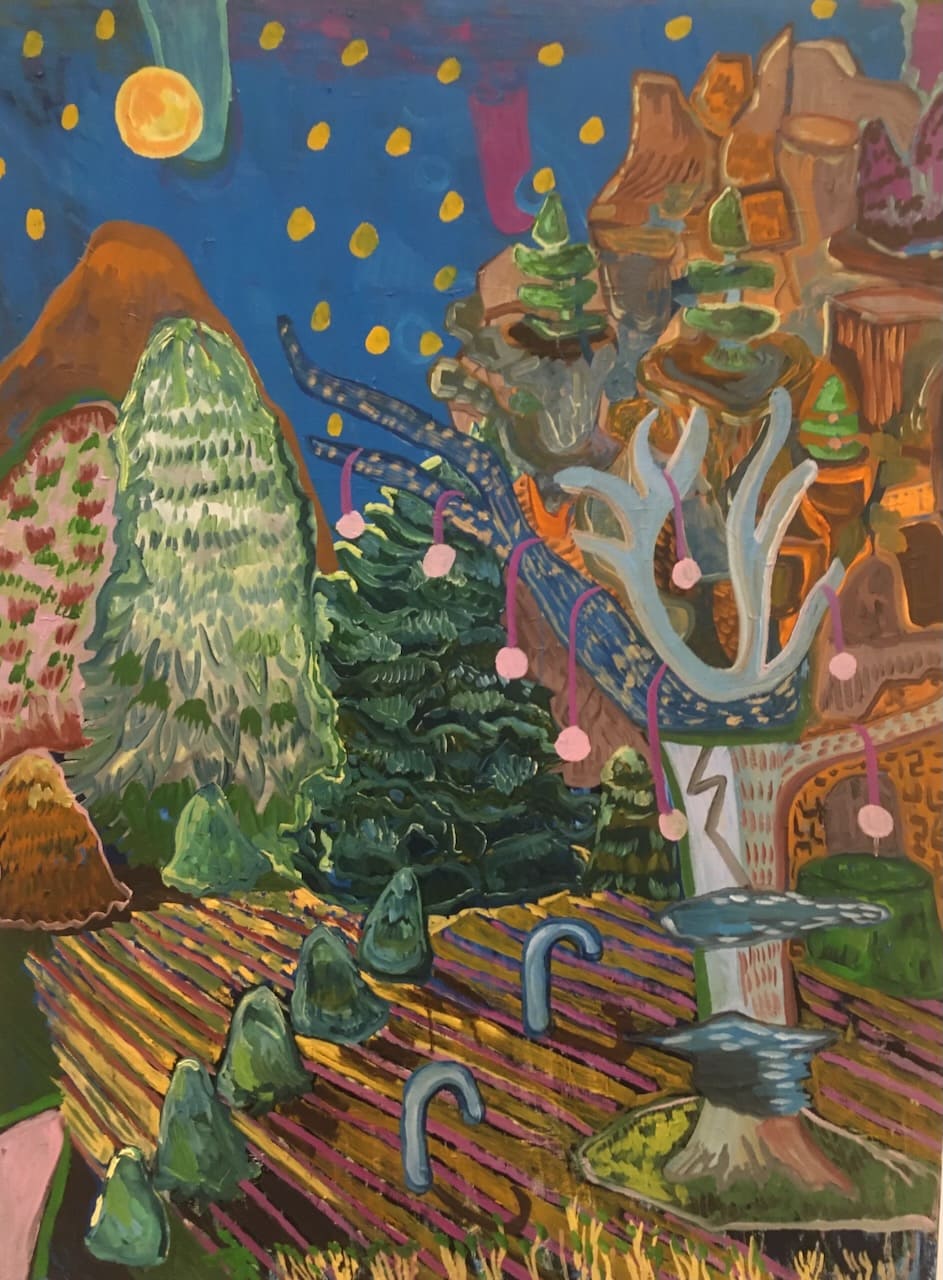
Seth Butler is a contemporary American fine artist whose paintings exist at the intersection of observation and imagination. Based in Upstate New York, Butler has developed a distinctive visual language that transforms familiar landscapes into vibrant, emotionally charged environments filled with movement, atmosphere, and symbolic meaning. Working primarily in oil paint, he combines bold color relationships, expressive markings, and patterned surfaces to create works that feel simultaneously grounded in nature and liberated by fantasy.
Born in 1974, Butler’s artistic path has been shaped by an ongoing exploration of how landscapes can serve as more than simple depictions of place. His paintings invite viewers into worlds where reality is filtered through memory, emotion, and creative interpretation. Through this approach, he has established a body of work that continues to evolve while maintaining a deep connection to the natural world.
From Fantasy to Landscape
Butler’s artistic development took a significant turn during his time in the MFA program at the University at Albany. While his earlier work often explored fantasy-based subjects, his studies encouraged a deeper engagement with landscape as a source of visual and conceptual information.
Rather than abandoning fantasy altogether, Butler found a way to merge the two interests. Landscape became the foundation upon which imaginative possibilities could unfold. Trees, mountains, skies, and natural forms remained recognizable, but they were transformed through heightened color, exaggerated structure, and inventive compositions. This synthesis allowed him to preserve the spirit of fantasy while grounding his work in direct observation and lived experience.
The result is a painting practice that treats the landscape not simply as scenery, but as a platform for exploration. Nature provides the initial framework, while artistic intuition and creative interpretation guide the final image.
Nature as a Source of Discovery
A central component of Butler’s process is his engagement with the natural environment. He frequently gathers source material during peaceful walks through forests and wooded areas, photographing scenes that later become starting points for paintings.
These photographs are not used as strict references. Instead, they function as visual notes that capture moments of light, shadow, atmosphere, and structure. Once in the studio, Butler reinterprets these observations, emphasizing qualities that may not be immediately visible in the original scene.
Color becomes more intense. Shadows deepen and expand. Patterns emerge within leaves, bark, and terrain. Forms may shift, stretch, or merge. Through this transformation, Butler uncovers hidden possibilities within ordinary landscapes and reveals a more expressive reality.
This approach allows him to move beyond straightforward representation and into a territory where observation and imagination coexist. His paintings encourage viewers to reconsider familiar environments and discover new layers of meaning within them.
The Language of Color and Pattern
One of the defining characteristics of Butler’s work is his use of color. Rather than striving for naturalistic accuracy, he embraces bold and unexpected palettes that heighten emotional impact and visual energy.
Vivid blues, radiant greens, intense reds, and glowing yellows often interact across the surface of his paintings. These color relationships create movement and tension while contributing to the dreamlike quality of the imagery.
Pattern also plays a significant role in his visual language. Tree trunks may become rhythmic arrangements of marks and shapes. Foliage can transform into decorative fields of repeated forms. These patterns introduce an element of abstraction that enriches the composition and invites closer examination.
At the same time, Butler carefully balances these decorative qualities with strong structural elements. Dark passages are frequently contrasted against luminous highlights, creating depth and directing the viewer’s attention throughout the painting.
The combination of expressive color, patterned surfaces, and confident mark-making gives his work a distinctive presence that is both contemporary and deeply personal.
Artistic Growth and Contemporary Dialogue
As Butler’s practice has matured, his work has attracted increasing attention within contemporary art circles. A recent collaboration with curator and artist Dan Cameron resulted in a pop-up exhibition in Greenwich, New York, followed by participation in a group exhibition at the Lake George Arts Project.
These opportunities have provided valuable platforms for showcasing the evolution of his artistic vision. Ongoing conversations with Cameron continue to influence Butler’s thinking about how his work is changing and expanding.
Such dialogue reflects an important aspect of contemporary artistic practice: the willingness to remain open to growth. Butler’s paintings demonstrate an artist who is continuously refining his visual language while remaining committed to the foundational ideas that have shaped his career.
His evolving relationship with landscape, abstraction, and imaginative interpretation suggests a practice that remains dynamic and responsive to new discoveries.
“Colorado”: A Vision Beyond Reality
An excellent example of Butler’s artistic philosophy can be found in his painting Colorado, completed in 2021 while attending the University at Albany. Measuring 48 by 36 inches, the work demonstrates many of the themes and techniques that define his approach.
Although inspired by the famous Red Rocks Amphitheatre in Colorado, the painting is not intended as a literal representation of the location. Instead, it serves as a creative reinterpretation that combines elements of observation with fantasy and symbolic invention.
Large, commanding trees dominate portions of the composition, contributing a sense of power and presence. Their scale and form move beyond realism, becoming almost mythical figures within the landscape. These trees establish an atmosphere that feels ancient and mysterious, suggesting a world shaped by imagination as much as by nature.
The sky presents another compelling feature of the painting. Butler introduces star-filled elements that blur the distinction between daylight and twilight. This merging of different times of day creates a dreamlike environment where conventional rules no longer apply. The viewer is invited into a space that exists somewhere between memory, fantasy, and reality.
The rocky formations on the right side of the composition reference the iconic geological structures associated with Red Rocks. However, they remain secondary to the painting’s broader visual narrative. Color takes precedence over realism, allowing the landscape to function as an emotional and symbolic space rather than a geographical record.
Movement, Humanity, and the Natural World
Perhaps one of the most intriguing aspects of Colorado is Butler’s use of striped ground patterns. These directional bands create a strong sense of movement across the composition, guiding the viewer’s eye diagonally from the upper left toward the lower right.
This movement introduces energy and rhythm, preventing the landscape from feeling static. The terrain becomes active and alive, participating in the visual journey rather than merely supporting it.
Another notable feature is the inclusion of tubular forms throughout the scene. These elements symbolize humanity’s presence within the natural environment. Unlike the organic structures surrounding them, the tubes suggest construction, intervention, and human influence.
Rather than presenting this relationship as purely positive or negative, Butler allows viewers to consider the complex interaction between nature and human activity. The tubes become markers of coexistence, reminding us that contemporary landscapes are often shaped by both natural processes and human decisions.
Continuing the Conversation
Seth Butler’s work demonstrates the enduring potential of landscape painting in contemporary art. By combining direct observation with imagination, he creates images that move beyond documentation and into the realm of personal expression.
His paintings celebrate nature while also questioning how we perceive and interpret it. Through bold color, inventive compositions, and symbolic elements, Butler transforms familiar environments into spaces of discovery and reflection.
As his artistic journey continues, works such as Colorado reveal an artist committed to expanding the possibilities of landscape painting while maintaining a deep connection to the natural world that inspires him. His evolving visual language ensures that each new painting contributes to an ongoing conversation about place, perception, memory, and imagination.
