


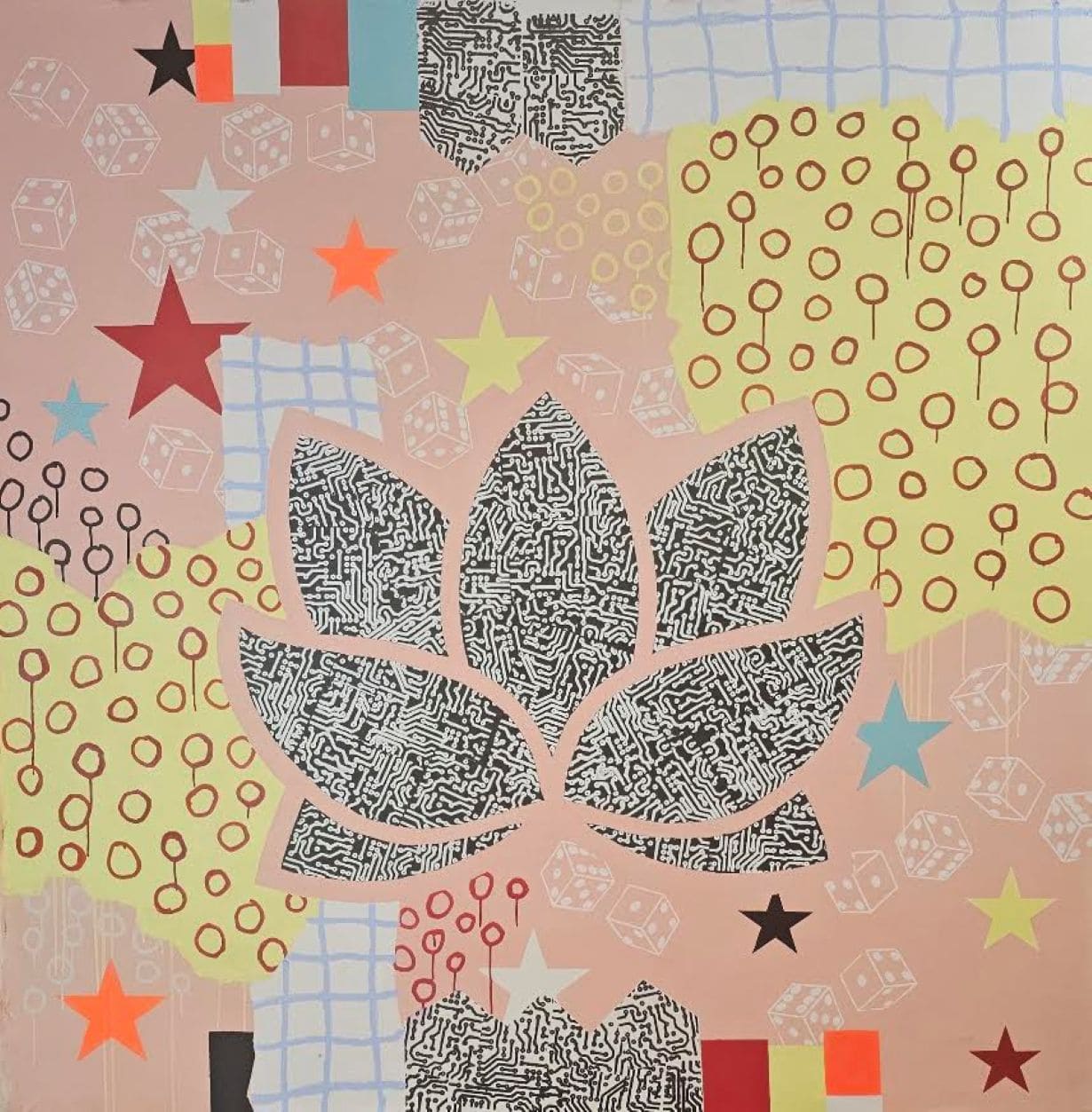
Peter Pryor is an American contemporary artist whose career has evolved through sculpture, performance art, new media, painting, street art, and mixed media. Across decades of creative exploration, Pryor has developed a distinctive visual language that brings together formal design principles, expressive color, historical references, language, commercial imagery, and the visual vocabulary of contemporary urban culture.
His artistic journey began with a strong foundation in both sculpture and painting. Pryor graduated from Pratt Institute with a BFA in Sculpture/New Forms in 1981 and later earned an MFA in Painting in 1993. His early practice was rooted in experimentation, with performance art and new media including film and sound forming an important part of his creative development. These early experiences established an approach to art that was open to different materials, processes, and ways of communicating ideas.
Rather than remaining within a single medium, Pryor continued to explore how visual elements could be combined and transformed. This willingness to experiment would become a defining characteristic of his work throughout his career.
A Pioneer of the Williamsburg Art Scene
During the early stages of his career, Pryor was among a small group of artists who lived and worked in Williamsburg, Brooklyn, at a time when the neighborhood was becoming an emerging center for independent artistic activity. His involvement in the local creative community placed him close to an important period in New York’s art history.
Pryor was also one of the organizers of the first art exhibition in Williamsburg, known as the All Fool Show. His participation reflected not only his commitment to his own practice but also his interest in creating opportunities for artists and contributing to the development of a community around contemporary art.
This connection to Williamsburg would later resonate with his interest in street and urban art. The experience of working in an environment where artists were experimenting outside traditional gallery structures helped shape Pryor’s understanding of art as something that could exist in public spaces as well as in the studio.
The Development of an Expressionistic Painter
Pryor began painting in the late 1980s and moved to Woodstock, New York, in 1988. Over the following decade, he devoted himself to painting while continuing his education and completing graduate school. This period became an important chapter in the development of his artistic identity.
His work was selected by Jay Gorney Art for exhibition in the Puck Building in New York City, providing an opportunity for his paintings to be presented within a significant artistic setting. Throughout the 1990s, Pryor’s practice focused heavily on expressionistic painting. His works during this period drew inspiration from both political and social subjects, allowing him to respond to the world around him through gesture, color, composition, and emotion.
Expressionism offered Pryor a way to communicate ideas without relying entirely on literal representation. His paintings could carry the energy of personal reaction while also engaging with larger cultural and social questions. This period established a foundation for the expressive qualities that continue to appear in his work, even as his visual language has changed considerably over time.
A Shift Toward Personal and Autobiographical Themes
In the 2000s, Pryor began moving toward more personal and autobiographical influences. His art became increasingly connected to his own experiences, memories, and observations, reflecting a desire to explore subjects that were closer to his individual story.
A particularly important moment came in 2008, when Pryor experienced what he described as a major shift an epiphany in his artistic practice. He reconsidered the direction of his work and began exploring small works on paper. At the same time, he started working in the streets of Lower Manhattan alongside other street artists.
This transition opened a new chapter in Pryor’s career. The street became a place of experimentation, where he could engage directly with public space, urban imagery, visual communication, and the traditions of contemporary street art. The experience also encouraged him to reconsider the relationship between art, design, and everyday visual culture.
Building a New Visual Language
Since this pivotal period, Pryor has continued developing a personal approach to street and urban art. His work incorporates references to history and language while also exploring fundamental elements of design. Through this process, he has created a visual system that allows him to build compositions according to a language and logic refined over many years.
His practice brings together a wide range of techniques, including silk screening, stencils, spray paint, and mixed media. Rather than using these materials simply for their surface qualities, Pryor combines them as components within a larger visual structure.
The result is artwork that can appear spontaneous and energetic while being carefully organized according to formal principles. Lines, patterns, color, symbols, and images interact with one another to create compositions that are both expressive and structured.
Pryor’s interest in computer circuits and commercial images has also become an important part of this visual vocabulary. Circuitry introduces ideas of technology, systems, connection, and repetition, while commercial imagery reflects the overwhelming presence of visual communication in contemporary life. By combining these references with personal imagery and formal design, Pryor creates paintings that feel connected to both urban culture and the increasingly digital world.
From the Streets Back to the Studio
As Pryor’s work developed, ideas that emerged through his street art practice gradually moved back into his studio. This transition allowed him to explore his visual language on a much larger scale. His paintings can reach approximately six feet, giving his compositions a physical presence that connects with the immersive qualities of public art.
At this scale, the relationship between individual marks and the overall composition becomes especially important. Patterns, stencils, lines, and images can be viewed both as individual elements and as parts of a larger system.
Pryor continues to seek a balance between spontaneity and control. His use of spray paint and mixed media introduces expressive energy, while silk screens and stencils provide repetition and structure. This tension between freedom and order has become central to his mature practice.
“Lotus 1” and the Complexity Behind Simplicity
One of the works that demonstrates Pryor’s evolving approach is Lotus 1, created in 2026. The mixed-media painting on canvas measures 68 by 68 inches (173 by 173 cm) and belongs to a larger series that explores computer circuits alongside patterns, images, and repeated visual structures.
At first glance, the painting may appear deceptively simple. However, the apparent simplicity of the composition conceals an exceptionally detailed process. Within the lotus flower alone, Pryor used more than 60 separate handmade silk screens and produced more than 100 screen prints.
This labor-intensive process reveals the depth of thought behind the finished image. The lotus becomes more than a recognizable botanical form; it serves as a framework through which Pryor can explore repetition, pattern, rhythm, and structure. The handmade screens introduce subtle variations, while the layering of prints builds complexity within the composition.
Pryor combines the lotus with patterns, lines, and color to create a more formal arrangement. In this sense, Lotus 1 represents a departure from the expressionistic painting that characterized much of his earlier career. The work retains his interest in expressive color and mixed media, but it places greater emphasis on formal composition and an organized visual language.
The painting also reflects the broader evolution of Pryor’s practice. His earlier work was strongly influenced by expressionism and political and social concerns, while his later work has increasingly focused on developing a personal system of imagery and design. Lotus 1 brings together these different stages of his career, connecting his interest in experimentation with his ongoing search for structure.
An Ongoing Practice of Exploration
Today, Peter Pryor works from his studio in Newburgh, New York, while also teaching part-time. His career demonstrates a continuous willingness to question and redefine his own artistic practice. From early performance and new media experiments to expressionistic painting, street art, and highly constructed mixed-media compositions, Pryor has consistently embraced change as part of the creative process.
His work reflects a conversation between the handmade and the technological, the spontaneous and the structured, the personal and the public. Silk screens, stencils, spray paint, computer circuits, commercial imagery, and formal design principles all become tools within a visual language that has been developed and refined over decades.
With works such as Lotus 1, Pryor continues to explore how familiar forms can be transformed through repetition, layering, and design. His artistic journey is ultimately one of continual discovery and an ongoing effort to create a visual language that is both deeply personal and connected to the changing world around him.
