


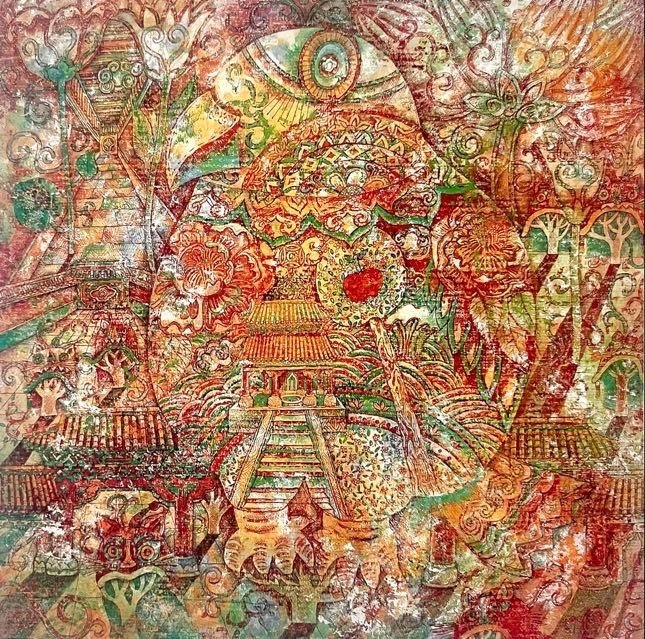
Huang Yi Min was born in Shanghai, China, in 1950. Her artistic journey has been shaped not only by formal education and professional experience, but also by the profound social and cultural changes she witnessed during her formative years. Her work reflects a lifelong relationship with Chinese tradition, memory, imagination, and the visual possibilities that emerge when historical spaces meet everyday life.
At the age of 16, Huang experienced the decade-long Cultural Revolution, a period that profoundly disrupted education and contributed to the widespread rejection of many Chinese cultural traditions. Her own studies were interrupted, and she spent time working as a farmer in the fields. Yet even during those difficult years, her connection with art did not disappear. She continued to practice, observe, learn, and develop an appreciation for the cultural heritage around her.
This experience became an important foundation for her later artistic language. Rather than abandoning tradition, Huang continued to explore it through her imagination. Her paintings would eventually transform familiar elements of Chinese history and architecture into dreamlike scenes where reality and fantasy exist side by side.
From Beijing Normal University to a Professional Artistic Career
Huang Yi Min graduated from the Fine Arts Department of Beijing Normal University, where her artistic abilities developed within a structured academic environment. Her education provided her with an understanding of drawing, composition, and visual expression while strengthening the connection between her artistic practice and the cultural traditions that had fascinated her throughout her life.
After graduation, Huang worked as an art editor at China Children’s Publishing House. The position gave her extensive opportunities to draw character sketches and landscape paintings. Through this continuous practice, she developed a distinctive visual approach that combined traditional Chinese cultural references with a surrealist sensibility.
Her work does not simply reproduce historical subjects. Instead, she reimagines them. Familiar buildings, landscapes, figures, and natural elements can appear in unexpected relationships, creating a sense of wonder and visual tension. The resulting paintings often feel like fragments of a dream recognizable enough to connect with reality, yet transformed enough to invite the viewer into an imaginative world.
In 1997, Huang immigrated to the United States as an outstanding talent. Her move to America introduced another important chapter in her artistic development, allowing her to bring her Chinese cultural memories into a new environment and continue exploring them through painting.
The Forbidden City and Ordinary Life
For nearly two decades, Huang Yi Min has explored a particularly compelling artistic intersection: the meeting point between the famous Ming Dynasty imperial palace complex, the Forbidden City in Beijing, and ordinary residential buildings.
This juxtaposition is central to understanding her artistic vision. The Forbidden City represents history, power, architecture, and China’s imperial past, while ordinary residential buildings evoke everyday life and personal experience. By bringing these contrasting worlds together, Huang creates paintings that exist somewhere between historical memory and contemporary reality.
Her compositions often transform these spaces rather than simply documenting them. Architectural forms become elements within a larger imaginative landscape, while scale and perspective can shift in unexpected ways. Through this process, Huang encourages viewers to consider how history remains present within ordinary life.
Her paintings therefore become more than representations of places. They become reflections on memory itself. The past can appear enormous and monumental in one moment, then intimate and fragile in another. This movement between different scales and realities gives her work its distinctive emotional atmosphere.
“Scenery with Birds”: A Dialogue Between Past and Present
One of Huang Yi Min’s notable works, Scenery with Birds, was created in 1995. The painting was inspired by Tanzhe Temple in Beijing, an ancient Buddhist temple whose history predates the Forbidden City by more than a thousand years.
Huang was fortunate to live at Tanzhe Temple for a week, allowing her to experience its quiet atmosphere and spiritual character firsthand. Rather than treating the temple simply as an architectural subject, she absorbed the atmosphere of the place and transformed that experience into an imaginative composition.
At the heart of the painting is an unusual artistic idea: Huang designed the temple with its 999 halls on a small bird. This striking relationship between the monumental and the miniature creates a powerful contrast of scale. A structure associated with centuries of history becomes connected to something delicate, natural, and seemingly insignificant.
The bird becomes more than a decorative element. It creates a bridge between the vastness of history and the freedom of imagination. By placing an enormous architectural idea within such a small living form, Huang challenges the viewer’s expectations about size, importance, and perspective.
The painting also creates tension between the present and the past. Tanzhe Temple carries the weight of ancient history, while Huang’s imaginative transformation places that history into a new visual context. The result is neither a straightforward historical painting nor a purely abstract fantasy. Instead, it occupies the space between memory and invention.
A Surrealist Language Rooted in Chinese Tradition
What makes Huang Yi Min’s work particularly distinctive is the way she combines surrealist imagination with traditional Chinese cultural references. Her paintings are not detached from history; they emerge from it.
The artist’s early experiences, her years of studying and practicing art, and her professional work as an art editor all contributed to this approach. Traditional architecture, landscapes, figures, and cultural symbols become raw materials for visual experimentation.
Her surrealism is therefore deeply personal. It is not simply about creating strange or impossible images. It is a way of reconsidering familiar cultural memories. By changing scale, combining unrelated spaces, or placing historical architecture into unexpected environments, Huang creates new ways of seeing the past.
This approach also allows her work to communicate across cultures. Viewers familiar with Chinese history may recognize the significance of the Forbidden City, Tanzhe Temple, or traditional architectural forms, while international audiences can still engage with the universal themes of memory, spirituality, imagination, and the passage of time.
Recognition in the United States and Beyond
Huang Yi Min’s artistic achievements have received recognition both in the United States and internationally. Her works have been reviewed by The New York Times, and she received the Anna Walinska Academic Achievement Award in the United States.
Her paintings have also entered significant private and institutional collections. Collectors associated with institutions including the Singapore Art Museum and Hong Kong Museum of Art have collected her work, alongside collections connected with Singapore Simin Art Gallery, the Crystal Art Foundation in New York, New York Chinese Gallery, and the Newark Museum of Art.
Such recognition reflects the broader appeal of Huang’s artistic language. Her paintings connect Chinese cultural heritage with contemporary imagination, creating a visual vocabulary that can speak to audiences far beyond their historical origins.
Painting Memory Into a New Reality
Huang Yi Min’s art can ultimately be understood as an exploration of how memory survives through imagination. Her experiences of cultural change, interrupted education, rural life, formal artistic training, professional illustration, and migration to the United States have all contributed to a body of work deeply connected to both personal and collective history.
Scenery with Birds offers an especially clear example of this approach. The ancient tranquility of Tanzhe Temple becomes the starting point for a fantastical meditation on scale, time, and spirituality. The image of a vast temple imagined upon a small bird captures the essence of Huang’s artistic philosophy: history can be monumental, but imagination can make it intimate.
Through her paintings, Huang Yi Min continues to build a bridge between China’s cultural past and the imaginative possibilities of the present. Her work reminds viewers that traditions do not have to remain frozen in time. They can be remembered, questioned, transformed, and reimagined.
In Huang’s artistic world, ancient architecture can meet ordinary life, enormous histories can rest upon tiny birds, and the boundaries between reality and dreams can dissolve. It is within these spaces of contrast that her paintings find their emotional power and where her enduring dialogue with Chinese culture continues to unfold.
