


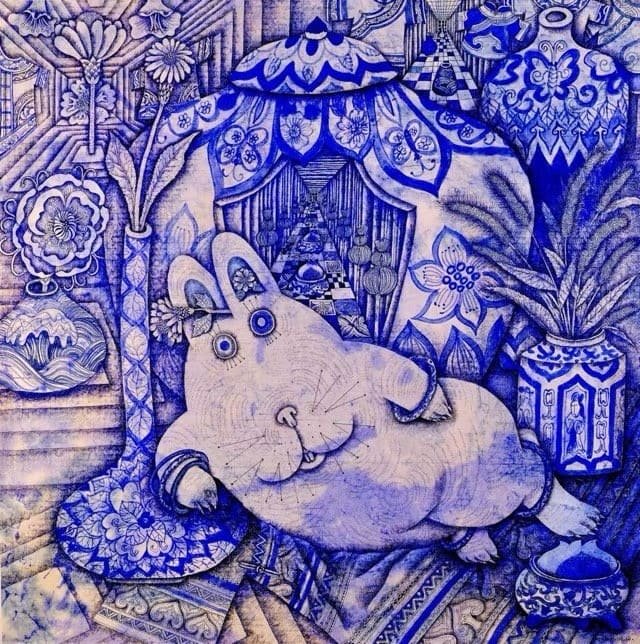
Huang Yi Min, born in Shanghai, China, in 1950, has developed an artistic practice shaped by memory, traditional Chinese culture, personal experience, and an enduring fascination with the relationship between imagination and reality. Her journey as an artist has crossed historical periods and geographical boundaries, eventually leading her from China to the United States, where she continued to develop a distinctive body of work rooted in both Eastern cultural traditions and contemporary artistic expression.
Her experiences during the Cultural Revolution, her education in fine arts, and her years working as an art editor all contributed to a visual language that combines traditional references with surrealist imagination. Across her paintings, Huang transforms familiar cultural symbols, everyday experiences, animals, architecture, and human emotions into scenes that invite viewers to consider deeper questions about memory, compassion, vulnerability, and human nature.
Early Life and the Influence of Chinese History
Born in Shanghai in 1950, Huang Yi Min grew up during a period of profound social and cultural change in China. At the age of 16, she experienced the Cultural Revolution, a decade-long period that interrupted her education and contributed to the widespread rejection of many Chinese cultural traditions.
Despite these circumstances, Huang continued to maintain a strong connection with art and traditional culture. While working as a farmer in the fields, she continued to practice art and develop her understanding through observation and lifelong learning. These experiences became an important part of her artistic foundation, allowing her to preserve a relationship with traditional culture even during a period when many established traditions were being challenged.
Her relationship with Chinese cultural heritage later became an important element of her artistic identity. Rather than simply reproducing traditional imagery, Huang incorporated cultural references into imaginative compositions, allowing the past and present to coexist within her paintings.
Education and the Development of Her Artistic Language
Huang graduated from the Fine Arts Department of Beijing Normal University. Her formal education provided her with a foundation in drawing, painting, and visual expression, while her personal experiences continued to influence the direction of her work.
Following university, Huang worked as an art editor at China Children’s Publishing House. Her professional responsibilities involved continual drawing, including character sketches and landscape paintings. This sustained practice helped her develop an increasingly recognizable visual approach.
Over time, her work evolved toward a surrealist style based on traditional Chinese influences. She brought together elements that might initially appear unrelated, creating compositions in which historical architecture, ordinary life, animals, and imagined situations could occupy the same visual space.
The Forbidden City and Everyday Life
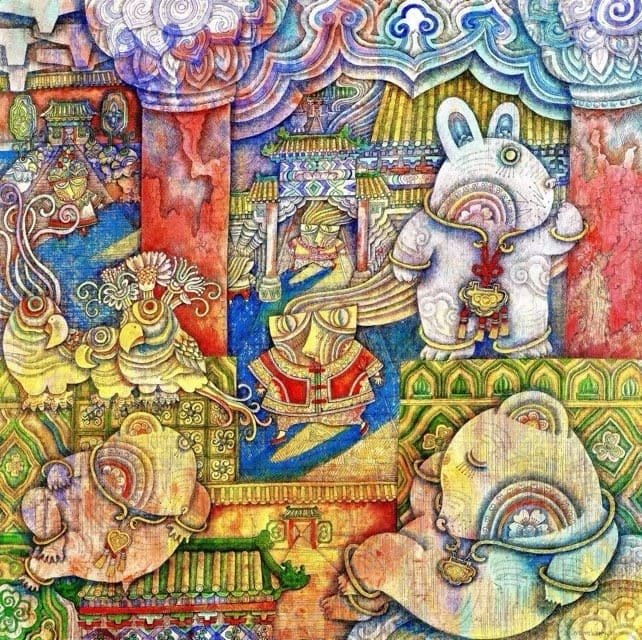
One of the distinctive features of Huang’s work is her use of the space between the extraordinary and the ordinary. Her performance scenes and paintings often draw upon the intersection between the famous Ming Dynasty imperial palace complex, the Forbidden City in Beijing, and ordinary residential environments.
This contrast provides a powerful setting for emotional expression and imagination. The Forbidden City carries associations with Chinese history, imperial culture, architecture, and tradition, while residential buildings represent everyday life and personal experience. By bringing these worlds together, Huang creates a visual space where historical memory and contemporary existence can interact.
For nearly two decades, she developed works around this intersection, using imaginative situations to explore emotional and psychological dimensions of life. Her approach demonstrates how traditional imagery can remain relevant when transformed through personal memory and contemporary artistic imagination.
“Luxury” and the Story of Robert
One of Huang Yi Min’s particularly personal works is Luxury, a painting whose central protagonist is a rabbit. The story behind the work originates from an experience involving her daughter and a pet rabbit named Robert.
When Huang’s daughter was 13, she raised Robert and became deeply attached to him. The rabbit would often lie comfortably in her daughter’s arms. Huang noticed that his posture sometimes resembled the reclining figure in Titian’s Venus of Urbino, creating an unexpected connection between an ordinary domestic animal and one of the most recognizable traditions of Western art history.
The story took a tragic turn during winter. Robert was left on a balcony in the cold, and Huang remembers the experience with regret. After becoming seriously ill, Robert died. Her daughter mourned the rabbit for months, even preserving fur from his tail in an envelope.
For Huang, this memory became more than a story about the loss of a pet. It became an examination of human selfishness, indifference, responsibility, and compassion. She has described her lasting regret over leaving Robert outside in the cold as an important emotional foundation for the painting.
The Rabbit as a Symbol
Following Robert’s death, rabbits began to appear frequently in Huang’s paintings. For the artist, the rabbit represents purity, weakness, agility, and resilience. These qualities allowed the animal to become a recurring symbolic figure through which she could explore aspects of human nature.
In Luxury, the rabbit lies at the center of the composition, its body unfolding through the image in a manner inspired by the reclining form of Venus of Urbino. This artistic connection gives the painting another layer of meaning. A familiar domestic animal becomes connected with an important tradition of Western painting, while the surrounding imagery remains connected to Huang’s Chinese cultural background.
The painting also includes a blue-and-white porcelain vase, an object associated strongly with Chinese artistic and decorative traditions. Its presence creates a dialogue between the delicate beauty of Chinese porcelain, the history of European painting, and the intimate story of a family pet.
Between Human Emotion and Imagination
Huang’s work demonstrates how seemingly simple subjects can carry complex emotional meanings. Animals in her paintings are not merely decorative elements. They can become embodiments of vulnerability, affection, memory, and endurance.
Her rabbits and cats, particularly in works created between 1995 and 2000, represent characters that the artist viewed as more realistic, resilient, and lovable than humans. Through them, she could explore human behavior indirectly, allowing animals to become mirrors for human emotions and contradictions.
This approach is central to Huang’s surrealist language. Rather than separating imagination from reality, she allows the two to overlap. Personal memories become visual narratives, historical references become contemporary symbols, and ordinary experiences become subjects for deeper reflection.
Recognition in China, Singapore, and the United States
Huang’s artistic career eventually expanded beyond China. In 1997, she immigrated to the United States as an outstanding talent, continuing her artistic practice in a new cultural environment.
Her work has attracted attention internationally, including reviews in The New York Times. She was also awarded the Anna Walinska Academic Achievement Award in the United States.
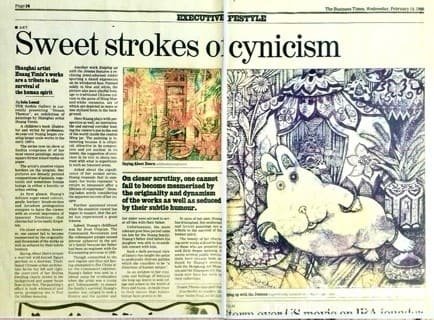
Luxury achieved significant attention following Huang’s personal art exhibition in Singapore. The work was collected by the Hong Kong Museum of Art and was featured in a major color review in The Straits Times. American critic Lora Renzi also wrote an extensive commentary on the work, offering observations on its exploration of human nature. For Huang, the response was deeply meaningful and encouraged her to continue developing her artistic practice.
Her works have also entered collections associated with institutions, galleries, directors, and private collectors, including the Singapore Art Museum, Hong Kong Museum of Art, Singapore Simin Art Gallery, New York Crystal Art Foundation, New York Chinese Gallery, and the Newark Museum of Art.
A Continuing Dialogue Between Cultures
Huang Yi Min’s art reflects a life lived across changing historical and cultural landscapes. Her experiences in China, her relationship with traditional culture, her education, immigration to the United States, and her encounters with Western art have all contributed to a practice that resists simple categorization.
Through surreal compositions, historical references, animals, architecture, and personal memories, she creates works in which different cultural traditions can exist together. Luxury demonstrates this approach particularly clearly. The memory of a beloved rabbit becomes connected to Titian, Chinese porcelain, family grief, and questions about human responsibility.
For Huang, art is therefore not only an exercise in visual beauty. It is also a means of preserving memory, confronting regret, and transforming personal experience into a broader reflection on humanity. Her paintings invite viewers to look beyond their immediate imagery and consider the emotional stories hidden within them. In doing so, Huang Yi Min continues to build a distinctive artistic language where Chinese tradition, surrealist imagination, and deeply personal experience meet.
