


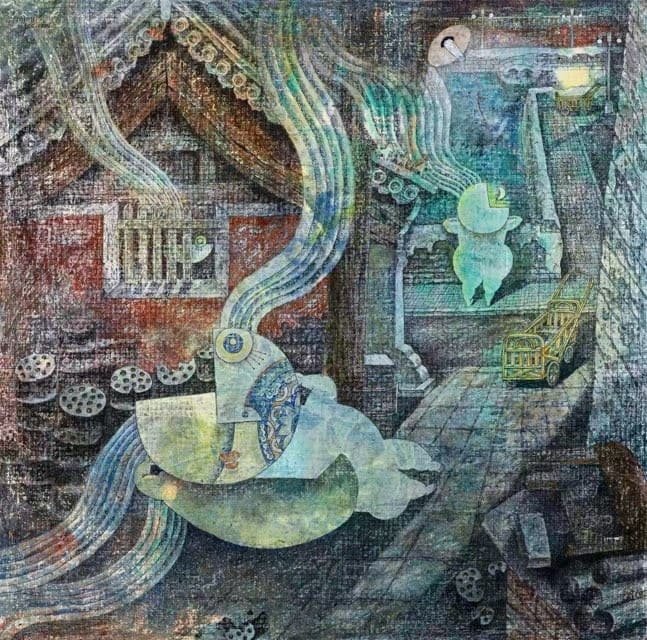
Huang Yi Min was born in Shanghai, China, in 1950. Her artistic journey developed through periods of dramatic social change, personal experience, and a deep connection to Chinese cultural traditions. She graduated from the Fine Arts Department of Beijing Normal University, building an artistic foundation that would later inform her distinctive approach to painting and visual expression.
At the age of sixteen, Huang experienced the decade-long Cultural Revolution, a period that interrupted her studies and contributed to widespread rejection of traditional Chinese cultural values. Yet even during these difficult years, her relationship with art did not disappear. While working as a farmer in the fields, she continued to practice, observe, learn, and engage with the traditions that remained important to her.
This experience became an important part of the perspective she eventually brought to her artistic practice. Rather than viewing culture as something distant or preserved only in museums, Huang encountered it through everyday life, memory, hardship, landscapes, architecture, and human experience.
From Art Education to Professional Practice
After graduating from university, Huang Yi Min worked as an art editor at China Children’s Publishing House. The position gave her an opportunity to continually draw character sketches and landscape paintings while developing her visual language.
Her practice gradually formed a surrealist style rooted in traditional Chinese influences. Rather than separating imagination from reality, Huang began bringing the two together. Familiar places, historical environments, and ordinary people could become transformed through emotional interpretation and imaginative composition.
This approach allowed her to explore not only what a place looked like, but also what it represented. History, memory, social change, and individual emotion could coexist within the same visual space.
The Forbidden City and the Everyday World
One of the defining elements of Huang Yi Min’s artistic practice is her interest in the meeting point between the monumental and the ordinary. Her performance scenes were often situated at the intersection of Beijing’s famous Ming Dynasty imperial palace complex, the Forbidden City, and ordinary residential buildings.
The contrast offered Huang a rich visual and emotional territory. The Forbidden City carries associations of imperial history, cultural heritage, and grandeur, while the surrounding residential spaces represent everyday existence. By bringing these worlds together, Huang found a way to explore the relationship between nobility and simplicity, historical memory and contemporary life.
For nearly two decades, this intersection became an important setting for her emotional expression and imagination. Her work does not simply document these places. Instead, she transforms their contrasts into an artistic language through which the past and present can interact.
Finding Beauty Beyond Perfection
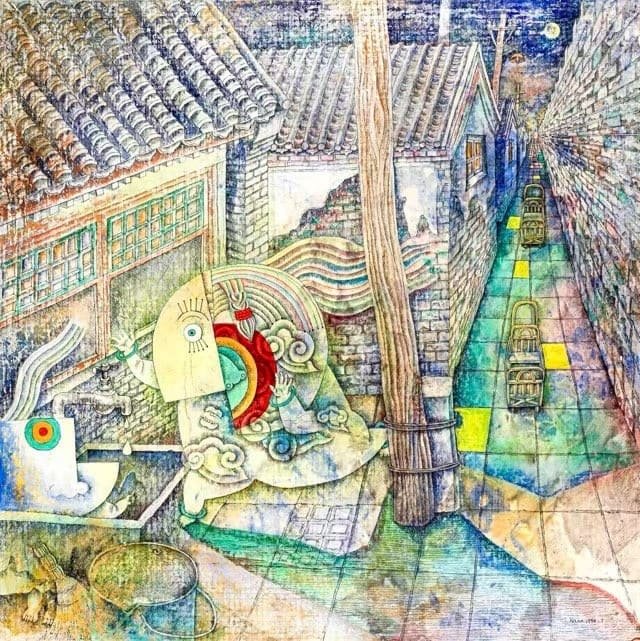
Huang’s reflections on her work Winter Carnival reveal an important aspect of her aesthetic philosophy. She is drawn toward people and environments that carry evidence of difficulty rather than polished perfection.
For Huang, suffering can leave behind a depth that cannot easily be reproduced. A wound hidden beneath the surface may become a source of poetic feeling, memory, and emotional truth. This perspective leads her away from idealized images of prosperity and toward the imperfect realities of ordinary life.
Her aesthetic rejects what she sees as artificial perfection. Instead of being attracted to surfaces that appear flawless and successful, she finds meaning in places where people have little reason or desire to pretend.
This philosophy gives her work a distinctive emotional character. A small makeshift shelter, scattered objects, piles of discarded materials, or ashes lying on the ground can become meaningful visual elements. What might ordinarily be considered signs of poverty, disorder, or neglect can reveal another kind of beauty when viewed through Huang’s artistic perspective.
Winter Carnival: A Celebration of Reality
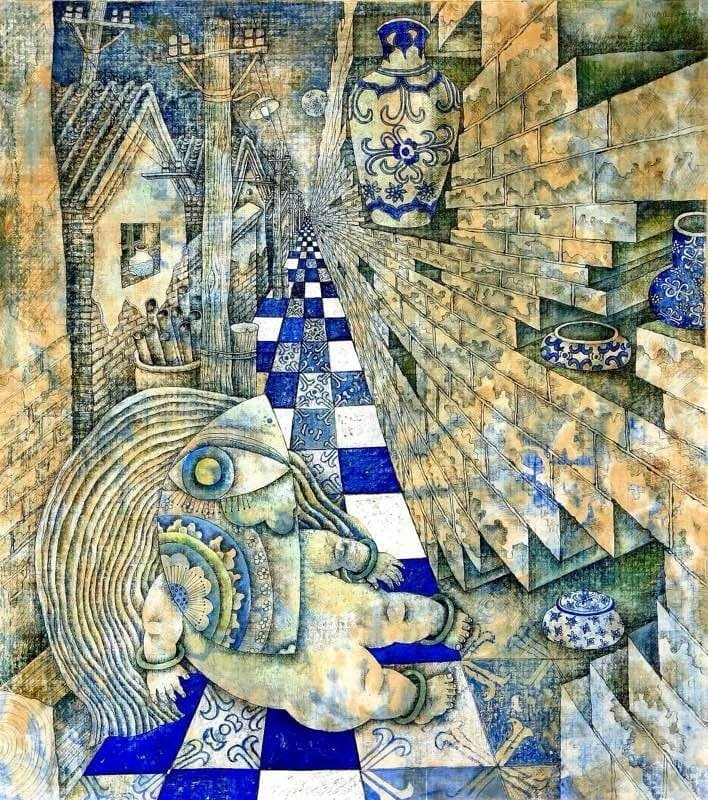
In Winter Carnival, Huang Yi Min turns this philosophy toward the physical and emotional landscape of the old hutongs around the Forbidden City.
The title suggests celebration, yet the world she describes is far removed from conventional images of a carnival. Instead of spectacle and polished surfaces, Huang discovers a quieter and more complicated beauty in scarcity, practicality, age, and imperfection.
The hutongs contained exactly the qualities that attracted her artistic sensibility. They carried profound historical associations while also showing the effects of long neglect. They were inhabited by modern people whose lives were intertwined with the old structures around them.
Every brick and stone could therefore hold several meanings at once. The buildings represented history and the present, grandeur and humility, permanence and change. This intense contrast became central to Huang’s fascination with the environment.
For her, the hutongs were not simply architectural spaces. They were living witnesses to changing generations and changing values. People lived and died among them, sharing their environment and becoming part of its continuing story.
The resulting visual world was neither entirely historical nor entirely contemporary. It existed between the two, creating a space where memory, imagination, and reality could meet.
The Loss of a Historical Landscape
The connection between Huang and the Forbidden City hutongs was ultimately shaped by their disappearance. In 1997, the hutongs were demolished, and after reconstruction, the environment that had inspired Huang was gone.
This loss adds another layer of meaning to Winter Carnival. The work becomes connected not only to a physical place but also to memory. Once the original surroundings disappeared, the artwork could serve as a way of preserving the emotional experience associated with them.
Huang’s approach demonstrates how art can become a form of remembrance. Buildings may be demolished, neighborhoods transformed, and familiar landscapes replaced, but the emotional impressions created by those places can continue through artistic expression.
Recognition and Collection
Huang Yi Min’s work has received recognition beyond her native China. In 1997, she immigrated to the United States as an outstanding talent, continuing her artistic development within a new cultural environment.
Her work received reviews from The New York Times, and she was awarded the Anna Walinska Academic Achievement Award in the United States. Her works have also entered private and institutional collections associated with figures and organizations in the international art world.
Among the collections connected with her work are the Singapore Museum of Art, Hong Kong Museum of Art, Singapore Simin Art Gallery, New York Crystal Art Foundation, New York Chinese Gallery, the Newark Museum of Art, and private collectors.
A Surrealist Language Rooted in Memory
Huang Yi Min’s artistic practice brings together traditional culture, personal history, surrealist imagination, and observations of ordinary life. Her work demonstrates how an artist can find profound meaning in spaces that might otherwise be overlooked.
The emotional power of her work comes from its refusal to treat history as something separate from everyday existence. In her paintings and artistic scenes, grand cultural heritage can stand beside humble surroundings, while memory can exist alongside change.
Through this perspective, Huang transforms imperfection into a source of beauty and neglected environments into spaces of emotional significance. Winter Carnival particularly captures this sensibility, preserving the atmosphere of a vanished landscape and the complicated feelings it inspired.
Her art ultimately asks viewers to look beyond appearances. What seems broken may contain memory. What appears ordinary may carry history. And what has been discarded or forgotten may reveal a beauty that polished perfection can never fully express.
