


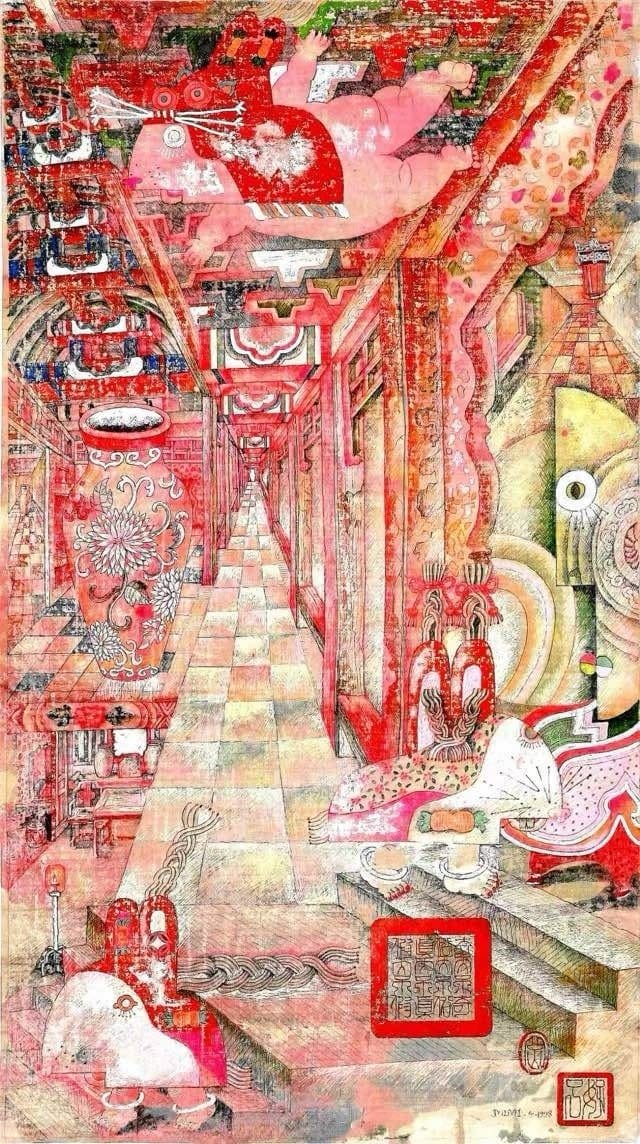
Born in Shanghai, China, in 1950, Huang Yi Min is an artist whose work brings together Chinese cultural heritage, personal memory, and surrealist imagination. Educated in the Fine Arts Department of Beijing Normal University, Huang developed an artistic perspective shaped by both formal training and the profound social changes that marked his early life. His experiences during the Cultural Revolution, which began when he was sixteen, interrupted his studies and unfolded against a broader rejection of traditional Chinese cultural values. Yet this period also deepened his relationship with art, learning, and the cultural traditions that would remain central to his practice.
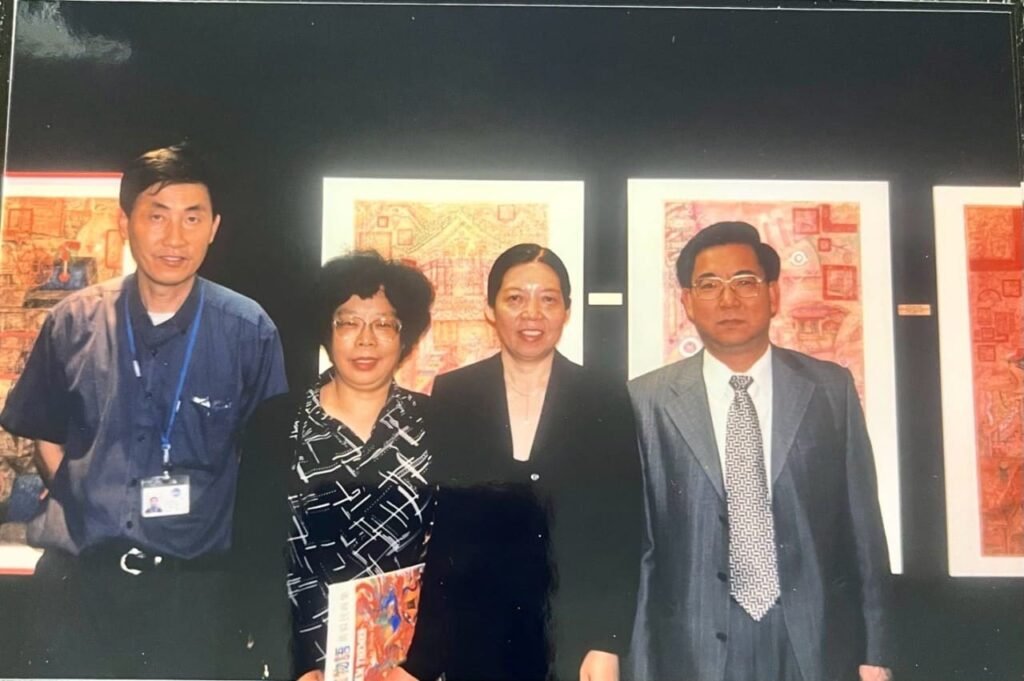
While working as a farmer in the fields, Huang continued to cultivate his artistic interests. This commitment to learning under difficult circumstances became an important part of his creative development. Rather than abandoning the cultural inheritance surrounding him, he maintained a lasting engagement with its stories, symbols, and philosophical questions. Art became a means of preserving a personal connection to tradition while developing an imaginative language through which to examine human experience.
After graduating from university, Huang worked as an art editor at China Children’s Publishing House. The position provided opportunities to produce character sketches and landscape paintings, strengthening his observational skills and expanding his visual vocabulary. Over time, these experiences contributed to the development of a surrealist approach grounded in traditional Chinese culture. His paintings would increasingly explore the space between recognizable environments and imagined realities, allowing historical references and emotional associations to coexist within a single composition.
Between the Forbidden City and Everyday Life
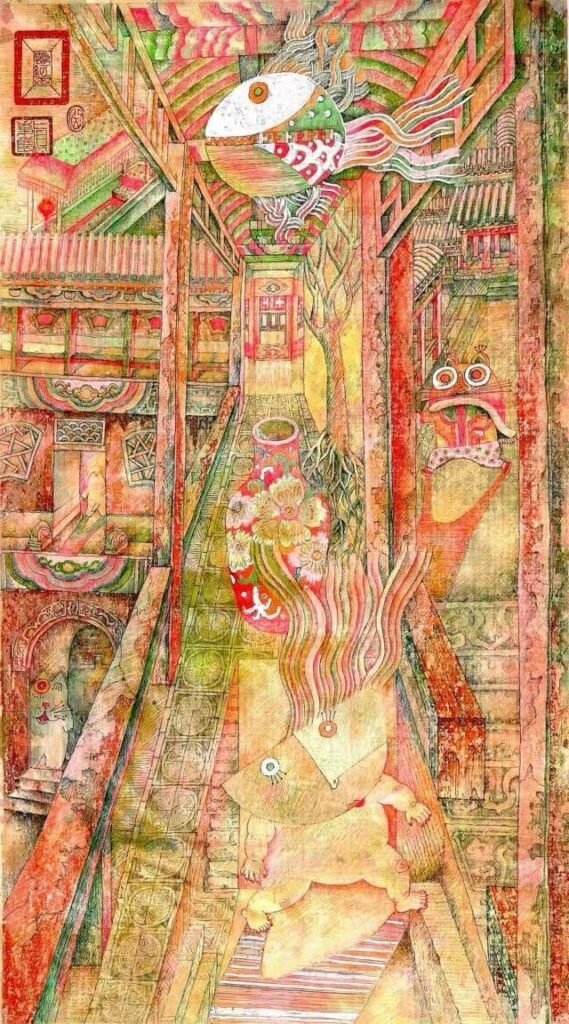
A defining feature of Huang’s artistic practice is his engagement with the contrast between Beijing’s Forbidden City, the celebrated imperial complex of the Ming dynasty, and the ordinary residential environments that surround it. These distinct settings provide more than architectural references. They establish a visual and conceptual meeting point between China’s historical grandeur and the intimate realities of contemporary life.
For nearly two decades, Huang has explored this intersection through compositions shaped by emotional expression and imaginative transformation. His work draws on the visual memory of traditional Chinese environments while moving beyond straightforward representation. Familiar architectural elements can become part of a dreamlike world in which the boundaries between history, memory, and fantasy remain open.
Surrealism offers Huang a way to approach cultural heritage without treating it as something fixed or distant. Instead, tradition becomes a living resource that can be reconsidered through individual experience. His paintings invite viewers to recognize familiar cultural references while remaining open to unexpected forms, unusual relationships, and ambiguous meanings. Through this approach, the historical landscape becomes a setting for personal reflection rather than simply a record of the past.
Dream of the Red Chamber: Art as an Exploration of Love
One of Huang’s most significant artistic projects draws inspiration from Dream of the Red Chamber, the celebrated Chinese novel associated with Cao Xueqin. The literary work’s exploration of love, longing, social expectations, and impermanence provides a foundation for Huang’s sustained visual investigation of human relationships.
The artist has returned to the novel repeatedly throughout his life, reading it six times and creating multiple bodies of work in response to its emotional and philosophical complexity. His first encounter with the story occurred at the age of sixteen, when its treatment of love left a lasting impression. In his reflections, Huang describes love as a territory that cannot be touched or possessed in ordinary terms, an idea that has continued to inform his interpretation of the novel.
Subsequent readings transformed his understanding of the story, particularly as his own experiences changed. By the fifth reading, he had encountered what he describes as a profound connection with another person, an experience that altered how he understood the emotional dimensions of the text. Literature, in this sense, became inseparable from the passage of time and the evolving nature of personal experience.
His painting Dream of the Red Chamber translates these concerns into a distinctive visual language. A warm palette of pink and pink-green tones creates a muted, warm-gray atmosphere, while the pearl-sand-red of a carved Chinese seal introduces a striking accent. The seal bears the words “Fu Ji is absurd” and “Meeting in a big dream brings comfort to those who have been heartbroken,” connecting the painting to questions of illusion, consolation, and the emotional contradictions of love.
Although the work employs an abstract language that can appear cool and rational, its unusual small animals and dreamlike imagery introduce an unsettling dimension. These figures resist straightforward interpretation, creating tension between the painting’s visual strangeness and its underlying emotional warmth. From a distance, the imagined landscape becomes a place of beauty and longing, suggesting that love remains a pursuit worthy of a lifetime, even when its promises are uncertain.
Me and You: Toward a Landscape of Emotional Freedom
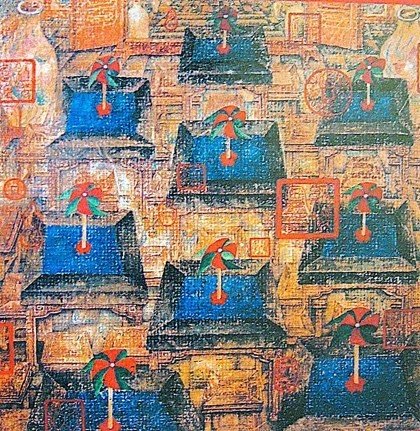
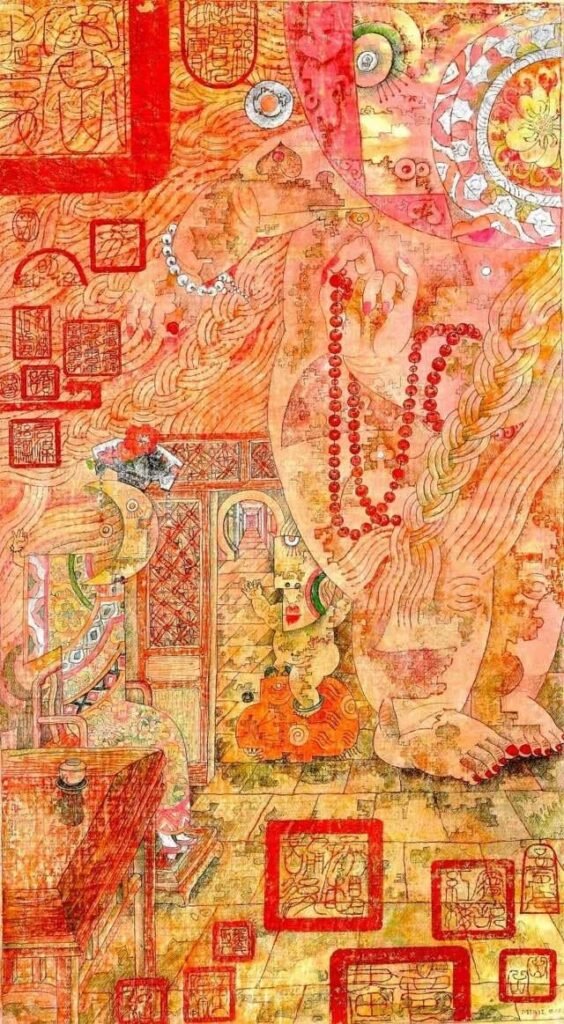
Huang’s continuing engagement with Dream of the Red Chamber has developed into a new project titled Me and You. In this body of work, abstract fragments of love gradually take on human form, creating a visual language that moves between abstraction and recognizable experience.
The project reflects the artist’s interest in the possibility of emotional honesty. Huang imagines a landscape of freedom in which individuals can set aside their social masks and encounter themselves and others more truthfully. Rather than presenting love as an uncomplicated ideal, his work approaches it as a complicated process of recognition, vulnerability, and change.
This emphasis on emotional freedom connects his literary inspiration to his broader artistic concerns. Just as his surrealist paintings bring historical architecture into conversation with everyday environments, Me and You brings abstract ideas into contact with human relationships. In both cases, meaning emerges through the coexistence of seemingly different realities.
Exhibitions, Recognition, and International Collections
Huang’s work has received international attention through exhibitions, critical coverage, and inclusion in private and institutional collections. His solo exhibition, Dream of Red Mansions, was held at the United Nations Secretariat Building in New York in 2001 and at the Crystal Foundation in New York in 2002. Both presentations attracted attention from different sectors of the New York art community and received media coverage.
His artistic achievements have also been recognized through the Anna Walinska Academic Achievement Award in the United States. According to the artist’s biography, his work has received reviews from The New York Times and entered collections associated with the Singapore Art Museum, Hong Kong Museum of Art, Simin Art Gallery in Singapore, Crystal Art Foundation in New York, and New York Chinese Gallery. Collectors also include the director of the Newark Museum of Art and private collectors.
These exhibitions and collections reflect the reach of a practice rooted in Chinese cultural experience but engaged with questions that extend beyond national and historical boundaries.
A Continuing Dialogue Between Memory and Imagination
Huang Yi Min’s artistic journey demonstrates how cultural inheritance can remain a source of creative discovery across changing circumstances. From the disruption of his early education to his professional work in publishing and his later exhibitions in the United States, he has continued to explore the relationship between tradition and individual expression.
His paintings bring together architectural memory, surrealist imagery, literary inspiration, and the emotional complexity of human relationships. Through his sustained engagement with Dream of the Red Chamber, Huang transforms a foundational work of Chinese literature into an evolving visual inquiry into love, illusion, and freedom.
Ultimately, his art proposes that tradition need not be preserved through repetition alone. It can be reimagined, questioned, and experienced anew. Within Huang’s dreamlike worlds, the past remains present, imagination opens unfamiliar possibilities, and love becomes an enduring search for truth, connection, and a place where human experience can be expressed without disguise.
