


Don Schwab is a Slovenian painter whose artistic journey has developed around a long-running project known as Liminal Archives. Born in 1965 in Slovenia, Schwab has spent more than three decades developing a visual language that explores the boundaries between memory, civilization, matter, and realities that remain beyond ordinary perception.
Rather than approaching his paintings as isolated works or unrelated collections, Schwab sees Liminal Archives as one continuously evolving project. Each series contributes another fragment to a larger visual universe, allowing ideas, symbols, forms, and discoveries from earlier stages to return in altered ways. The result is an artistic practice that feels less like a conventional body of work and more like an ongoing excavation.
Schwab describes himself as a cosmic archaeologist, a phrase that captures the distinctive perspective behind his paintings. His work imagines the canvas as a site where fragments of unknown histories can be uncovered, examined, and connected to possibilities that have yet to be understood.
Experiences Between London and Amsterdam
Between 1983 and 1993, Schwab lived and worked in London and Amsterdam. These years played an important role in broadening his artistic outlook, exposing him to different cultural environments and expanding the visual and conceptual possibilities within his practice.
Living in two major European cities during this formative period provided Schwab with experiences that could be absorbed into his developing understanding of art, architecture, society, and the relationship between the familiar and the unknown. Instead of leading toward a fixed artistic formula, these experiences appear to have contributed to a practice that remains open to transformation.
That openness has continued throughout Liminal Archives. Schwab does not appear interested in reaching a final destination. Instead, each painting can become another stage in a process of discovery, with new visual elements emerging from the interaction between what has already been found and what remains unexplored.
Painting as a Recovered Fragment
A central idea in Schwab’s practice is the notion that a painting can function like a recovered fragment. His works suggest that what appears on the canvas may be part of a much larger history, even when that history cannot be clearly identified.
Architectural structures, organic matter, human or fragmented figures, symbols, and atmospheric abstractions occupy the same visual space. These elements can appear familiar individually, yet their combinations resist straightforward interpretation. They create environments that seem to belong simultaneously to the past, present, and an imagined future.
This approach allows Schwab to avoid fixed narratives. Rather than telling viewers exactly what a particular image means, he creates conditions in which multiple possibilities can coexist. A structure might suggest a forgotten civilization. A figure might appear as evidence of an unknown encounter. A beam of light might function as a physical phenomenon, a symbolic intervention, or something that belongs to a reality beyond the visible world.
The uncertainty is an important part of the experience.
From Awakening to Prespatial and Convergence
Over the decades, Liminal Archives has moved through interconnected stages including Awakening, Prespatial, and Convergence. These titles suggest a practice concerned with emergence, dimensions beyond conventional space, and the coming together of previously separated elements.
The individual stages do not operate as closed chapters. Instead, earlier discoveries continue to influence later paintings. Forms and ideas can return, change, fragment, or become part of something new. This creates continuity without repetition.
Schwab’s visual universe therefore remains in motion. The archive grows as new paintings introduce additional fragments, while earlier material continues to inform the direction of the project. The process resembles an archaeological investigation in which every discovery raises another question.
Under New Management: A World in Transformation
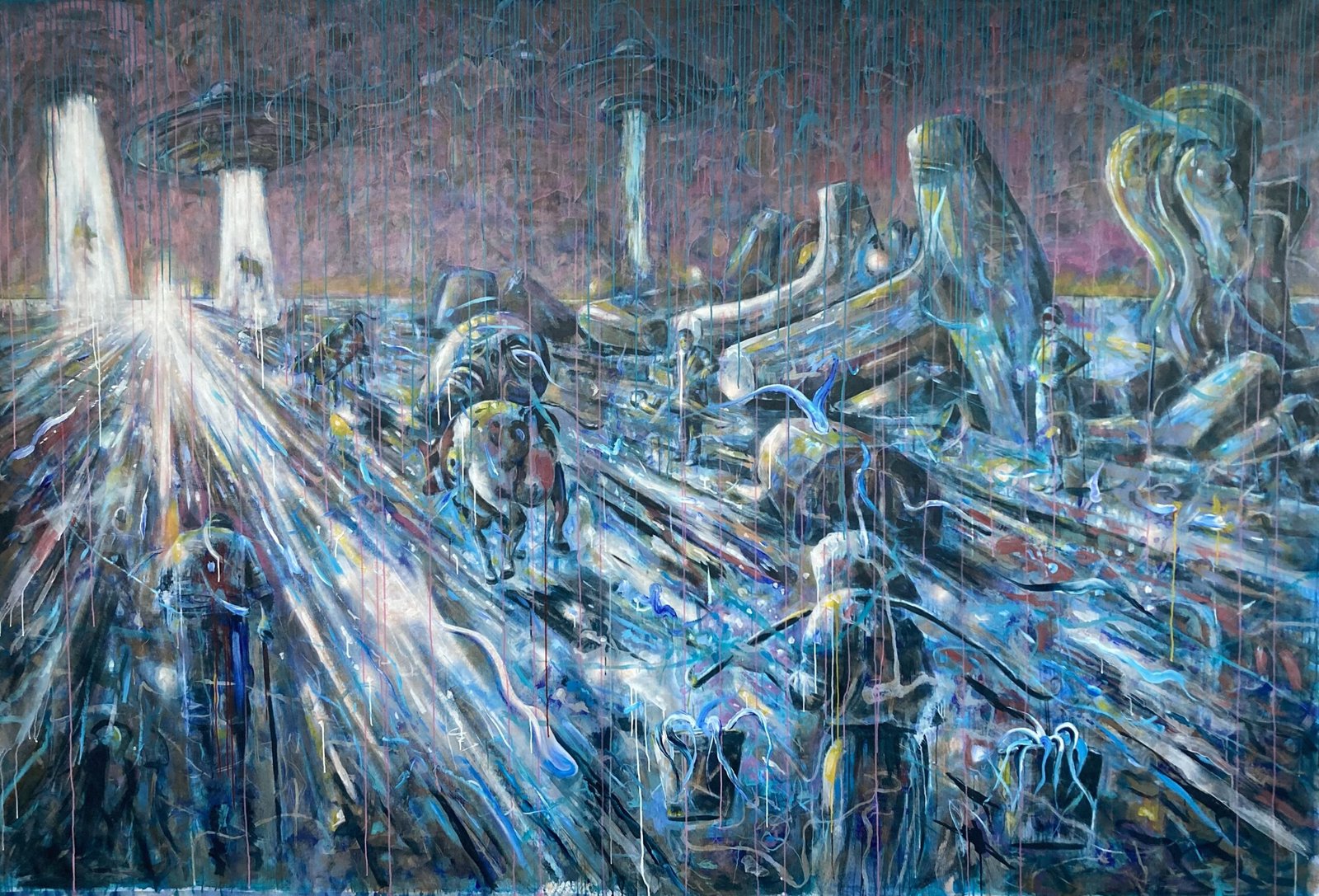
One example of this evolving approach is Under New Management, a work from the Liminal Archives project within Continuum. Created in acrylic on canvas and measuring 200 × 330 cm, the painting presents an expansive and unstable environment caught between collapse and transformation.
Streams of light move through monumental structures, fragmented figures, and organic forms. The composition suggests that an unfamiliar order may be taking control, although the nature of that order remains deliberately unclear.
Rather than presenting a conventional scene with a beginning, middle, and conclusion, Under New Management feels like a moment extracted from a much larger process. The viewer encounters a world in transition, where established structures appear unstable and different forms of existence seem to overlap.
The scale of the canvas reinforces this impression. At 200 × 330 cm, the work provides Schwab with a substantial field in which architectural, organic, figurative, and abstract elements can interact. The painting can be approached as a landscape, an archaeological site, a fragment of another civilization, or an environment belonging to a reality that does not follow familiar rules.
Continuum and the Flow of Memory
Within Continuum, Under New Management becomes a suspended moment in a larger cycle. Civilization appears to be reorganizing itself, while memory, matter, and energy move through the composition toward an unresolved future.
The title itself introduces a sense of transition. Something has changed, but the consequences of that change are not yet known. The phrase “Under New Management” can suggest political, social, technological, or even cosmic transformation, but Schwab does not reduce the painting to any single interpretation.
Instead, the work maintains an open-ended quality. Light passes through structures. Forms appear to emerge and disappear. Organic and architectural elements occupy the same environment. The viewer is left to consider whether the scene represents the remains of something that has already happened or the beginning of something that has yet to occur.
This ambiguity allows the painting to operate on several levels at once.
A Cosmic Archaeologist at Work
Schwab’s description of himself as a cosmic archaeologist provides a useful way of approaching Liminal Archives. Archaeology traditionally deals with traces left behind by civilizations, cultures, and individuals. Schwab extends this idea into an imaginative territory where the traces may belong to vanished civilizations, unknown histories, or realities outside conventional perception.
His paintings do not attempt to reconstruct these imagined histories literally. Instead, they preserve their fragments. Symbols remain unexplained. Figures are incomplete. Architecture appears without a clearly identifiable civilization. Atmospheric fields connect objects that might otherwise belong to entirely different worlds.
The paintings therefore become spaces for investigation rather than definitive explanations.
An Archive Without a Final Chapter
Don Schwab’s Liminal Archives continues to develop as an interconnected visual universe rather than a completed collection. More than thirty years into the project, the paintings remain open to new forms, discoveries, and interpretations.
His practice demonstrates how painting can operate as a form of speculative archaeology, using fragments rather than explanations and atmosphere rather than fixed narratives. Through mixed media and an evolving combination of architecture, organic matter, figures, symbols, and abstraction, Schwab creates worlds that feel simultaneously ancient, contemporary, and yet to come.
Under New Management embodies this approach particularly clearly. Its monumental scale and shifting forms present a civilization suspended between what was and what might become. It is not a resolved story, but a fragment from a larger continuum.
For Schwab, that incompleteness is not a limitation. It is the space where discovery remains possible. As Liminal Archives continues to expand, each new painting adds another piece to an ever-growing universe, inviting viewers to look beyond what is immediately visible and imagine what might exist just beyond the edge of the known.
