


Beat Canonica is a contemporary Swiss artist whose work reflects an extraordinary blend of emotional depth, intellectual curiosity, and expressive freedom. Born on August 4, 1972, in Winterthur, Switzerland, Canonica has spent decades developing a highly personal artistic language rooted in experimentation, symbolism, and introspection. His journey as an artist is not defined by traditional academic pathways alone, but by a lifelong commitment to observation, self-discovery, and creative exploration.
Raised in Uster in the Canton of Zurich and later living in different parts of Zurich before settling in Oberwinterthur in 2020, Canonica’s environment has played an important role in shaping his artistic perspective. The urban rhythms of Swiss city life, combined with moments of solitude and contemplation, appear throughout his work in both subtle and direct ways. His art captures emotional complexity while remaining deeply human and accessible.
Self-taught in drawing, calligraphy, and painting, Canonica gradually cultivated his own distinct style that incorporates signs, writings, abstract forms, and expressive gestures. Although largely self-directed, he also pursued courses at the Zurich University of the Arts and the F&F School of Art and Design in Zurich, experiences that further refined his technical and conceptual understanding of visual expression.
What makes Canonica particularly compelling is the breadth of his interests beyond painting. His background includes studies in business administration, psychology, improvisational theater, and recovery coaching. He is also passionate about literature, music, languages, poetry, photography, and performance. This multidisciplinary engagement enriches his artistic practice and gives his work an unmistakable emotional and intellectual dimension.
Art as an Extension of Human Experience
Since 1997, Beat Canonica has consistently created artworks using a wide range of materials, including acrylics, charcoal, oil, graphite, lacquer, pastels, and colored pencils. His willingness to move between mediums reflects an artist who is less concerned with rigid stylistic boundaries and more interested in emotional authenticity.
Throughout the years, he has independently organized numerous exhibitions in cities such as Zurich, Winterthur, Uster, and Fribourg. His participation in international art competitions, including the renowned ArtPrize Luxembourg, demonstrates both his commitment to artistic growth and the increasing recognition of his work beyond Switzerland.
Canonica’s artistic approach often embraces abstraction while maintaining emotional immediacy. His works do not merely aim to represent reality; they seek to evoke states of feeling, memory, vulnerability, and transformation. The viewer is invited not only to observe but to emotionally participate in the artwork.
This openness is perhaps connected to the artist’s broader understanding of human psychology and communication. His experiences in improvisational theater and his studies in psychology contribute to an awareness of emotional nuance, gesture, silence, and perception. As a result, many of his artworks feel deeply alive, almost theatrical in their emotional movement.
“A Blind Who Sees The Flowers” as an Oeuvre of Inner Perception
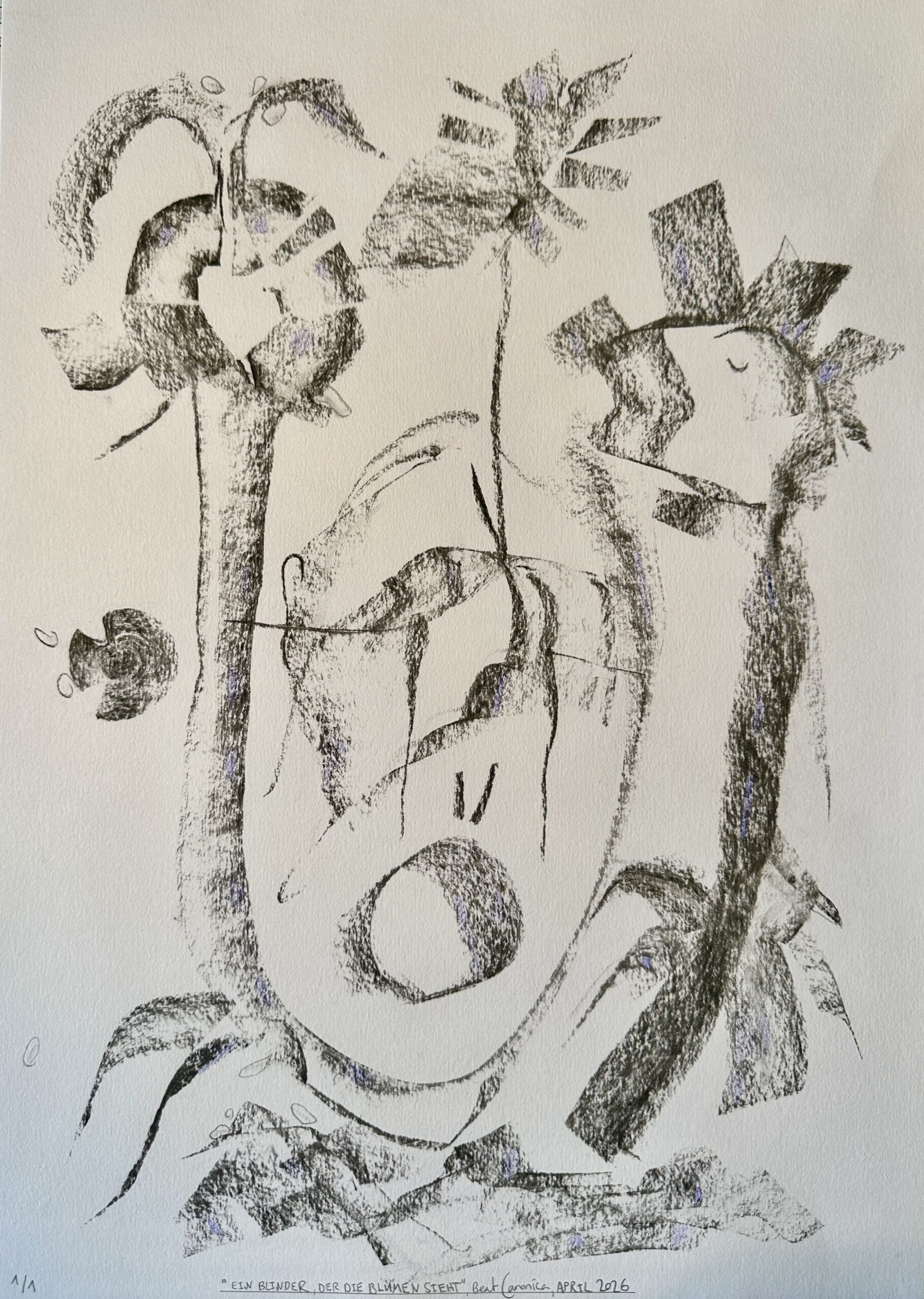
The oeuvre Ein Blinder, der die Blumen sieht (“A Blind Who Sees the Flowers”) stands as a profound meditation on perception, sensitivity, and the invisible dimensions of human experience. Rather than referring to a single artwork alone, the term “oeuvre” suggests a broader artistic expression and conceptual body of work that reflects Canonica’s philosophical and emotional concerns.
Created using charcoal, polymer colored pencils, and graphite, the oeuvre immediately draws the viewer into an atmosphere of emotional ambiguity and poetic introspection. Rather than presenting literal imagery, Canonica constructs an abstract visual language that encourages contemplation and personal interpretation.
The charcoal establishes the emotional foundation of the composition. Deep, fluid strokes create movement and atmosphere, giving the forms a sense of organic vitality. The lines seem to shift between recognizable figures and abstract energies, allowing the viewer to move freely through the emotional space of the work.
Against these darker tonal structures, the colored pencils introduce subtle moments of brightness and fragility. The colors emerge softly, suggesting the emotional presence of flowers rather than botanical realism. Through this restrained use of color, Canonica captures the sensation of beauty being felt internally rather than simply observed externally.
Graphite details provide moments of precision and structure within the otherwise fluid composition. This balance between softness and definition creates a visual tension that mirrors the relationship between emotional intuition and rational understanding.
The Symbolism of Blindness and Inner Vision
The title Ein Blinder, der die Blumen sieht carries extraordinary poetic depth. It challenges conventional assumptions about seeing and perception, suggesting that true awareness extends beyond physical sight. In Canonica’s interpretation, beauty and meaning can be experienced through emotion, touch, intuition, memory, and spiritual sensitivity.
Within the abstract forms, human and floral elements appear intertwined, symbolizing the interconnectedness between humanity and nature. A central figure seems to embrace or protect a flower, reinforcing the idea that emotional connection can transcend visual understanding.
The oeuvre encourages viewers to reconsider what it means to truly “see.” Modern life often prioritizes surfaces and appearances, but Canonica’s work proposes a more profound form of perception rooted in empathy and emotional presence. Blindness in this context becomes symbolic not of limitation, but of another mode of understanding the world.
This poetic inversion gives the work its emotional power. The blind figure becomes someone capable of perceiving beauty on a deeper level, beyond distraction and superficial observation. Through this idea, Canonica creates a moving reflection on compassion, awareness, and human sensitivity.
A Multidisciplinary Artistic Spirit
Beyond visual art, Beat Canonica continues to engage with numerous creative disciplines. His interests in haiku poetry, short stories, photography, and music reveal an artist constantly searching for new forms of expression. He plays instruments including piano, flute, harmonica, guitar, and xylophone, occasionally performing in private settings.
His presence on social media further demonstrates his versatility. Through platforms such as Instagram and TikTok, Canonica shares not only artworks but also elements of performance, humor, and physical comedy. This ability to move between seriousness and playfulness reflects an artist comfortable embracing the full spectrum of human emotion.
Rather than limiting himself to a single artistic identity, Canonica exists as a multidisciplinary creator whose work is informed by observation, psychology, literature, sound, and performance. This layered creative practice gives his art remarkable depth and individuality.
The Continuing Evolution of an Independent Artist
Beat Canonica represents the spirit of the independent contemporary artist: self-directed, exploratory, and deeply committed to authentic expression. His creative journey demonstrates that meaningful art can emerge from varied life experiences and emotional honesty rather than rigid artistic conventions alone.
Through the oeuvre Ein Blinder, der die Blumen sieht, Canonica invites viewers into a world where perception becomes emotional rather than purely visual. His work encourages reflection on empathy, connection, identity, and the unseen dimensions of human experience.
In a world increasingly dominated by speed and surface imagery, Canonica’s art offers something quieter and more enduring. It reminds viewers that beauty often exists not in certainty, but in sensitivity, vulnerability, and emotional resonance. His work asks audiences not simply to look, but to experience and feel more deeply.
