


Neil David Field-Williams is a British contemporary artist whose work navigates the complex intersection of structure, symbolism, and psychological narrative. Working primarily through large-scale oil painting, his practice examines how classical compositional principles can still function within the fragmented emotional and cultural conditions of contemporary life. Through a distinctive Neo-Formalist approach, Field-Williams creates paintings that are intellectually rigorous while remaining emotionally resonant, inviting viewers into spaces shaped by uncertainty, memory, and moral ambiguity.
Emerging from the Bristol street-art scene during the late 1980s and early 1990s, Field-Williams developed an early understanding of visual communication through direct engagement with public space. That environment, charged with social tension and rapid cultural transformation, informed his awareness of how imagery can operate both aesthetically and politically. The immediacy of street culture left a lasting imprint on his artistic sensibility, even as his later work evolved toward highly refined figurative oil painting. Rather than abandoning the urgency of those early experiences, he transformed them into a more contemplative visual language grounded in atmosphere, symbolism, and psychological depth.
Alongside his studio practice, Field-Williams has spent nearly four decades working within UK education. His extensive involvement in teaching, lecturing, and international workshops has shaped a disciplined and reflective methodology toward art-making. Metacognitive thinking and creative initiative remain central to his process, resulting in works that feel carefully constructed without losing emotional intensity. This balance between analytical structure and expressive ambiguity defines much of his artistic identity.
Field-Williams is also the founder of several creative platforms and an associate of international think tanks, positioning his practice within wider cultural and intellectual conversations. As the initiator of the Neo-Formalist group, he advocates for renewed engagement with classical construction while acknowledging the instability and uncertainty that characterize modern existence. His work does not seek nostalgia for historical forms; instead, it reactivates them within a contemporary psychological and symbolic framework.
Neo-Formalism and the Search for Contemporary Meaning
At the centre of Field-Williams’ artistic philosophy is Neo-Formalism, a practice that revisits traditional compositional systems while confronting the emotional and cultural complexities of the present. In his paintings, structure becomes more than a technical device. It acts as a philosophical framework through which uncertainty, identity, and human fragility can be explored.
Unlike purely abstract formalism, his work remains deeply invested in narrative suggestion and symbolic resonance. Figures, landscapes, and objects carry psychological weight while resisting fixed interpretation. This openness is essential to his practice. Rather than presenting direct answers, the paintings function as spaces of contemplation where viewers must negotiate meaning for themselves.
This approach can be seen clearly in his commissioned civic works, including the Gates and Clocktower of Haverhill. These public works reflect his long-standing interest in place, legacy, and communal dialogue. Even in civic commissions, there is an awareness of symbolism and historical continuity, reinforcing his belief that art should remain connected to both social memory and contemporary experience.
Landscape as Psychological Terrain
One of the defining qualities of Field-Williams’ recent work is the transformation of landscape into symbolic and emotional terrain. Marshlands, fog, muted skies, and still water appear not merely as settings, but as active psychological environments. Atmosphere becomes a carrier of meaning, shaping the emotional tension of the painting as much as the figures themselves.
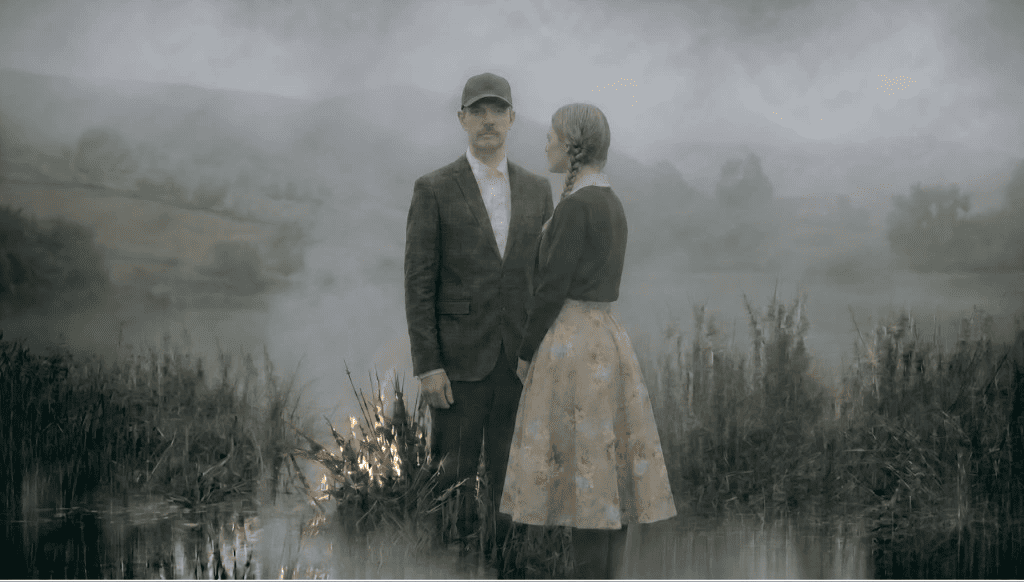
In his life-size oil painting exploring themes of revelation and concealment, the landscape operates as a suspended world between reality and allegory. Marshland, mist, and subdued light create an atmosphere of uncertainty where emotional and symbolic tensions emerge gradually rather than dramatically. The setting feels ancient yet contemporary, familiar yet detached from any specific location.
The figures within the composition are positioned carefully to intensify this ambiguity. The male figure confronts the viewer directly, carrying a quiet moral presence that feels simultaneously intimate and unsettling. In contrast, the female figure turns away, withdrawing into silence and introspection. This division of gaze creates a fractured narrative that resists resolution. Neither figure fully explains the other, and their emotional relationship remains suspended within the atmosphere of the painting.
This ambiguity is central to the work’s power. Rather than illustrating a literal story, the painting constructs a psychological condition. Viewers are drawn into questions surrounding identity, distance, belonging, and emotional isolation. The figures appear connected, yet separated by something unspoken and unresolved.
Fire, Water, and Symbolic Ritual
Perhaps the most striking symbolic element within the painting is the small fire positioned among the reeds. Though visually restrained, the fire becomes the emotional and conceptual centre of the composition. Surrounded by water and fog, it introduces a point of disruption within the stillness of the landscape.
The symbolism of the fire remains deliberately open. It may suggest purification, warning, sacrifice, memory, or renewal. Its placement between marshland and mist evokes ancient ritual spaces while also recalling biblical and mythological imagery. Themes of exile, pilgrimage, baptism, and moral reckoning quietly emerge through the relationship between flame, water, and atmosphere.
Importantly, Field-Williams avoids reducing these references to direct allegory. The work never insists upon a singular interpretation. Instead, symbolic elements operate simultaneously across multiple layers of meaning, allowing viewers to encounter the painting through personal association as much as cultural memory.
The restrained palette of greys, muted greens, and earthy tones intensifies this symbolic tension. Against the subdued environment, the fire appears almost like a wound within the composition, interrupting the quiet balance of the scene. This subtle use of colour demonstrates Field-Williams’ sophisticated understanding of emotional contrast and visual rhythm.
Classical Painting Within Contemporary Uncertainty
Although deeply rooted in the traditions of figurative oil painting, Field-Williams intentionally disrupts historical nostalgia through psychological ambiguity and contemporary emotional concerns. His paintings acknowledge the weight of classical structure while refusing the certainty often associated with historical academic painting.
This tension between order and uncertainty defines much of his work. Carefully constructed compositions coexist with unresolved emotional narratives. Symbolic references emerge without becoming fixed doctrine. Human presence appears fragile within environments shaped by silence, distance, and instability.
Through this approach, Field-Williams creates paintings that feel both timeless and unmistakably contemporary. His work reflects modern anxieties surrounding identity, morality, isolation, and belonging, yet it does so through the enduring language of figurative painting rather than fleeting visual trends.
What ultimately distinguishes his practice is its ability to hold contradiction without collapsing into confusion. His paintings remain disciplined yet emotionally open, symbolic yet elusive, structured yet vulnerable. They ask viewers not simply to observe, but to participate in acts of interpretation and reflection.
The Enduring Power of Ambiguity
Neil David Field-Williams continues to develop a body of work that bridges classical construction with contemporary psychological inquiry. Through Neo-Formalism, he proposes that structure and ambiguity are not opposites, but necessary partners in understanding modern experience.
His paintings resist easy explanation because they are designed to function as living spaces of contemplation. Atmosphere, symbolism, gesture, and silence become tools through which deeper questions emerge. Identity remains unstable, morality uncertain, and meaning suspended between revelation and concealment.
In an age increasingly dominated by immediacy and oversimplification, Field-Williams offers an alternative visual experience grounded in patience, reflection, and emotional complexity. His work reminds viewers that uncertainty itself can hold meaning, and that the most powerful images are often those that refuse to fully resolve.
