


Thomas Dix was born in 1959 in Füssen, Germany, and has built a career that bridges technical mastery with artistic exploration. His journey through photography reflects both discipline and curiosity, beginning with structured visual communication and evolving into an expressive, almost painterly approach to image-making. Over the decades, Dix has moved beyond traditional photography, reshaping his work into something that challenges the boundaries between documentation and abstraction.
Early Life and Professional Foundation
Thomas Dix studied photodesign and visual communication at a university of applied sciences in Dortmund, where he developed a strong foundation in composition, structure, and visual storytelling. These formative years played a crucial role in shaping his visual language, grounding his work in precision while allowing space for creative interpretation.
Following his studies, Dix established himself as a freelance photographer, specializing in architecture, interior spaces, landscapes, and nature. His professional work demanded clarity and technical excellence, capturing the geometry of built environments and the subtle atmospheres of natural settings. This phase of his career reflects a deep respect for realism and detail.
Yet even within these structured disciplines, Dix demonstrated an acute sensitivity to light, mood, and spatial depth, elements that would later become central to his experimental practice.
Encounters with India: A Transformative Decade
Between 1991 and 2001, Dix traveled seven times to India, an experience that would profoundly influence his artistic direction. These journeys resulted in the publication of five coffee-table books, each documenting the country’s vibrant culture, layered environments, and rich visual textures.
India presented a stark contrast to the visual landscapes of Europe. The intensity of color, complexity of everyday scenes, and diversity of forms expanded Dix’s perspective. His photography began to move beyond documentation, incorporating a more emotional and interpretive dimension.
This period can be understood as a turning point in his career, a time when observation began to merge with imagination, laying the groundwork for his later abstract explorations.
Transition into Fine Art and Experimental Photography
After decades of professional work, Dix retired from business in 2024 to fully dedicate himself to fine art. This transition marked a significant evolution in his practice. Freed from commercial expectations, he embraced abstract and experimental photography with renewed energy.
He describes this phase as a kind of “late revenge,” referring to photography’s belated revenge on painting, a medium to which it was long considered subordinate, and now reclaiming its place as an independent and expressive art form. His work now departs from straightforward representation, instead exploring ambiguity, movement, and emotional resonance. Photography becomes a tool not just for capturing reality, but for transforming it.
A defining aspect of his current work is the reediting of archival images. Dix revisits earlier photographs and reshapes them using his digital darkroom, creating what he calls a “pixel cosmos.” In these compositions, light, color, and structure are reimagined into entirely new visual experiences.
Notably, Dix does not use artificial intelligence in his process. His work remains rooted in human creativity, driven by intuition, experimentation, and imagination. This commitment reinforces the authenticity and individuality of his artistic voice.
Photography Meets Painting
One of the most compelling developments in Dix’s recent work is its increasing alignment with painting. His images often transcend the photographic medium, resembling expressive canvases built from light and motion.
Through techniques such as camera movement, layering, and digital manipulation, Dix creates compositions that feel fluid and gestural. Light becomes pigment, movement becomes brushstroke, and pixels transform into texture. This fusion of photography and painting reflects his desire to expand the expressive potential of the medium.
Yayoi Kusama Reloaded (2026)
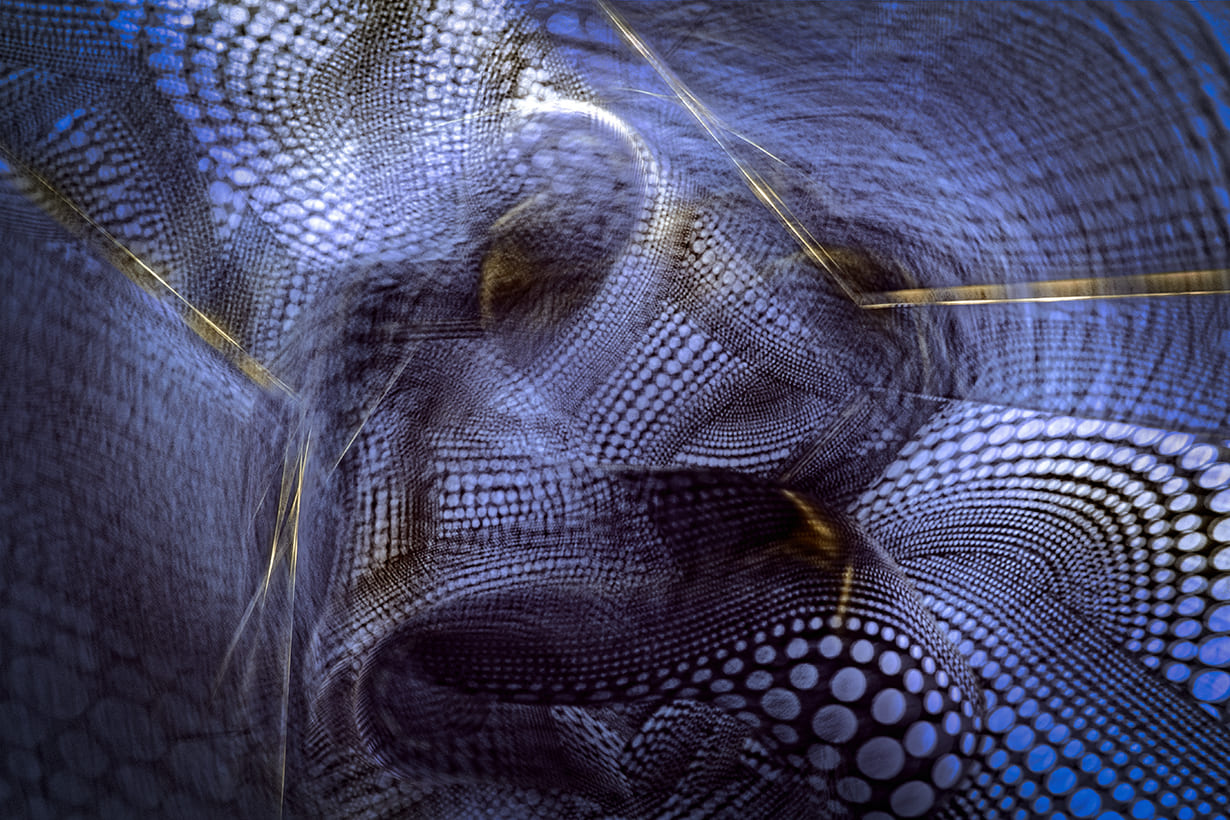
A powerful example of Dix’s contemporary practice is his 2026 artwork Yayoi Kusama Reloaded, a photographic piece measuring 60 x 40 cm. The work is inspired by the immersive installations of Yayoi Kusama, particularly her iconic “Infinity Mirrored Room – The Hope of the Polka Dots Buried in Infinity Will Eternally Cover the Universe.”
Dix encountered this installation during a retrospective at the Fondation Beyeler, an experience that left a lasting impression. Rather than simply documenting the work, he sought to reinterpret and extend its visual language.
Using a one-second exposure combined with deliberate camera movement, Dix transformed the installation into a dynamic field of light and motion. This technique disrupted the static composition, creating a sense of fluidity and depth. Among many experimental shots, one image emerged as particularly compelling, capturing what Dix describes as a transcendental and mystical dimension.
The resulting composition features meandering and overlapping dotted lines, echoing Kusama’s signature aesthetic while introducing a new level of abstraction. The interplay of shadow and light generates a layered spatial experience, drawing the viewer into what feels like an infinite visual realm.
Color plays a crucial role in the piece. Cool, bluish tones dominate the image, creating a technical and almost cosmic atmosphere. These are contrasted with subtle beams of warm light, adding depth and emotional resonance. The balance between these elements produces a visually striking and conceptually rich composition.
A Dialogue Between Influence and Innovation
While Yayoi Kusama Reloaded clearly acknowledges its inspiration, it stands as an original work in its own right. Dix engages in a dialogue with Yayoi Kusama’s visual language, transforming it through his own experimental approach.
This ability to reinterpret influence rather than replicate it is a defining characteristic of his work. Dix uses inspiration as a starting point for innovation, creating pieces that are both referential and entirely unique.
The Future of Dix’s Artistic Vision
As Thomas Dix continues to explore the boundaries of abstract photography, his work exemplifies the power of artistic evolution. His journey from precise architectural photography to expressive, painterly abstraction highlights his willingness to embrace change and push creative limits.
In a time when technology increasingly shapes artistic production, Dix’s commitment to human-driven creativity stands out. His work emphasizes the importance of imagination, experimentation, and personal vision.
Ultimately, Thomas Dix invites viewers to reconsider what photography can be, not just a means of capturing reality, but a medium capable of creating entirely new worlds shaped by light, movement, and artistic intent.
