


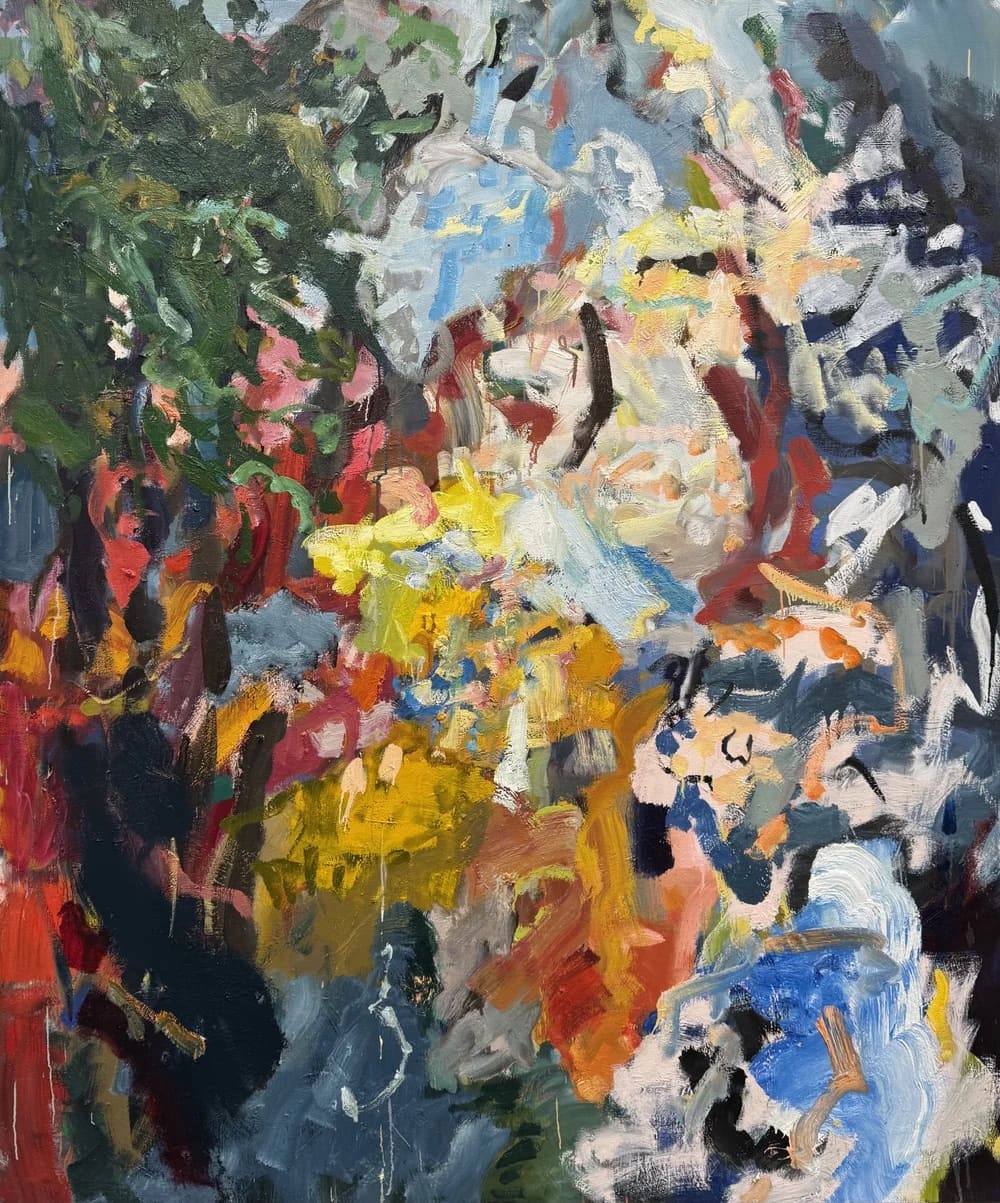
Emily Hopkins lives and works between the Hudson River Valley in New York and the Mid-Coast region of Maine, two landscapes that have profoundly shaped her artistic voice. This dual geography is more than a matter of residence; it is the foundation of a visual language rooted in observation, memory, and emotional response to place. The shifting seasons of the Hudson Valley and the rugged, atmospheric coastline of Maine offer Hopkins an ever-changing source of inspiration, reflected in the rhythm and vitality of her paintings.
A graduate of the Painting program at Pratt Institute in Brooklyn, New York, Hopkins developed a strong formal foundation that she would later expand into a deeply intuitive and expressive practice. Over the past four decades, she has built a consistent and evolving body of work, marked by its commitment to abstraction and its sensitivity to the natural world.
A Career Rooted in Exploration and Exhibition
Hopkins’ career is distinguished by a long history of exhibitions across both New York and Maine. Her work has appeared in numerous group exhibitions at respected venues such as Perry Lawson Fine Art, Garner Arts Center, Center for Maine Contemporary Art, Cynthia Winings Gallery, Carver Hill Gallery, and Leighton Gallery. These exhibitions reflect both the geographic breadth and the sustained relevance of her practice.
In addition to group shows, Hopkins has presented solo exhibitions at Husson College and The Yellow Shed, where her large-scale canvases have been given space to fully engage viewers. Looking ahead, she is preparing for upcoming solo exhibitions in 2026 at Yvette Torres Gallery and again at Cynthia Winings Gallery, a testament to her continued momentum and relevance in the contemporary art landscape.
The Language of Gesture and Color
At the heart of Hopkins’ work is a commitment to gestural abstraction. Her paintings are large, immersive, and emotionally charged, characterized by sweeping brushstrokes, layered textures, and vibrant color palettes. Rather than depicting the landscape in a literal sense, Hopkins distills her experiences into dynamic compositions that evoke the sensation of being within a place.
Her process often begins with direct observation, sketches or small plein air studies created outdoors, but quickly moves into a more intuitive and exploratory phase in the studio. This transition allows the work to evolve beyond representation, embracing spontaneity and discovery. The resulting canvases are not static images but living surfaces, alive with movement and energy.
Color plays a central role in her compositions. Bold hues interact with softer, atmospheric tones, creating a sense of depth and tension. The interplay of light and shadow, transparency and opacity, mirrors the complexity of the natural environments that inspire her. Through this approach, Hopkins captures not just what a landscape looks like, but what it feels like.
River Abstraction 2025–26: A Painting in Motion
One of Hopkins’ recent works, River Abstraction 2025–26, exemplifies her ability to translate lived experience into expressive form. This large-scale oil painting, measuring 72 by 60 inches, originates from a small plein air study created in Beacon, New York. From a vantage point overlooking Storm King Mountain and the Hudson River, Hopkins captured a fleeting moment in the fall of 2025, a scene defined by shifting light, moving water, and the quiet intensity of the season.
While the initial study served as a point of departure, the final painting took on a life of its own. In the studio, Hopkins allowed the memory of the landscape to merge with her emotional response, resulting in a composition that feels both grounded and abstract. The painting does not attempt to recreate the view; instead, it expresses the movement and aliveness of being immersed in nature.
Broad, gestural strokes suggest the flow of the river, while layered colors evoke the changing foliage and atmospheric conditions of autumn. There is a sense of constant motion within the canvas, as if the elements are in flux, water shifting, wind moving through trees, light flickering across the surface. This dynamism invites viewers to engage with the work not as passive observers, but as participants in the experience.
The Role of Nature in Abstraction
Nature is not simply a subject for Hopkins; it is a collaborator. Her paintings emerge from a dialogue between the external world and her internal perception of it. By working both outdoors and in the studio, she bridges the gap between direct observation and imaginative interpretation.
This approach aligns her with a lineage of abstract painters who have sought to capture the essence rather than the appearance of the natural world. Yet Hopkins’ work remains distinctly her own, shaped by her specific environments and her sustained engagement with them over time.
The Hudson River Valley and coastal Maine offer contrasting yet complementary influences. The river’s expansive vistas and seasonal transformations provide a sense of continuity and flow, while the Maine coastline introduces elements of ruggedness and unpredictability. Together, these landscapes inform the rhythm and structure of her compositions.
A Practice of Continuity and Renewal
Over more than forty years, Hopkins has maintained a practice that is both consistent and evolving. Her commitment to painting as a medium, particularly oil on canvas, reflects a deep respect for its material possibilities. At the same time, her willingness to embrace change and experimentation ensures that her work remains fresh and relevant.
Each painting represents a moment in an ongoing exploration, a continuation of ideas that have developed over decades. Yet there is also a sense of renewal in her work, as each canvas brings new challenges and discoveries. This balance between continuity and innovation is a defining characteristic of her practice.
Looking Ahead
With upcoming exhibitions in 2026 at Yvette Torres Gallery and Cynthia Winings Gallery, Hopkins continues to expand her reach and engage new audiences. These shows will provide an opportunity to experience her latest works in depth, offering insight into the current direction of her practice.
As she moves forward, Hopkins remains committed to the core principles that have guided her work from the beginning: a deep connection to place, an openness to process, and a belief in the expressive power of abstraction. Her paintings invite viewers to slow down, to look closely, and to reconnect with the rhythms of the natural world.
Conclusion
Emily Hopkins’ work stands as a testament to the enduring relevance of abstract painting. Through her bold gestures, vibrant colors, and intuitive process, she transforms personal encounters with landscape into universal experiences. River Abstraction 2025–26 is not just a painting of a place, but a reflection of what it means to be present within it, to feel its movement, its energy, and its life.
In an increasingly fast-paced world, Hopkins’ paintings offer a moment of pause, a chance to engage with the subtle, shifting beauty of nature, and to rediscover the emotional resonance of being fully immersed in it.
