


Yiannis Galanakis is a contemporary visual artist whose journey into image-making is deeply rooted in an academic background in science. He studied at the Physics Department of the Aristotle University of Thessaloniki, a discipline that reflects analytical thinking, structure, and an understanding of systems. While physics is often associated with precision and logic, Galanakis gradually shifted his focus toward a more intuitive and expressive field.
Since 2012, his artistic direction has evolved significantly into the realm of digital photo editing and compositing. This transition did not abandon his scientific grounding; rather, it expanded it into a visual language where structure meets imagination. Through digital manipulation and photographic layering, he constructs visual worlds that blur the boundary between documentation and invention.
Over the years, his photographic work has been exhibited in both solo and group exhibitions and has gained international recognition through competitions and festivals. His work has also been published in various art magazines and books, establishing him as an artist engaged in the global dialogue of contemporary digital art.
To explore more of his work and stay updated, you can visit his official website and social profile:
Website: https://galanakisyiannis.wixsite.com/mysite-1
Facebook: https://www.facebook.com/profile.php?id=100087620261569
Artistic Vision: Between Reality and Perception
Yiannis Galanakis approaches imagery not as a static record of reality but as a living, evolving language. His artistic statement draws on the evocative words of Willem M. Roggeman:
“Because language is a park full of images
that (full of shame and silent)
walk about bewildered with big blind eyes.”
This poetic reference becomes a conceptual entry point into Galanakis’s practice. For him, images are not merely visual outputs; they are fragmented narratives unstable, reflective, and often paradoxical. His compositions present what he describes as a “perverted reality,” not in a negative sense, but as a transformed and reassembled version of the familiar world.
Within this visual logic, fantasy and reality are not opposites but intertwined forces. His works function as narrative passages, cinematic stills, or visual essays that explore the instability of modern existence. They reflect a world in transition fluid, fragmented, and constantly reshaped by technological, social, and psychological forces.
The Image as a Self-Evolving Language
A central idea in Galanakis’s philosophy is that the image is not fixed, it is capable of reinventing itself. His work often reflects on how visual language evolves alongside technological progress. Digital tools are not simply instruments of production; they are active participants in shaping meaning.
In this sense, his images appear to test their own structure. They question how reality is constructed and how meaning is communicated in a world saturated with visual information. The image becomes self-aware, experimenting with its own syntax and visual grammar. It learns, adapts, and even dreams of future forms while existing in the present.
This ongoing transformation leads to what Galanakis describes as an evolving narrative a system where imagery becomes a language capable of expressing the unspoken. His work does not aim to provide answers but instead opens spaces for interpretation, reflection, and emotional response.
“Man in Exile”: A Study of Disconnection
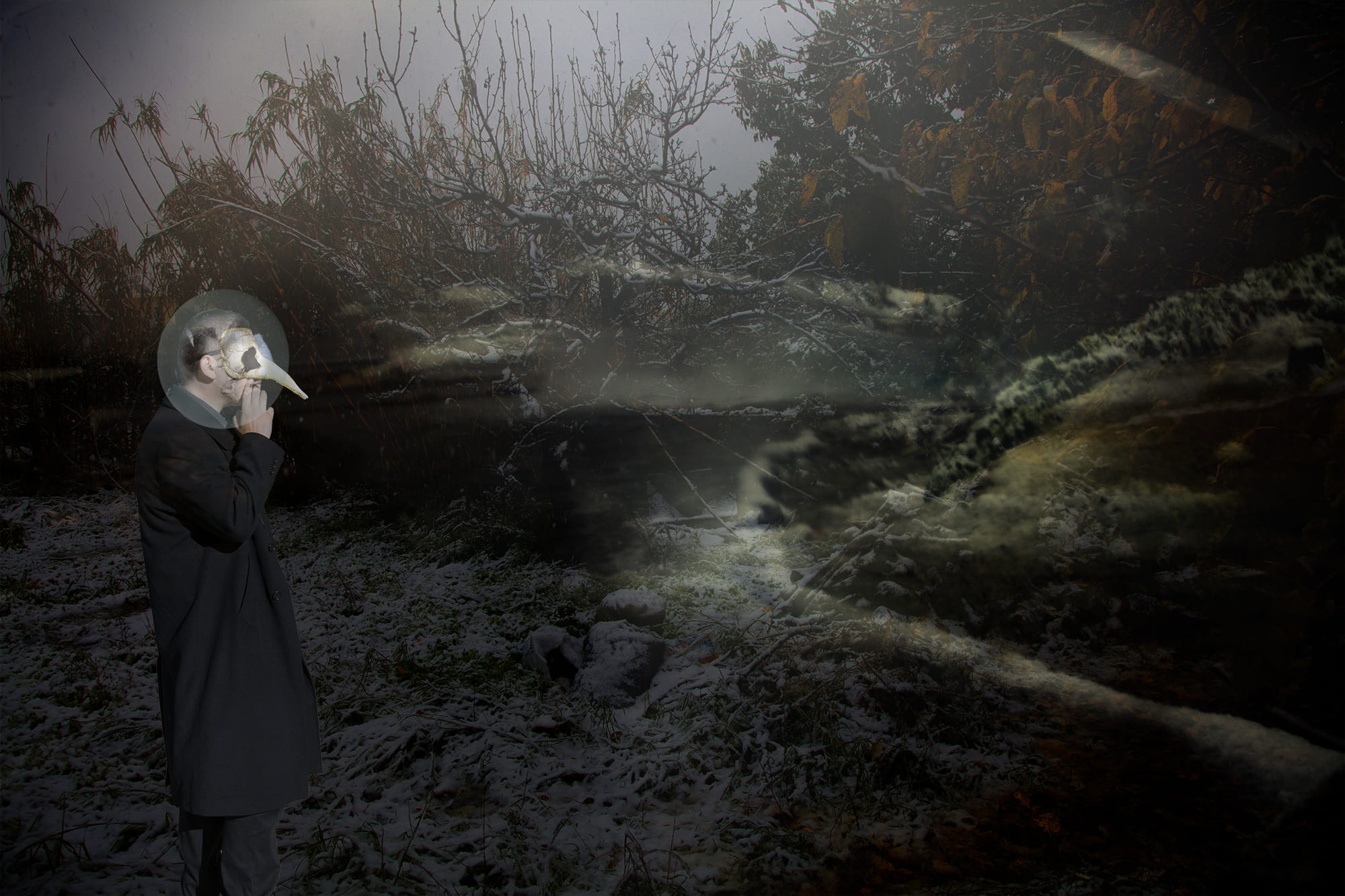
One of Galanakis’s notable works, Man in Exile, is a powerful example of his conceptual and visual approach. Created as a photography and digital image composite (50×75 cm), the work presents a haunting reflection on human alienation in the contemporary world.
In this image, the human figure appears severed from nature and estranged from “the Other.” The surrounding environment is not organic or grounding but technologically mediated suggesting a world where communication is increasingly replaced by images and data flows.
The figure exists in a state of isolation, disconnected from both personal identity and collective meaning. There is no clear sense of belonging, no stable reference point to anchor the individual within society or nature. This emotional and psychological distance becomes central to the narrative of the work.
At the same time, Man in Exile reflects a broader social commentary. It highlights the erosion of social cohesion and the growing sense of fragmentation within modern life. The human subject is portrayed as vulnerable and often passive, positioned before systems of power that feel distant, incomprehensible, and uncontrollable.
Rather than dramatizing resistance, the work emphasizes a quiet, almost resigned tension an existential pause where meaning is uncertain and fragile.
Visual Metaphor and Contemporary Relevance
Galanakis’s work resonates strongly with contemporary concerns about digital culture, identity, and communication. In a world increasingly defined by screens, algorithms, and data-driven interactions, his images ask critical questions: What happens to human experience when reality is mediated almost entirely through technology? How does meaning survive in an environment where images replace direct contact?
By constructing visually layered compositions, he mirrors the complexity of modern perception itself. Reality, in his work, is never singular it is fractured, reconstructed, and continuously interpreted through multiple lenses.
His approach aligns with a broader tradition of conceptual photography and digital art, where the image becomes a site of philosophical inquiry rather than simple representation. Yet his work maintains a distinctly poetic sensibility, where visual tension is balanced with emotional depth.
Conclusion: A Language of the Unspoken
Yiannis Galanakis’s artistic practice represents a thoughtful exploration of how images function in the contemporary world. Rooted in a scientific background yet driven by artistic intuition, his work bridges logic and imagination, structure and fluidity.
Through digital compositing, he constructs visual narratives that question reality while simultaneously expanding it. His images operate as metaphors for a fragmented and transitional era, where identity, communication, and meaning are constantly in flux.
In works like Man in Exile, Galanakis captures the psychological condition of modern existence isolated yet hyper-connected, visible yet estranged. Ultimately, his art proposes that imagery is not just a reflection of the world, but a language capable of revealing what words often cannot express: the silent, unspoken dimensions of human experience.
