


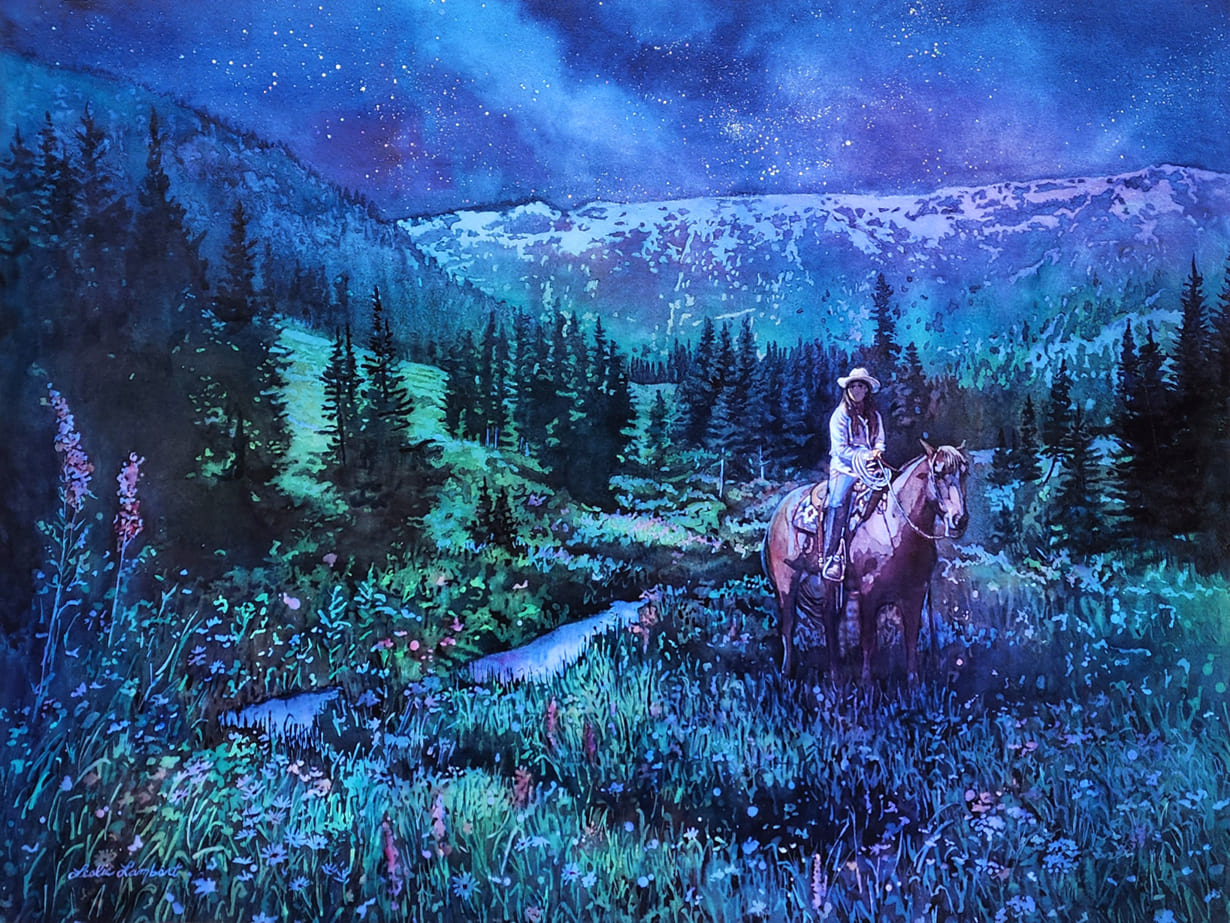
Leslie Lambert is a watercolor artist whose work celebrates the people, animals, and landscapes that define the American West. Raised in the Intermountain West, Lambert developed a deep connection to the region’s ranching communities, working landscapes, wildlife, and enduring traditions. These experiences have become a central source of inspiration throughout her artistic career, shaping paintings that explore not only the visual beauty of the West but also the powerful relationships between people, animals, and the land.
A Deep Connection to the American West
Lambert’s artistic vision is rooted in an understanding of the Western landscape as a place filled with history, memory, and human connection. Her paintings often focus on ranching life, wildlife, and the vast environments in which generations of families have lived and worked. Rather than treating the landscape as simply a backdrop, she presents it as an essential part of the story.
The people and animals within Lambert’s paintings often appear naturally integrated into their surroundings. Riders crossing open country, cattle moving through familiar terrain, and wildlife existing within expansive landscapes all become expressions of a larger relationship between life and place. Through these subjects, Lambert captures the quiet strength and enduring character of Western traditions.
The Unique Language of Watercolor
A defining element of Lambert’s artistic practice is her distinctive poured watercolor technique. By layering transparent color, she creates luminous surfaces while allowing water, pigment, and gravity to participate in the development of each painting. This process introduces a natural sense of movement and spontaneity, giving her work an organic quality.
Rather than attempting to control every aspect of the medium, Lambert embraces the unpredictable qualities of watercolor. Pigment can flow, merge, settle, and create unexpected transitions. These characteristics become part of the visual language of her paintings, helping her communicate the atmosphere and energy of the landscapes she portrays.
The transparency of watercolor also allows Lambert to explore light in particularly expressive ways. Layers of color can build depth while retaining a sense of luminosity, creating paintings that feel vibrant without losing their natural subtlety.
The Story Behind The Ground That Knows Our Names
One of Lambert’s compelling works, The Ground That Knows Our Names, captures a quiet moment beneath the immense Western night sky. Cattle and riders move across a landscape shaped by generations of work, tradition, and familiarity. The scene is peaceful, yet it carries a strong emotional presence.
The painting’s glowing light against the surrounding darkness creates an atmosphere of intimacy. The illuminated areas draw the viewer toward the riders and cattle, while the vast darkness surrounding them emphasizes the scale of the Western landscape. This contrast creates a sense of closeness within an otherwise immense environment.
At the heart of the painting is the relationship between ranching families, their animals, and the land they call home. The riders and cattle are not portrayed as temporary visitors to the landscape. They seem to belong to it, reflecting the generations of people who have built their lives around the rhythms of ranching and the land.
A Landscape Filled With Memory
The title The Ground That Knows Our Names adds another layer of meaning to the work. It suggests a landscape that has witnessed generations of lives, experiences, struggles, and traditions. The land becomes more than soil and open space; it becomes a keeper of memory.
For ranching families, the connection to the land can extend far beyond practical necessity. It can become part of family identity and cultural heritage. Familiar landscapes can carry memories of childhood, work, family, animals, and changing seasons. Lambert’s painting captures this emotional connection without relying on dramatic action.
Instead, the quietness of the scene allows the viewer to contemplate what has come before and what continues. The riders moving through the night seem to represent an ongoing tradition, connecting the present with generations that came before them.
Celebrating People, Animals, and Tradition
Lambert’s work consistently recognizes the importance of animals within Western life. Cattle and horses are not merely elements of a composition; they are participants in the stories she tells. Their presence reflects the practical and emotional bonds that develop between people and animals through years of shared work.
This sensitivity extends to Lambert’s portrayal of people. Her figures often exist within the broader environment rather than dominating it. This approach reinforces the idea that human life in the West is closely connected to the land and the natural world.
Through these relationships, Lambert’s paintings celebrate a way of life shaped by patience, responsibility, resilience, and tradition.
National Recognition and Exhibitions
Lambert’s artistic accomplishments have earned recognition well beyond her regional roots. Her work has received national honors, including Best of Show at the Women Artists of the West National Exhibition and First Place 2D at Cowgirl Up! These awards reflect the distinctive quality and impact of her watercolor paintings.
Her work has also been exhibited in museums and at national Western art shows, placing her paintings before audiences interested in the history, culture, and contemporary expression of the American West.
Lambert’s paintings have appeared in respected publications including Western Art Collector, Western Art & Architecture, PleinAir Magazine, and The Art of Watercolour. This recognition has further established her presence within the contemporary Western art community.
Where Technique Meets Emotion
One of the most engaging qualities of Lambert’s work is the way technical experimentation supports emotional storytelling. Her poured watercolor process gives her paintings a sense of spontaneity, while her carefully selected subjects provide a strong narrative foundation.
The interaction between water, pigment, and gravity can produce subtle variations that would be difficult to achieve through a completely controlled process. These unexpected qualities can echo the natural world itself, where light, weather, terrain, and atmosphere are constantly changing.
In The Ground That Knows Our Names, this combination of technique and subject creates a painting that feels both immediate and timeless. The glowing light, dark sky, cattle, riders, and landscape work together to communicate a feeling of belonging that goes beyond the specific scene.
Preserving the Spirit of the West
Leslie Lambert’s paintings offer viewers an opportunity to see the American West through a perspective that values both its visual beauty and its deeper cultural meaning. Her work does not simply document Western landscapes or ranching communities. It explores the emotional connections that make those places significant.
The Ground That Knows Our Names is a particularly moving example of this approach. Through a quiet nighttime scene, Lambert reflects on heritage, family, animals, work, and the land that holds generations of memories. The painting reminds viewers that some of the most powerful stories can be found in moments of stillness.
Lambert continues to bring these stories to life through her distinctive watercolor technique and her deep appreciation for the people, animals, and landscapes of the American West. Her work honors the traditions of the region while giving them a contemporary artistic voice. In doing so, she creates paintings that are not only visually luminous but also rich with a sense of place, history, and belonging.
More of Leslie Lambert’s work can be viewed at leslielambertart.com.
