


Michiko Azu has been observing the world and drawing in sketchbooks since childhood, developing a lifelong artistic practice rooted in close attention to the world around her. What began as a simple habit of recording observations gradually became a continuous thread connecting memory, perception, and time. Her sketchbooks have served not only as places to draw, but also as spaces where fleeting impressions, experiences, and visual discoveries could be preserved.
For many years, Azu worked primarily as a two-dimensional artist, exploring painting and drawing within the conventional boundaries of the picture plane. Her artistic language developed through an ongoing engagement with color, form, observation, and the relationship between inner awareness and the visible world. Yet her curiosity has increasingly led her beyond the limitations of a flat surface.
Recent global shifts, including rapid environmental changes and the emergence of artificial intelligence, have encouraged Azu to reconsider what it means for an artwork to exist and what it means to experience presence in a changing world. Rather than remaining confined to two-dimensional representation, she has begun exploring the meaning of presence in physical space.
This evolution represents not a departure from her earlier practice, but an expansion of the same curiosity that has guided her since childhood. Observation remains at the center of her work, while space, material, light, and physical presence provide new ways to translate her perceptions into artistic form.
From Two Dimensions Into Space
Azu’s transition from primarily two-dimensional work toward spatial exploration reflects a broader investigation into how an artwork can be experienced. A painting occupies a surface, but a spatial work occupies an environment. It can change according to light, distance, movement, and the position of the viewer.
This shift allows Azu to explore ideas that cannot easily be contained within a traditional canvas. Presence becomes physical rather than purely visual. Materials acquire their own weight and texture, while space becomes part of the composition.
Her approach is particularly relevant to a contemporary world in which technology increasingly influences how people see and experience reality. Artificial intelligence, digital environments, and rapid technological development have created new questions about perception, identity, creativity, and human presence.
Against this background, Azu’s interest in physical materials and spatial relationships offers a thoughtful counterpoint. Her work encourages viewers to slow down and encounter something tangible. Instead of presenting an image that can be understood instantly, she creates a situation that unfolds through observation.
A Dialogue Between Nature and Consciousness
At the heart of Azu’s work is an interest in relationships. Her practice seeks to visualize connections between the sun and earth, wind and water, and the artist’s consciousness and the object.
These relationships are not presented as literal representations of natural phenomena. Instead, they emerge through the interaction of color, surface, material, and space. The artwork becomes a meeting point where external forces and internal awareness can exist together.
The relationship between the sun and earth evokes cycles of energy, light, growth, and transformation. Wind and water suggest movement, change, erosion, and the continuous shaping of the natural environment. These forces are often invisible or difficult to grasp directly, yet their effects can be felt everywhere.
Azu’s work attempts to give such relationships a visual and physical presence. By translating intangible forces into material forms, she invites viewers to consider the connections that exist between themselves and the larger environment.
Her approach also places human consciousness within this network of relationships. The artist is not separate from the world being observed. Instead, perception becomes part of the work itself.
The Physical Presence of Soft Metal Mesh
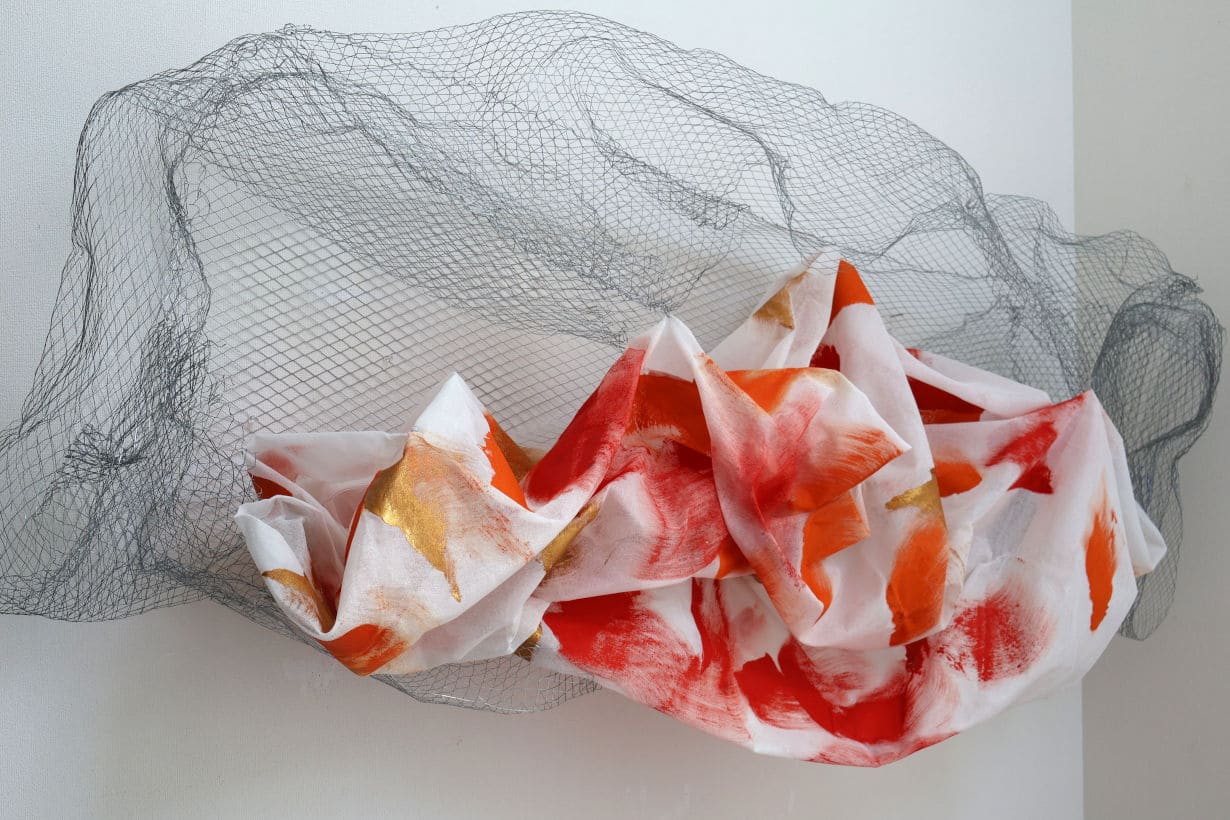
One of the most distinctive elements in Azu’s work is the use of soft metal mesh. The material introduces a fascinating tension between strength and delicacy.
Metal is traditionally associated with durability, structure, and permanence. Yet the softness and flexibility of the mesh create an entirely different impression. It can bend, shift, overlap, and respond to its surrounding space. Its structure allows light and shadow to pass through, creating an ever-changing relationship between solid form and openness.
For Azu, the mesh possesses a kind of bodily presence. It is not simply a technical material used to construct an artwork; it becomes an active part of the visual and conceptual experience.
Its surface can appear delicate and vulnerable while simultaneously maintaining a sense of tension. This contradiction creates a subtle physical energy within the work.
The viewer may notice the mesh differently depending on their position, the surrounding light, and the amount of time spent looking. What initially appears to be a fixed structure can begin to feel almost dynamic, as though it is quietly responding to its environment.
Layers of Awareness
Azu describes her work through the convergence of layers of deep awareness, momentary color forms, and the bodily presence of soft metal mesh. These elements reveal an artistic process that brings together fleeting perception and deeper consciousness.
Color plays an important role in this relationship. Rather than functioning simply as decoration, color can suggest a momentary experience something perceived briefly before changing or disappearing.
These momentary forms exist alongside deeper layers of awareness. The result is an artwork that does not necessarily reveal everything at once. It asks the viewer to spend time with it.
The longer one observes, the more relationships begin to emerge. Color interacts with structure. Structure interacts with light. Light alters the perception of the surface. The viewer’s own position changes what can be seen.
In this sense, the artwork becomes an experience of perception itself.
Making Time Visible
Time is one of the most important underlying ideas in Azu’s practice. Although time cannot be physically seen, it constantly reveals itself through change. Landscapes transform, materials age, light shifts, memories evolve, and human perception changes from one moment to the next.
Azu’s work seeks to make this invisible dimension perceptible.
The layers within the artwork can suggest accumulated experiences, while the changing relationship between color, surface, and mesh evokes moments that are continuously forming and dissolving.
The quiet tension held within the mesh becomes especially significant. It suggests a moment suspended between stillness and movement. The work appears physically present and stable, yet its visual experience remains open and changeable.
This approach connects naturally with Azu’s childhood practice of drawing in sketchbooks. A sketchbook captures a particular moment in time. Her spatial work extends that same impulse into a larger physical environment, transforming the act of recording into an experience that can be entered, observed, and felt.
Observation as an Artistic Language
Throughout Azu’s development, observation has remained a fundamental part of her artistic language.
Her practice begins with looking closely. Rather than accepting the visible world as something fixed, she considers the relationships and subtle changes taking place beneath its surface.
This way of working allows her to move between the external and internal worlds. The natural environment provides one source of inspiration, while consciousness provides another. The resulting work exists somewhere between what is seen and what is felt.
This balance is particularly important in her transition toward spatial art. The physical object becomes a bridge between perception and experience. It gives form to ideas that might otherwise remain intangible.
Rather than explaining these ideas directly, Azu allows materials and spatial relationships to communicate them.
An International Artistic Journey
Although based in Japan, Azu’s artistic journey has extended well beyond her home country. Her work has been presented through solo and group exhibitions internationally, including exhibitions in the United States, Sweden, Italy, Spain, China, and South Korea.
These international experiences have placed her work within a diverse range of artistic environments and allowed her practice to engage with audiences across different cultural contexts.
Yet geographical movement has not changed the fundamental concerns at the center of her work. Observation, nature, consciousness, material, and time continue to provide a consistent foundation.
Her international exhibition history reflects the ability of these themes to communicate beyond a single cultural setting. Questions about humanity’s relationship with nature, the experience of time, and the meaning of physical presence are increasingly relevant across borders.
Art in a Changing World
Azu’s recent exploration of space arrives at a particularly significant moment. Environmental changes are reshaping landscapes and ecosystems, while artificial intelligence is transforming ideas about creativity and human capability.
In such a world, questions surrounding presence become increasingly important.
What does it mean to be physically present when so much of contemporary life takes place through screens and digital environments? What happens to our awareness of materials, space, and the natural world when technology increasingly mediates our experiences?
Azu does not attempt to answer these questions through direct statements. Instead, she approaches them through material and perception.
Her work returns attention to the physical encounter to the surface of an object, the movement of light, the texture of a material, and the awareness of one’s own body within space.
Expanding the Experience of Art
Michiko Azu’s artistic journey demonstrates how a practice can evolve while remaining faithful to its original impulse. The child who once filled sketchbooks through careful observation has developed into an artist exploring the complex relationship between consciousness, nature, material, and space.
Her movement from two-dimensional art toward spatial exploration has opened new possibilities for understanding presence. Soft metal mesh, layered surfaces, momentary colors, and subtle physical tensions become tools through which invisible relationships can be made perceptible.
At the center of her work is a quiet invitation to pay attention.
To observe the relationship between sun and earth. To sense the movement between wind and water. To recognize the connection between consciousness and object. To notice how light changes a surface and how one’s own position changes an experience.
Through these encounters, Azu transforms material into a meditation on time and presence.
Her work reminds viewers that art does not always need to provide an immediate answer. Sometimes its greatest power lies in creating a space where observation can deepen, where perception can slow down, and where the invisible relationships connecting people, objects, nature, and time can become momentarily visible.
