


Carol Hartman is an American oil painter, curator, and educator whose large-scale abstract paintings confront the environmental consequences of human activity. For more than four decades, she has developed a powerful visual language that transforms climate instability, industrial disruption, and ecological collapse into immersive painterly experiences. Through monumental canvases filled with movement, texture, and atmospheric intensity, Hartman explores humanity’s increasingly fragile relationship with the natural world.
Her work exists at the intersection of contemporary abstraction and environmental consciousness. Rather than depicting landscapes in a traditional sense, Hartman creates emotionally charged visual fields inspired by wildfire destruction, melting ice sheets, polluted rivers, hurricanes, oil slicks, and atmospheric instability. These paintings are not simply representations of environmental disasters; they are reflections on human decision-making, industrial systems, and the long-term consequences of ecological neglect.
Over the course of her career, Hartman has exhibited nationally and internationally, earning recognition for both the conceptual depth and physical scale of her paintings. Her work has appeared at the Florence Biennale, ART SAN DIEGO, and in International Contemporary Masters. She has also collaborated with the Royal College of Art in London and maintains affiliations with Vedica Art Gallery in Mumbai and Paris, reinforcing her position within a global contemporary art dialogue.
A Life Dedicated to Art and Education
Beyond her studio practice, Carol Hartman has made significant contributions to arts education and curatorial leadership. She served as Gallery Director and professor at both California State University Sacramento and California State University Fresno, where she helped mentor and inspire generations of emerging artists.
Her academic background shaped not only her understanding of painting but also her perspective on the social responsibility of contemporary art. Hartman approaches abstraction as a means of communication, creating works that encourage reflection and dialogue rather than passive observation. Her paintings invite viewers to consider how environmental instability is connected to political, industrial, and human systems.
Throughout her career, Hartman has balanced teaching, curating, and exhibiting while continuously evolving her artistic practice. This combination of intellectual engagement and visual experimentation has allowed her work to remain relevant across decades of changing artistic and cultural landscapes.
Now living in Montana, Hartman continues to create ambitious large-scale paintings informed by the environmental realities surrounding contemporary life. The natural landscapes around her serve as both inspiration and warning, reinforcing the themes of vulnerability and transformation that define her work.
Abstraction as Environmental Language
Hartman’s paintings are rooted in abstraction, yet they carry unmistakable environmental associations. Her compositions often resemble aerial views, geological formations, storm systems, or collapsing ecosystems. Sweeping gestures, layered surfaces, and fractured textures generate a sense of instability that mirrors the ecological disruptions shaping the modern world.
Oil paint plays an essential role in her process. Hartman builds dense surfaces through layering, creating paintings that feel simultaneously fluid and turbulent. The material richness of the medium allows her to evoke smoke, water, ash, pollution, erosion, and combustion without directly illustrating them. This ambiguity gives the viewer space to emotionally engage with the work while forming personal interpretations.
Scale is equally important within her practice. Many of Hartman’s paintings are monumental in size, physically surrounding the viewer and intensifying the emotional experience of the work. Instead of observing environmental destruction from a distance, audiences become immersed within these visual environments. The paintings function almost like psychological landscapes, capturing the overwhelming complexity of climate crisis and ecological instability.
At the heart of her work is the idea that environmental disasters are not isolated events. Wildfires, contaminated waterways, melting ice fields, and industrial accidents are interconnected symptoms of larger systems shaped by human behavior. Hartman’s paintings reveal these connections while avoiding direct narrative or illustration. Through abstraction, she communicates the emotional and physical realities of environmental change in ways that statistics and reports often cannot.
“Disruption” and the Visualization of Catastrophe
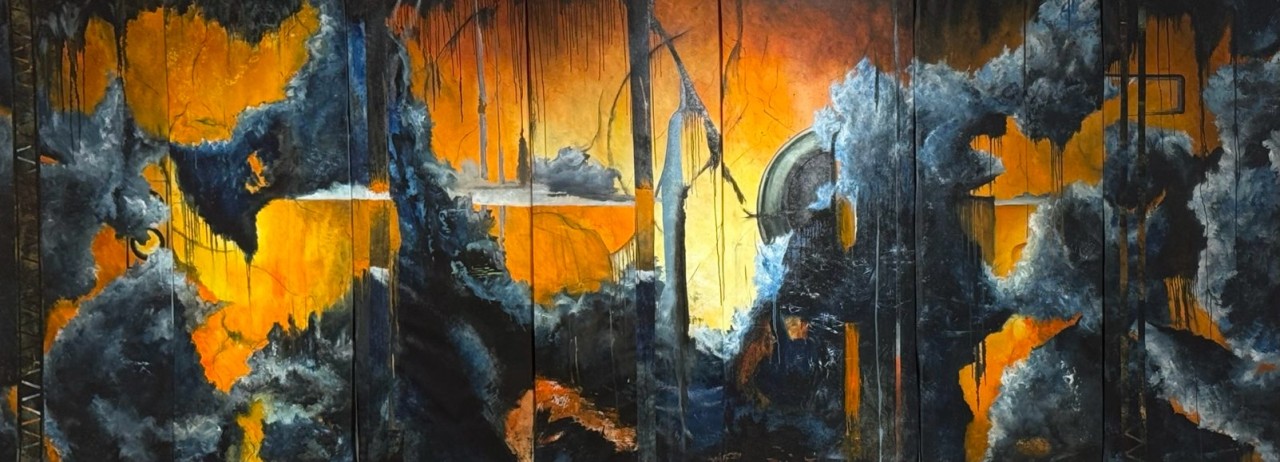
One of Carol Hartman’s most significant works is Disruption, a monumental 7-foot by 20-foot oil painting composed across seven canvas panels. The work addresses the catastrophic Yellowstone River train derailment, transforming a specific industrial disaster into a broader meditation on environmental fragility and industrial consequence.
The sheer scale of Disruption immediately commands attention. Spanning multiple panels, the painting creates a panoramic experience that mirrors the expansive reach of ecological catastrophe itself. Rather than presenting a literal depiction of the derailment, Hartman uses abstraction to evoke its emotional and environmental impact.
Turbulent gestures move across the surface like waves of destruction, while fractured forms and layered textures suggest instability, contamination, and collapse. Darkened passages evoke smoke, oil, and industrial debris, while moments of luminosity create tension between devastation and resilience. The painting captures not only the violence of the event but also its lingering aftermath.
The Yellowstone River serves as both a real location and a symbolic representation of vulnerable environmental systems. Through Disruption, Hartman emphasizes how industrial failures extend beyond a single incident, affecting ecosystems, communities, and future generations.
What makes the painting especially compelling is its emotional immediacy. Viewers are not positioned as distant observers of tragedy. Instead, the immersive scale and abstract composition draw them into the chaos itself. The painting becomes an experiential space where environmental anxiety and industrial consequence collide.
The Tipping Point
Hartman’s recent solo exhibition, The Tipping Point, presented at the Holter Museum of Art with support from the Andy Warhol Foundation, further expanded her exploration of climate crisis and ecological instability. The title suggests a critical threshold, a moment when systems become irreversible and balance can no longer be restored.
This concept is central to much of Hartman’s work. Her paintings frequently exist in states of tension, where movement, fragmentation, and instability dominate the visual field. Yet alongside destruction, there are also traces of resilience and transformation. This complexity prevents her paintings from becoming purely pessimistic. Instead, they acknowledge both the danger and uncertainty of environmental change.
Hartman’s ability to combine aesthetic sophistication with environmental urgency distinguishes her work within contemporary abstraction. Her paintings remain visually engaging while also carrying profound social and ecological significance.
A Continuing International Presence
Carol Hartman continues to expand her international presence through exhibitions and collaborations around the world. Her upcoming exhibition at the National Museum of Modern Art in Mumbai, supported by the Consulate General of the Netherlands, reflects the growing global relevance of her work and themes.
As environmental concerns increasingly shape cultural conversations worldwide, Hartman’s paintings offer a space for reflection, confrontation, and awareness. Through abstraction, she communicates the emotional dimensions of climate instability in ways that transcend language and geography.
Her work demonstrates how contemporary painting can function not only as artistic expression but also as cultural testimony. Paintings such as Disruption stand as visual records of an era defined by environmental uncertainty, industrial consequence, and ecological transformation.
Through monumental scale, layered abstraction, and conceptual depth, Carol Hartman continues to challenge viewers to confront the realities of a rapidly changing planet. Her paintings remind us that art has the power to illuminate the complexities of our time while encouraging deeper awareness of the world we collectively shape.
