


Cécile Batillat creates works that exist between memory and dream, philosophy and symbolism, image and poetry. Through drawing, painting, and literary fragments, she invites viewers into a meditative world where reality is never fixed, but constantly transformed by emotion, remembrance, and imagination. Her art does not merely depict scenes or figures; it questions how human beings perceive existence itself.
Graduating from the University of Paris I Panthéon-Sorbonne with a degree in visual arts, video, and new technologies, Batillat developed an artistic language shaped equally by academic rigor and poetic intuition. Her early collaborations with the Experimental Academy of Theaters in Paris and her work directing independent documentaries reveal an enduring fascination with narrative, performance, and the hidden dimensions of human experience. Later, as a professor of literature and philosophy, she deepened her engagement with questions surrounding representation, perception, and meaning.
When Batillat returned fully to painting and drawing, she approached them not simply as visual disciplines, but as philosophical investigations into what she calls The Real. Her practice explores the tension between appearance and essence, between what can be seen and what can only be felt intuitively. Folktales, myths, and archetypes drawn from the collective unconscious serve as recurring foundations in her work. These references allow her to bridge Eastern and Western approaches to representation while constructing images that feel timeless and deeply psychological.
One of the most compelling aspects of Batillat’s artistic language is the integration of haikus into her visual compositions. These poetic fragments do not function merely as captions or explanations. Instead, they expand the artwork beyond sensory perception and open symbolic pathways for interpretation. The viewer is encouraged to move between text and image, creating an emotional resonance that transforms observation into contemplation.
Per l’Eternità and the Fragility of Time
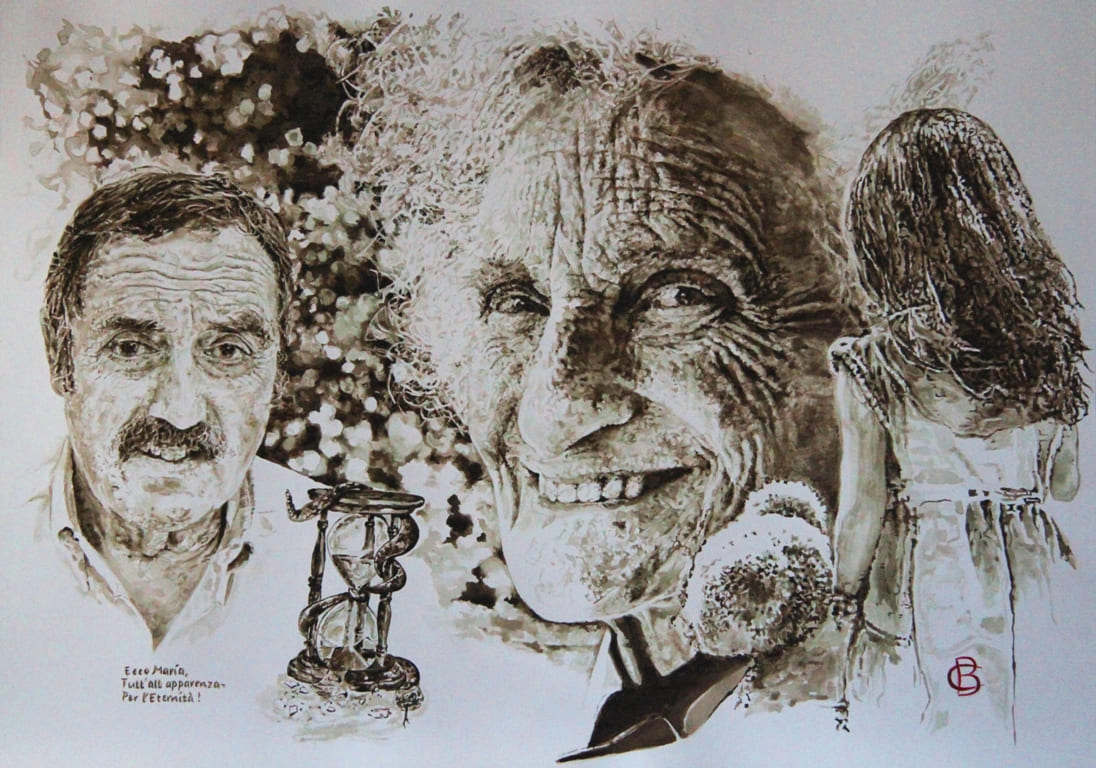
Among Batillat’s works, Per l’Eternità (For Eternity) (2024) stands as a profound meditation on memory, mortality, and continuity. Created in sepia inks on Canson paper for an exhibition at the Mona Lisa Gallery in Paris themed Generation: Collective Creations, the work possesses the atmosphere of an old photograph recovered from a forgotten archive. Yet beneath its nostalgic tones lies a deeply philosophical reflection on the passage of time.
The composition depicts three figures. Two face the viewer directly: an elderly woman and a man whose gazes seem suspended between presence and absence. Beside them stands a little girl turned away from us, holding a teddy bear by the hand. Her posture suggests observation, perhaps even silent witnessing. She exists simultaneously inside the scene and outside of it, embodying innocence confronted with the inevitability of time.
At the lower edge of the work appears a striking symbolic element: an unbalanced hourglass with shattered glass and spilling sand, encircled by a snake. The imagery immediately evokes cycles of time, mortality, destruction, and renewal. The broken hourglass suggests that time itself has ruptured, no longer functioning as a linear progression. Meanwhile, the snake recalls ancient symbols of eternity, transformation, and perpetual return.
Behind the figures, the shadow of a tree dances in light. This subtle detail introduces movement into an otherwise still image. The tree’s shadow becomes almost spectral, suggesting memory itself: elusive, shifting, impossible to fully grasp.
Integrated into the artwork is Batillat’s haiku:
Here is Mary
All in appearance
For Eternity.
The brevity of the haiku intensifies the emotional atmosphere rather than explaining it. The line All in appearance becomes especially significant, questioning whether identity itself is only surface, illusion, or temporary manifestation. The phrase For Eternity simultaneously comforts and unsettles, implying permanence while confronting impermanence.
Batillat’s genius lies in the way she leaves interpretive space open. The observer is never given a definitive narrative. Instead, memory becomes active. The viewer projects personal associations into the scene, allowing imagination to continue the story beyond the boundaries of the paper. The work therefore becomes collaborative: image, text, and viewer together create meaning.
Between Literature and Visual Art
Batillat’s background in literature and philosophy strongly informs her visual vocabulary. Her works often resemble fragments of unwritten novels or scenes from forgotten myths. Rather than relying on dramatic spectacle, she builds emotional intensity through silence, symbolism, and ambiguity.
This approach aligns her with traditions of Symbolism and Surrealism, yet her voice remains distinctly contemporary. In an age dominated by immediacy and oversaturation of images, Batillat creates works that demand slowness. They encourage viewers to pause, reflect, and inhabit uncertainty.
Her use of sepia tones in Per l’Eternità reinforces this atmosphere. The restrained palette removes distraction and directs attention toward emotional and symbolic depth. Sepia evokes archival memory, family photographs, and fading histories, allowing the artwork to exist outside conventional time.
At the same time, her engagement with Eastern and Western philosophies broadens the conceptual reach of her practice. The haiku form introduces an economy of language associated with Zen aesthetics, where emptiness and silence carry as much meaning as words themselves. Combined with Western symbolic imagery, Batillat constructs a visual philosophy that transcends geographical and cultural boundaries.
Poetry, Memory, and the Echo of Childhood
The emotional universe surrounding Per l’Eternità expands further through the sonnet written for its upcoming presentation at the Fridman Gallery in New York alongside the diptych Da Capo Salva I and II. The poem deepens Batillat’s recurring themes of childhood, disappearance, remembrance, and return.
Lines such as A child back turned, keeps watch beside the garden there echo the imagery of the artwork itself, reinforcing the figure of the child as guardian of memory. The garden emerges as a symbolic place of origin, innocence, and lost time. Yet it is never entirely inaccessible. Through art, music, and recollection, fragments of the past can briefly return.
Particularly moving is the image of the piano breathing softly out of wood, where memory becomes physical and sensory. The final lines of the sonnet suggest that art possesses the power to resurrect emotional landscapes otherwise lost to time:
The melody in dust rekindles burred fire,
And back the garden comes, more deep in red and green.
This poetic dimension is essential to understanding Batillat’s practice. For her, art is not merely representation; it is invocation. Through image and language, she summons hidden emotional realities and invites viewers to reconnect with forgotten parts of themselves.
An International Artistic Presence
Over the years, Batillat’s work has been exhibited across Europe, America, and Asia, receiving numerous international awards. Her growing international recognition reflects the universal resonance of her themes. Regardless of culture or geography, viewers recognize themselves within her meditations on time, memory, childhood, and mortality.
Yet despite this recognition, her work maintains an intimate quality. Each drawing feels personal, almost confidential, as though the viewer has encountered a private memory translated into symbolic form. This balance between universality and intimacy is one of the defining strengths of her artistic voice.
In a contemporary art landscape often driven by spectacle and immediacy, Cécile Batillat offers something increasingly rare: contemplative depth. Her works remind us that art can still function as a philosophical and emotional space where silence, poetry, and symbolism reveal truths that language alone cannot fully express.
Through Per l’Eternità, Batillat transforms a simple image into a meditation on existence itself. The child, the elderly figures, the broken hourglass, the snake, and the shadowed tree all become fragments of a larger reflection on time and memory. Combined with the haunting simplicity of her haiku, the work transcends ordinary representation and enters the realm of the symbolic and eternal.
In Cécile Batillat’s universe, reality is never fixed. It vibrates beneath appearances, waiting to be rediscovered through memory, imagination, and the quiet power of art.
