


Huang Yi Min was born in Shanghai, China, in 1950, during a period of immense political and cultural transformation. Her life and artistic journey have been deeply intertwined with the historical realities of modern China, particularly the turbulence of the Cultural Revolution. Yet from those difficult years emerged an artist whose work carries both emotional depth and philosophical reflection, blending memory, imagination, and traditional Chinese culture into a singular visual language.
Huang graduated from the Fine Arts Department of Beijing Normal University, one of China’s respected academic institutions for the arts. However, her path toward becoming an internationally recognized artist was far from straightforward. At the age of sixteen, she experienced the beginning of the Cultural Revolution, a decade-long movement that interrupted education and reshaped cultural life across China. During this period, many traditional artistic and intellectual practices were rejected or suppressed, leaving a profound effect on an entire generation.
For Huang Yi Min, these years became both painful and formative. While working as a farmer in rural fields, she continued to nurture her artistic spirit privately. Art became not merely a profession, but a form of survival and lifelong learning. Even amid social upheaval, she maintained a deep love for traditional Chinese culture, preserving an inner connection to history, literature, and visual storytelling. This commitment would later become the emotional foundation of her artistic identity.
The Formation of a Surrealist Vision
After completing her university education, Huang worked as an art editor at the China Children’s Publishing House. The position allowed her to constantly practice drawing, especially character sketches and landscape paintings. Over time, she developed a highly personal style that merged traditional Chinese aesthetics with surrealist imagination.
Her paintings do not simply depict reality. Instead, they reconstruct emotional spaces where memory, history, and fantasy coexist. One of the defining visual elements in her work is the repeated appearance of the Forbidden City in Beijing. The ancient imperial palace complex becomes more than an architectural setting; it transforms into a symbolic stage where personal emotions and collective cultural memory intersect.
For nearly twenty years, Huang explored scenes that combined the grandeur of the Ming Dynasty palace architecture with ordinary residential buildings. This juxtaposition creates a striking dialogue between past and present, nobility and common life, permanence and change. Within these layered environments, her figures often appear suspended between dream and reality, reflecting both longing and disillusionment.
The emotional atmosphere of her paintings carries a quiet intensity. Rather than relying on dramatic gestures, Huang builds meaning through symbolic arrangements, muted tension, and poetic ambiguity. Her surrealist approach remains rooted in tradition while also speaking to universal human emotions such as isolation, desire, nostalgia, and spiritual searching.
“Dream of the Red Chamber” as Lifelong Inspiration
Among Huang Yi Min’s most significant artistic achievements is her long-running “Dream of the Red Chamber” series. This body of work has occupied her creative life for over two decades and continues to evolve alongside her own personal experiences and reflections.
Inspired by the classic Chinese literary masterpiece Dream of the Red Chamber, Huang approaches the text not as a historical artifact but as a living emotional universe. As she revisits the novel repeatedly throughout her life, her understanding deepens and transforms. The paintings themselves reflect this evolving relationship between literature and lived experience.
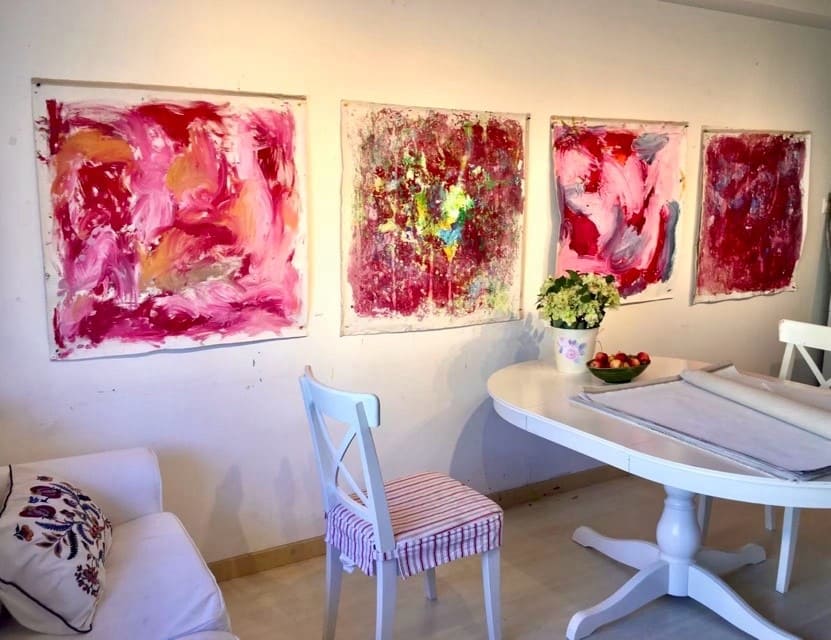
The series moved gradually from paper to canvas and from smaller compositions to larger-scale works, mirroring the expansion of her artistic confidence and emotional perspective. What began as literary interpretation developed into a profound meditation on life itself.
For Huang, the world of the Red Chamber becomes a gateway into abstraction and the complexity of human existence. Her paintings ask timeless questions: What is love? What remains after beauty fades? How do memory and illusion shape human life?
In her own interpretation, love is inseparable from pain and disillusionment. The colors, figures, and dreamlike spaces in her paintings suggest that human life itself resembles a fragile dream, filled with fleeting moments of beauty and inevitable loss. This philosophical undercurrent gives her work a contemplative depth that resonates beyond cultural boundaries.
Rather than illustrating scenes directly from the novel, Huang transforms its emotional spirit into symbolic visual experiences. Her compositions often dissolve conventional space, allowing architecture, figures, and color to flow together in ways that feel psychological rather than literal. The result is art that invites viewers not simply to observe, but to emotionally inhabit the painting.
Recognition Beyond Borders
In 1997, Huang Yi Min immigrated to the United States as an artist recognized for outstanding talent. This transition marked an important new chapter in her career, allowing her work to reach broader international audiences while also deepening her reflections on identity, memory, and cultural continuity.
Her paintings received critical recognition in the United States, including reviews by The New York Times. She was also honored with the prestigious Anna Walinska Academic Achievement Award, acknowledging both her artistic excellence and intellectual contribution to contemporary art.
Huang’s works have been collected internationally by museums, galleries, directors, and private collectors. Her paintings are included in collections associated with the Singapore Museum of Art, the Hong Kong Museum of Art, Singapore Simin Art Gallery, the New York Crystal Art Foundation, and the New York Chinese Gallery. Works have also entered the collections of the director of the Newark Museum of Art as well as numerous private collectors.
Such recognition reflects the universal emotional language of her art. Although deeply rooted in Chinese culture and literary tradition, her paintings speak to broader themes of memory, displacement, longing, and the search for meaning.
Art Between Dream and Reality
What makes Huang Yi Min’s work especially compelling is her ability to transform personal and historical experiences into poetic visual narratives. Her paintings do not present fixed answers or direct explanations. Instead, they create spaces for reflection, where viewers are invited to confront their own emotions and memories.
The surrealist atmosphere of her work functions almost like a dream state, where historical architecture, literary references, and human figures merge into symbolic landscapes. Yet beneath the dreamlike imagery lies a profound awareness of reality; the realities of political upheaval, cultural loss, emotional fragility, and the passing of time.
Her lifelong dedication to traditional culture, despite experiencing a period that sought to suppress it, gives her art particular significance. Through painting, Huang preserves and reimagines cultural memory rather than allowing it to disappear. In doing so, she bridges generations and geographies, carrying the spirit of classical Chinese thought into contemporary global art discourse.
The “Dream of the Red Chamber” series ultimately becomes more than an artistic project. It becomes a meditation on the human condition itself. Love, suffering, beauty, illusion, and impermanence all coexist within her canvases, reminding viewers that life, much like a dream, is both intensely vivid and painfully fleeting.
Through decades of artistic exploration, Huang Yi Min has created a body of work that remains emotionally resonant, intellectually layered, and visually unforgettable. Her paintings stand as quiet yet powerful reflections on culture, memory, and the fragile beauty of human existence.
