


Helena Kotnik is an artist whose work explores the emotional and psychological dimensions of contemporary life through painting, sculpture, ceramics, tapestry, and mixed media experimentation. Her artistic language is rooted in questions surrounding gender, sexuality, identity, and the environment, transforming each artwork into a space for reflection and dialogue. Rather than offering fixed interpretations, Kotnik creates visual experiences that encourage viewers to engage with the complexities of human existence and the shifting realities of the modern world.
Educated in Fine Arts at the University of Barcelona and the Akademie der bildende Künste in Vienna, Kotnik developed a strong intellectual and artistic foundation that continues to shape her multidisciplinary practice today. Her experiences working as a guide in art museums in Barcelona, volunteering in galleries, and later serving as an art mediator exposed her to a wide range of artistic movements, theories, and audiences. These experiences deepened her understanding of how art communicates across cultural and emotional boundaries and reinforced her belief that art should inspire discussion rather than dictate conclusions.
Currently working as an art teacher, Helena Kotnik continues to combine education and artistic practice in meaningful ways. Her work reflects a continuous process of experimentation, observation, and emotional inquiry, allowing her to build a body of work that is both visually compelling and conceptually rich.
A Multidisciplinary Artistic Practice
Although painting remains central to Helena Kotnik’s artistic identity, her creative practice extends far beyond the canvas. Throughout her career, she has explored performance art, sculpture, ceramics, woodwork, and more recently tapestry using recycled materials. Each medium offers new possibilities for expression and allows her to investigate different emotional and conceptual dimensions within her work.
This openness to multiple forms of artistic expression reflects her broader philosophy that art should remain fluid and adaptable. Rather than limiting herself to one visual language, Kotnik allows the subject matter itself to guide the choice of materials and techniques. Whether working with gouache, watercolor, textiles, or wood, her process remains deeply connected to experimentation and emotional exploration.
Her influences are equally expansive. Kotnik draws inspiration from classical and contemporary painters, sculptors, performers, writers, sociologists, and theorists. These references are woven into her work in subtle and layered ways, creating compositions that feel intellectually grounded while remaining emotionally accessible.
Psychological Human Landscapes
Helena Kotnik describes her paintings as “psychological human landscapes,” a phrase that perfectly captures the emotional depth and symbolic complexity of her work. Her paintings function as emotional maps where identities, memories, and social narratives overlap and interact. Through layered imagery and expressive compositions, she explores the tensions that define modern life.
Color plays a central role in her visual language. Fascinated by the relationship between color, emotion, and psychology, Kotnik combines gouache, ink, colored pencils, soft pastels, and watercolor to build intricate surfaces filled with movement and emotional resonance. These materials allow her to create layers not only in texture and form but also in meaning.
At first glance, some of her paintings may appear playful or almost childlike in their simplicity. Yet this apparent innocence often conceals deeper emotional and social commentary. Beneath the vibrant colors and expressive forms are reflections on identity, vulnerability, social expectations, and the emotional pressures of contemporary existence.
This contrast between visual accessibility and conceptual depth gives her work a distinctive presence. Viewers are initially drawn in by the energy and warmth of the compositions, only to discover more challenging questions embedded within the imagery. Kotnik’s paintings resist passive viewing and instead encourage prolonged engagement and interpretation.
Reimagining Historical Influences
A defining characteristic of Helena Kotnik’s work is her ability to create a dialogue between historical artistic traditions and contemporary concerns. Rather than separating past and present, she brings them together in ways that feel both timeless and relevant.
Historical references can often be sensed within her compositions, whether through echoes of expressionism, symbolism, figurative abstraction, or other artistic movements. However, these influences are never presented as direct imitation. Instead, Kotnik reinterprets them through a contemporary lens, using them to explore current issues surrounding identity, social change, emotional isolation, and ecological awareness.
This connection between historical influence and modern experience gives her work a universal quality. Her paintings speak across cultures and generations because they focus on emotional truths that remain deeply human and widely recognizable. At the same time, they remain firmly connected to contemporary social realities.
Importantly, Kotnik avoids creating work that feels overly prescriptive or ideological. She prefers to ask questions rather than provide answers. This openness allows viewers to approach her paintings from their own personal perspectives and emotional experiences, making each interaction with the work unique.
Family and the Complexity of Human Connection
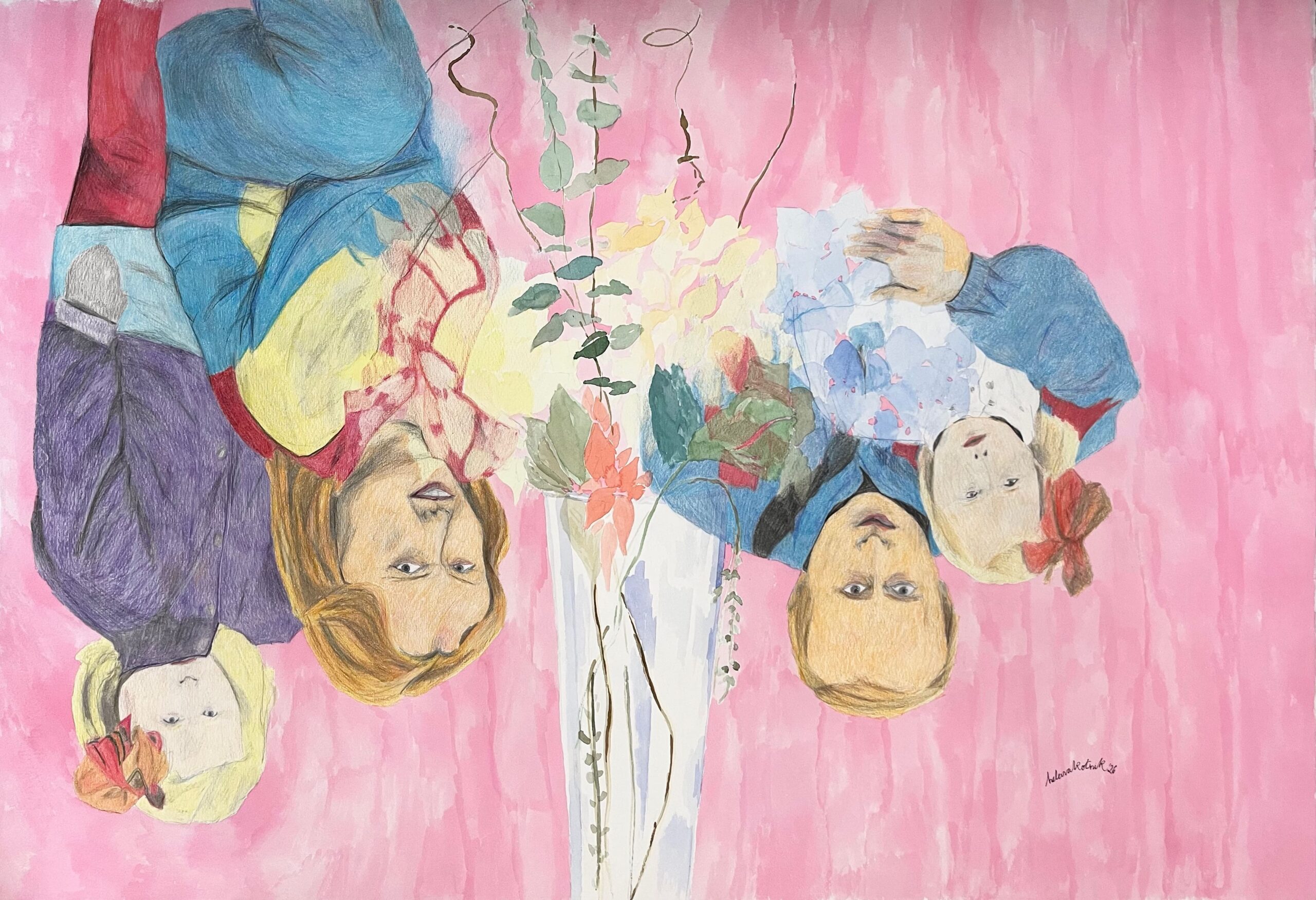
One of Helena Kotnik’s notable works, Family, exemplifies many of the themes and techniques that define her artistic practice. Measuring 100 x 70 cm and created using gouache, colored pencils, and watercolor, the piece explores the emotional complexity of human relationships and the fragile structures that connect individuals to one another.
Rather than presenting an idealized image of family, Kotnik approaches the subject as a psychological and emotional landscape. The painting reflects intimacy while also suggesting tension, vulnerability, and emotional fragmentation. Through layered forms, expressive lines, and dynamic color relationships, the work captures the complicated realities that often exist within personal relationships.
The materials themselves contribute significantly to the emotional atmosphere of the piece. Gouache provides opacity and intensity, watercolor introduces fluidity and softness, while colored pencils create intricate details and subtle emotional textures. Together, these mediums allow Kotnik to construct a composition that feels simultaneously delicate and emotionally charged.
Like much of her work, Family avoids straightforward interpretation. Instead, it invites viewers to reflect on their own experiences of connection, belonging, identity, and emotional memory. The painting becomes less about a specific narrative and more about the universal emotional structures that shape human relationships.
Art as Dialogue
Helena Kotnik’s work extends beyond aesthetics and functions as a catalyst for conversation and reflection. Her paintings are not designed simply to decorate a space but to provoke thought and emotional engagement. Through layered symbolism, expressive color, and psychological depth, she encourages viewers to confront the complexities of contemporary life and their own place within it.
In an increasingly fast-paced and polarized world, Kotnik’s art offers an alternative approach grounded in nuance, openness, and emotional honesty. Her works remind viewers that identity is not fixed, that human emotions are often contradictory, and that uncertainty can itself become a meaningful space for reflection.
This commitment to openness is what gives her art such enduring power. By refusing to impose definitive conclusions, Helena Kotnik creates space for personal interpretation and genuine dialogue. Her paintings remain in the viewer’s mind because they continue to ask questions long after the visual experience has ended.
Through her multidisciplinary practice and emotionally layered visual language, Helena Kotnik continues to build a body of work that is both deeply personal and universally resonant. Her art captures the tensions, vulnerabilities, and possibilities of contemporary life while inviting audiences to look more closely at themselves and the world around them.
