


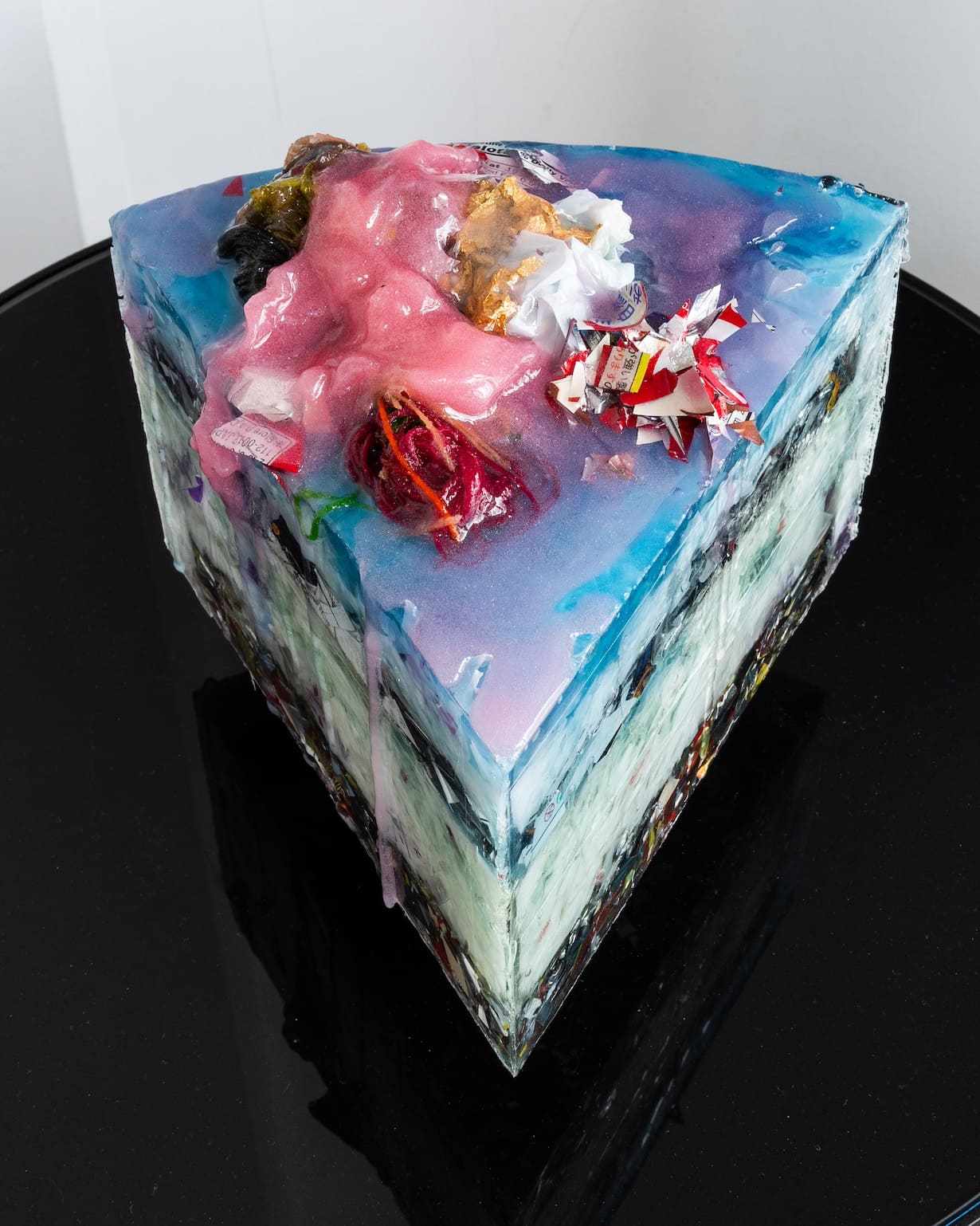
Charles Osawa is a contemporary American sculptor whose work challenges audiences to reconsider the relationship between beauty, excess, and waste. Working primarily with recycled materials and epoxy resin, Osawa creates sculptures that are visually striking while carrying complex social commentary. His artistic practice transforms discarded objects into lasting works of art, highlighting the contradictions of modern life and encouraging viewers to confront the environmental and cultural consequences of consumerism.
Born in Los Angeles, California, in 1983, Osawa pursued studies in interior design and architecture at Parsons School of Design in New York, graduating with Departmental Honors in Architectural Design in 2008. His architectural education continues to influence his sculptural language, evident in the careful balance of structure, composition, and spatial awareness found throughout his work. Today, living and working in New York, he has established a distinctive artistic voice that bridges design, sculpture, and conceptual art.
His growing international recognition includes receiving both the Emerging Artist Grant and the Denis Diderot Grant from Château d’Orquevaux in 2025. His work has also been featured at Satellite Art Show during Miami Art Basel in 2025 and the Work In Progress anti-art fair during Mexico City Art Week in 2026, demonstrating his increasing presence within contemporary art circles.
Architecture as the Foundation of Artistic Thinking
Osawa’s background in architectural design provides more than technical precision it shapes the way he conceptualizes sculpture itself. Rather than simply assembling found materials, he constructs experiences that encourage viewers to examine form, texture, permanence, and symbolism simultaneously.
Architecture teaches the organization of space, while sculpture allows emotions and narratives to occupy that space. Osawa merges these disciplines by creating works that possess structural sophistication while remaining emotionally provocative. Every material, surface, and compositional decision contributes to a larger conversation about society and human behavior.
This architectural sensibility also influences the way his sculptures interact with viewers. Rather than existing solely as isolated objects, they become environments of thought that invite multiple interpretations from different perspectives.
Recycled Materials as Cultural Memory
One of the defining characteristics of Charles Osawa’s artistic practice is his commitment to recycled materials. Instead of viewing discarded objects as worthless, he treats them as fragments of contemporary civilization carrying hidden histories.
Every piece of refuse has already lived a life within society. Packaging, plastics, broken objects, and industrial remnants all reflect patterns of consumption that define modern culture. By incorporating these materials into his sculptures, Osawa preserves traces of collective human behavior while simultaneously questioning the systems that produced them.
His process transforms trash into permanence, suggesting that what society attempts to forget often becomes its most enduring legacy. In this sense, recycling becomes both an environmental act and a philosophical one, turning waste into evidence of civilization itself.
The materials retain their original identities while acquiring entirely new meanings, allowing audiences to reconsider what value truly means in an age dominated by disposable culture.
The Cake Series: Luxury Beneath the Surface
Among Osawa’s most compelling bodies of work is his Cake Series, an exploration of what he describes as “the highest form of social discomfort expressed in the world of Art.”
At first glance, the sculptures resemble extravagant celebratory cakes, objects universally associated with joy, abundance, achievement, and indulgence. Their colorful forms and glossy finishes immediately attract viewers through familiarity and visual pleasure.
Yet beneath this seductive exterior lies something profoundly unsettling.
Rather than edible confections, these cakes are constructed from discarded materials preserved within layers of epoxy resin. They become monuments to consumption rather than celebration, exposing the uncomfortable relationship between desire, excess, and waste.
The cake functions as a universal cultural symbol. Across societies, cakes mark birthdays, weddings, achievements, and celebrations. Osawa subverts this familiar object, transforming it into a metaphor for social absurdity. Instead of nourishment, viewers encounter preserved debris. Instead of sweetness, they confront permanence.
This inversion encourages audiences to question what contemporary society truly celebrates.
Grotesque Luxury and the Performance of Consumption
Osawa introduces the concept of “grotesque luxury” throughout the Cake Series, challenging conventional ideas of beauty and wealth.
Luxury traditionally represents perfection, abundance, exclusivity, and refinement. Osawa complicates these expectations by combining luxurious visual aesthetics with the reality of discarded waste. The sculptures appear expensive, polished, and desirable while simultaneously exposing the hidden consequences of consumer culture.
The tension between attraction and discomfort becomes central to the viewing experience.
The glossy resin surfaces invite admiration, yet closer inspection reveals fragments of refuse embedded within them. This contradiction mirrors contemporary society itself, where polished appearances frequently conceal environmental degradation, overconsumption, and social imbalance.
Rather than condemning consumer culture outright, Osawa presents it honestly, allowing irony to become one of his strongest artistic tools.
Epoxy Resin and the Illusion of Permanence
Perhaps the most intellectually compelling aspect of Osawa’s work lies in his use of epoxy resin.
Resin possesses extraordinary durability, capable of preserving objects for immense periods of time. Osawa intentionally exploits this material quality to create a striking paradox. The very objects society considers disposable become preserved for generations.
His statement that the Cake Series aims to “deliver our shards of trash to the future with taste” captures both humor and tragedy simultaneously.
The resin transforms temporary waste into archaeological artifacts of the future. If future civilizations were to encounter these sculptures, they would discover not precious relics but evidence of humanity’s consumption habits carefully sealed within transparent permanence.
The sculptures therefore function as speculative time capsules, preserving today’s environmental footprint as tomorrow’s historical record.
Social Absurdism and Cultural Reflection
Throughout his practice, Osawa reflects what he describes as “the cycle of social absurdism entrapped in inevitable social decay.”
His sculptures explore contradictions that have become normalized within contemporary society. Humanity produces unprecedented abundance while generating unprecedented waste. Objects are manufactured for convenience but discarded with astonishing speed. Luxury and excess often exist alongside environmental instability.
Rather than illustrating these issues literally, Osawa communicates them through symbolism.
His work avoids direct political messaging in favor of visual metaphors that encourage personal reflection. Viewers are invited to recognize themselves within the sculptures, seeing their own habits, celebrations, and participation in broader systems of consumption.
This openness allows the work to resonate across cultures, making its social commentary universally accessible.
Sculpture as a Dialogue Between Beauty and Responsibility
Charles Osawa’s sculptures demonstrate that contemporary art can be visually captivating while remaining intellectually rigorous. His ability to balance elegance with discomfort allows his work to transcend traditional categories of environmental art, conceptual sculpture, and social critique.
The Cake Series illustrates how familiar symbols can be reimagined to reveal uncomfortable truths about contemporary existence. By preserving discarded materials within beautiful sculptural forms, Osawa asks audiences to reconsider not only what they consume, but what they choose to preserve both materially and culturally.
His work reminds us that the future will inherit more than our achievements. It will also inherit the physical evidence of our values, habits, and priorities.
Through recycled materials, architectural precision, and conceptual depth, Charles Osawa transforms waste into lasting cultural testimony. His sculptures become monuments to the contradictions of modern civilization beautiful, unsettling, ironic, and enduring. In doing so, he offers a powerful reflection on the legacy humanity is creating, one preserved fragment at a time.
