


YE Xingqian, born in 1963, is a painter whose life and work embody a rare fusion of cultural identities. Of Chinese origin and later naturalized as a French citizen, his journey reflects both geographical movement and artistic evolution. From an early age, his path seemed almost inevitable. He began painting at just five years old, demonstrating a precocious sensitivity to form, rhythm, and the expressive potential of traditional techniques.
In 1982, YE Xingqian made a defining decision to emigrate to France. This transition marked more than a change of location; it opened a dialogue between Eastern and Western artistic traditions that would shape his entire career. Immersed in the European art scene while remaining deeply connected to his Chinese heritage, he cultivated a visual language that transcends borders. His work does not simply merge influences but reinterprets them, creating a space where cultural memory and contemporary expression coexist.
Recognition Across Continents
Over the decades, YE Xingqian has achieved significant recognition both in Europe and Asia. His work has been embraced by major institutions, affirming his place within the global art landscape. In 2018, five of his delicate watercolors on rice paper entered the permanent collection of the Guimet National Museum, one of Europe’s most important museums dedicated to Asian art. This milestone highlighted the enduring relevance of his mastery of traditional Chinese techniques.
His presence in institutional collections continued to grow. In 2021, a large ink painting on canvas was acquired by the Cernuschi Museum, further reinforcing his reputation as a contemporary interpreter of ink painting. By 2024, six of his works had been acquired by the Georges Labit Museum and exhibited at the Paul Dupuy Museum, demonstrating sustained institutional interest in his evolving practice.
Meanwhile, in China, his trajectory followed a more complex path. Initially misunderstood, his work challenged conventional expectations of traditional painting. Over time, however, perceptions shifted. His art began to resonate more deeply, leading to regular exhibitions and increasing recognition. A defining moment came in 2023, when he received a prestigious commission from the Chinese government. The resulting large scale canvas was displayed at the historic Zhengyangmen Gate in Beijing, a powerful acknowledgment of his significance within the cultural sphere.
The Language of Ink
At the heart of YE Xingqian’s practice lies ink, a medium deeply rooted in Chinese artistic tradition. Yet his approach is far from conventional. Rather than adhering strictly to classical methods, he explores the expressive possibilities of ink in a contemporary context. His compositions often balance spontaneity with control, allowing fluid gestures to interact with carefully structured forms.
Ink, for YE Xingqian, is not merely a material but a language. Through variations in density, rhythm, and movement, he conveys emotion, atmosphere, and philosophical reflection. His works often evoke landscapes, but they resist literal representation. Instead, they suggest inner worlds, inviting viewers to engage in contemplation.
A Monumental Ink Composition
One of the highlighted works is a monumental ink painting on Chinese paper measuring 492 x 220 cm. This expansive format allows YE Xingqian to fully explore the dynamic potential of ink. The scale itself is significant as it transforms the act of painting into a physical, almost performative gesture.
In this piece, the viewer encounters sweeping movements and layered textures that create a sense of depth and energy. The composition unfolds gradually, encouraging the eye to travel across its surface. There is a tension between emptiness and fullness, a hallmark of traditional Chinese aesthetics, yet the execution feels distinctly modern.
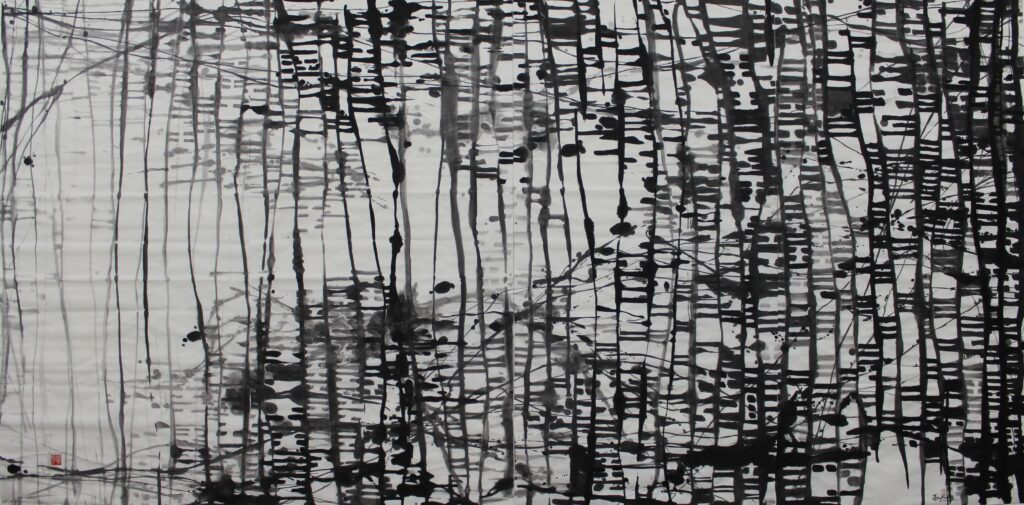
The work’s size also reinforces its immersive quality. Standing before it, one is not simply observing an image but entering a visual environment. The ink flows with a sense of inevitability, as though guided by an internal logic that transcends conscious control. This balance between intention and spontaneity is central to YE Xingqian’s artistic philosophy.
Porcelain as a Contemporary Medium
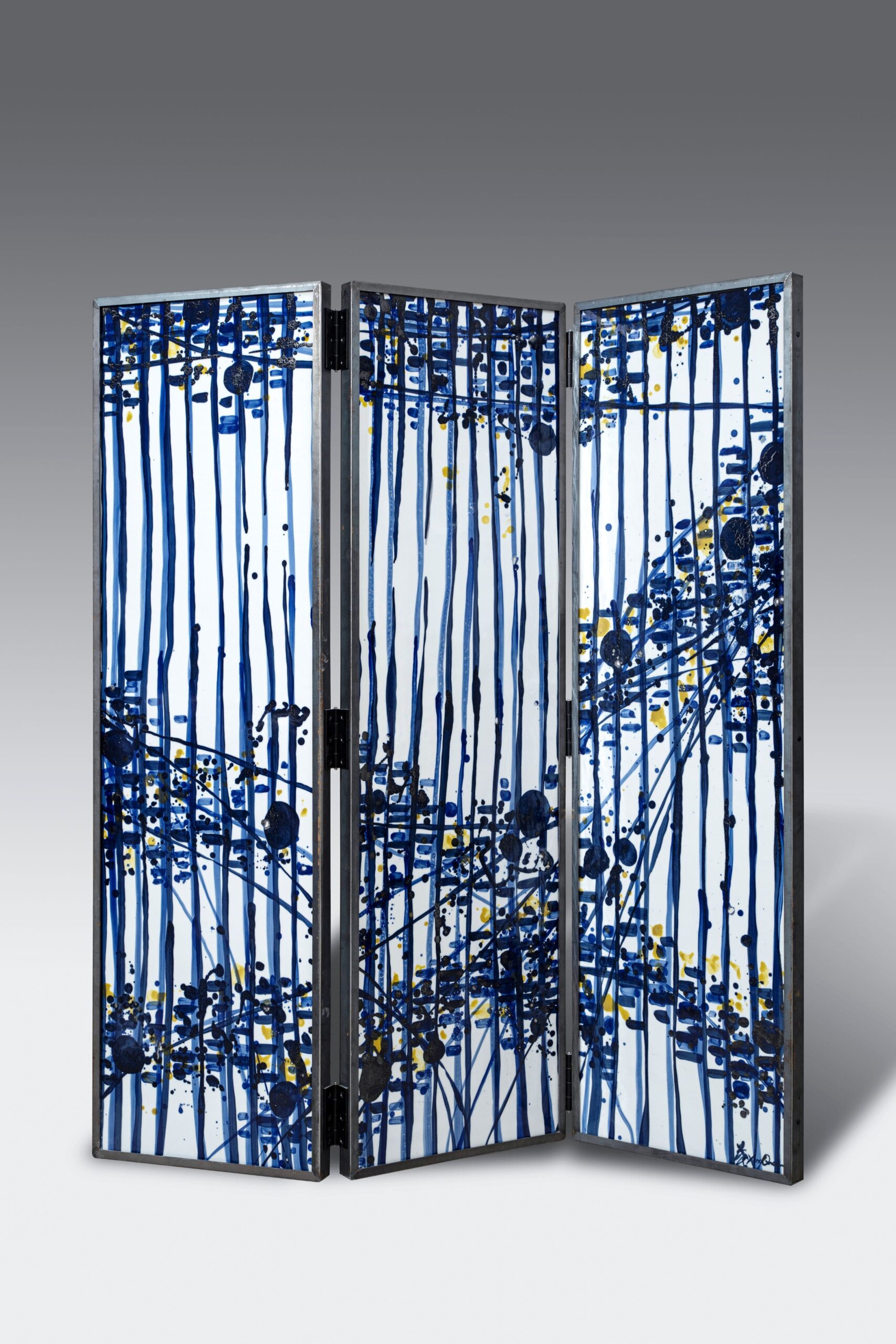
In contrast to the fluidity of ink on paper, YE Xingqian’s folding screen made of porcelain introduces a different material dimension. Measuring 170 x 150 cm, with each panel at 170 x 50 cm, the work reimagines a traditional format through an unconventional medium.
The folding screen has a long history in East Asian art, often used as both a functional object and a decorative surface. By choosing porcelain, a material associated with fragility, refinement, and craftsmanship, YE Xingqian transforms this historical form into something strikingly contemporary.
The use of porcelain introduces a tactile and reflective quality that contrasts with the absorbent nature of paper. Light interacts with the surface, creating subtle variations that change depending on the viewer’s perspective. This interplay adds a dynamic element to the work, making it feel alive and responsive.
At the same time, the segmentation of the panels creates a rhythm that guides the viewer’s experience. Each section can be read individually, yet together they form a cohesive whole. This balance between fragmentation and unity echoes broader themes in YE Xingqian’s work, particularly the idea of bridging different cultural and artistic traditions.
Between Tradition and Innovation
What defines YE Xingqian’s practice is his ability to navigate the space between tradition and innovation. He does not reject the past. Instead, he engages with it critically and creatively. His work reflects a deep respect for classical Chinese art while simultaneously pushing its boundaries.
This duality is also reflected in his personal journey. As an artist who has lived and worked between China and France, he embodies a cross-cultural perspective that informs every aspect of his practice. His art becomes a site of dialogue, where different histories, philosophies, and aesthetic values intersect.
A Continuing Evolution
YE Xingqian’s career is marked by constant evolution. From his early experiments with ink to his large-scale contemporary works, he has continually expanded his artistic vocabulary. His recognition by major institutions and his growing presence in both Europe and China suggest that his work resonates across cultural contexts.
Yet what remains most compelling is his commitment to exploration. Each work represents not a conclusion but a step in an ongoing process. Whether working with ink, paper, or porcelain, YE Xingqian approaches his practice with a sense of curiosity and openness.
Conclusion
YE Xingqian stands as a significant figure in contemporary art, not only for his technical mastery but for his ability to bridge cultures and reimagine tradition. His work invites viewers to reconsider the possibilities of ink painting and to engage with art as a space of reflection and connection.
Through monumental compositions and innovative use of materials, he continues to push the boundaries of his medium while remaining deeply rooted in his heritage. In doing so, he creates art that is both timeless and profoundly relevant, offering a vision that transcends geographical and cultural divides.
