


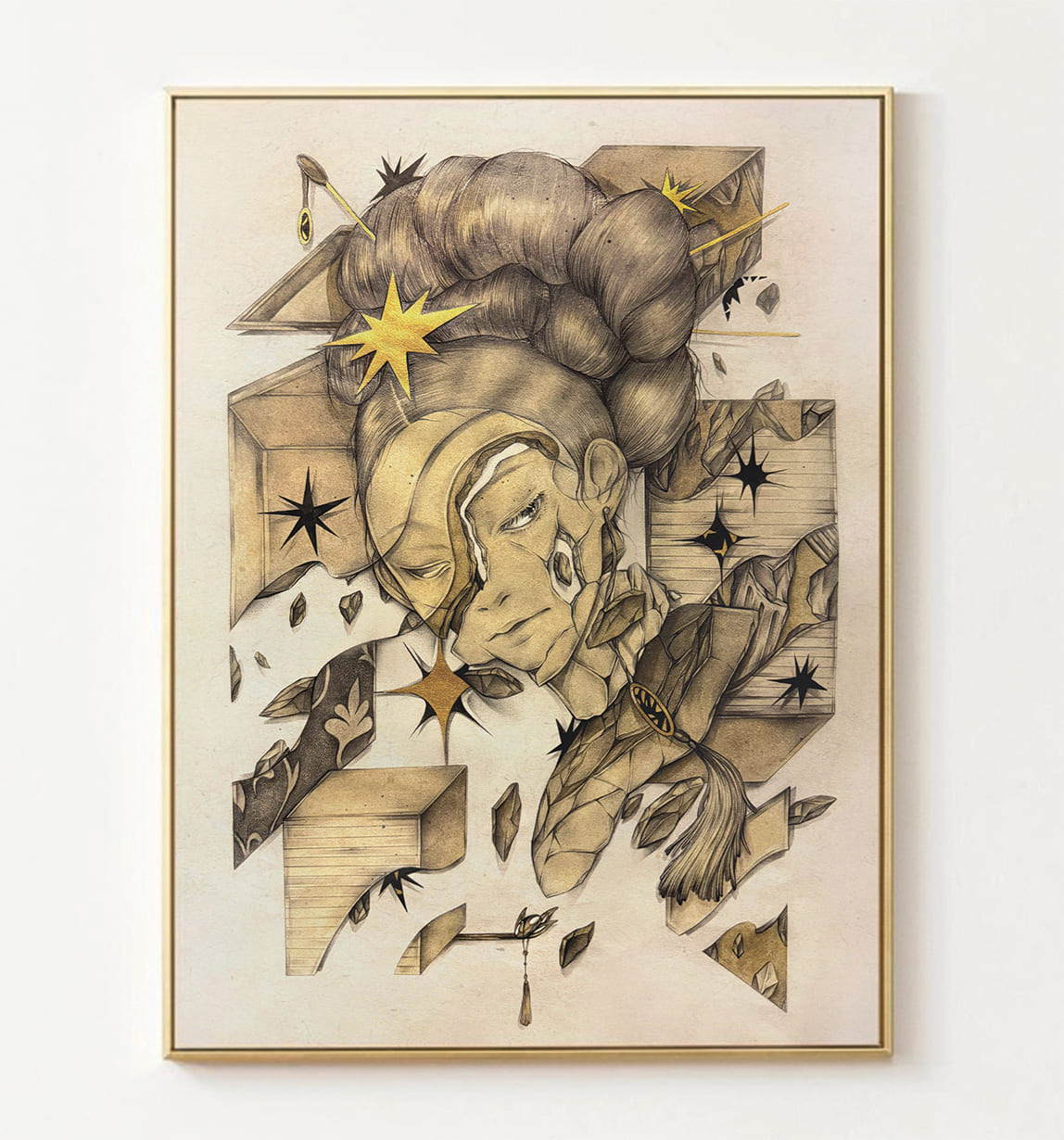
Min Park is a Brooklyn-based artist and illustrator whose work invites viewers into a space where identity is not fixed, but constantly shifting, dissolving, and reforming. Through her distinctive visual language, she explores the complexities of memory, perception, and the subconscious. Her work does not simply depict figures or narratives, it creates an atmosphere where emotions, thoughts, and fragments of experience coexist in a delicate balance.
With a Master of Fine Arts in Communication Design from Pratt Institute and a Bachelor of Fine Arts from Dankook University, Park brings both conceptual depth and technical precision to her practice. Her background allows her to bridge storytelling with a systems-driven approach, working fluidly across digital, motion, and print. Yet, at the heart of her practice lies a deep commitment to traditional mediums, particularly ink and watercolor, which she uses to build immersive and layered compositions.
A Foundation Rooted in Tradition and Innovation
Park’s artistic journey is shaped by a dialogue between tradition and contemporary practice. Drawing inspiration from Korean art traditions, she embraces the expressive qualities of ink, where each line carries intention and spontaneity. At the same time, her work reflects a modern sensibility, integrating abstraction, fragmentation, and conceptual storytelling.
Her training in communication design plays a significant role in how she constructs her images. There is a structural awareness in her compositions, where each element feels carefully placed yet organically evolving. This balance between control and fluidity allows her to create works that feel both intentional and ephemeral.
By combining traditional techniques with contemporary ideas, Park creates a visual language that feels timeless yet distinctly current. Her work resonates with audiences across cultures, as it speaks to universal experiences of identity, memory, and transformation.
The Language of Ink and Watercolor
Ink and watercolor are central to Park’s artistic expression. These mediums allow her to explore subtle variations in tone, texture, and movement. Her ink lines are often delicate yet purposeful, forming the foundation of her compositions. They guide the viewer’s eye while also suggesting movement and transformation.
Watercolor, on the other hand, introduces softness and atmosphere. Through gentle washes and restrained palettes, she creates depth without overwhelming the composition. The interplay between ink and watercolor results in a dynamic tension, where precision meets fluidity.
This combination enables Park to build layered images where forms appear and disappear. Figures are not always clearly defined. Instead, they emerge from the surface and dissolve back into it, reflecting the transient nature of identity and memory.
Exploring Identity as a Fluid Experience
One of the central themes in Park’s work is identity. Rather than presenting it as something stable or fixed, she portrays identity as fluid and ever-changing. Her compositions often feature faces and figures that shift, overlap, and fragment. These elements suggest the multiple layers that make up a person’s sense of self.
Through repetition and variation, she emphasizes the idea that identity is not singular. It is shaped by memories, experiences, and perceptions that evolve over time. The fragmented nature of her imagery reflects this complexity, inviting viewers to consider their own shifting identities.
Negative space plays a crucial role in this exploration. By leaving areas undefined, Park creates room for ambiguity and interpretation. This openness allows viewers to project their own experiences onto the work, making each encounter deeply personal.
Memory and Dreamlike Perception
Memory is another key element in Park’s artistic practice. Her work captures the way memories are often incomplete, layered, and influenced by emotion. Instead of presenting clear narratives, she creates compositions that feel like glimpses into a dream or a fleeting thought.
The dreamlike quality of her work is achieved through subtle transitions, soft edges, and atmospheric layering. Forms blend into one another, creating a sense of movement and transformation. This reflects the way memories can shift over time, becoming less defined yet more emotionally resonant.
Her use of repetition reinforces this idea. By revisiting certain shapes or forms, she mimics the way memories resurface and evolve. These repetitions create rhythm within the composition, guiding the viewer through a visual journey that feels both familiar and elusive.
Composition and the Power of Restraint
One of the most striking aspects of Park’s work is her use of restraint. Rather than relying on bold colors or complex details, she often works with a limited palette. This minimalism draws attention to the nuances of mark-making and composition.
Every line, wash, and space is carefully considered. The tension between filled and empty areas creates a sense of balance and harmony. At the same time, it introduces a quiet intensity, as viewers are encouraged to focus on subtle details and transitions.
This approach allows Park to create compositions that are both visually engaging and emotionally resonant. The simplicity of her palette enhances the complexity of her themes, making her work both accessible and thought-provoking.
Bridging Inner Thought and Lived Experience
Park’s work exists at the intersection of inner thought and lived experience. Her compositions do not depict specific events or stories. Instead, they capture the emotional and psychological landscapes that shape how we understand ourselves and the world around us.
By blending figurative and abstract elements, she creates a space where reality and imagination coexist. This ambiguity allows viewers to interpret the work in their own way, finding connections that resonate with their personal experiences.
Her ability to translate complex ideas into visual form is a testament to her skill as both an artist and a storyteller. Each piece becomes a reflection of the human experience, exploring themes that are deeply personal yet universally relatable.
Recognition and Global Presence
Min Park’s work has been exhibited internationally, reaching audiences across different cultural contexts. Her ability to communicate complex ideas through visual language has earned her recognition from leading institutions, including the Society of Illustrators.
This recognition highlights the impact of her work within the contemporary art and illustration landscape. It also reflects her ability to push boundaries while remaining grounded in a strong artistic foundation.
As her career continues to evolve, Park remains committed to exploring new ways of expressing identity, memory, and perception. Her work continues to resonate with viewers, offering a space for reflection and introspection.
A Continuing Exploration
Min Park’s artistic practice is an ongoing exploration of the self and the world. Through her use of ink, watercolor, and layered composition, she creates works that invite viewers to slow down and engage deeply.
Her ability to balance tradition and innovation, structure and fluidity, makes her work both distinctive and compelling. Each piece becomes a moment of discovery, where forms shift, meanings evolve, and new interpretations emerge.
In a world that often seeks clarity and definition, Park’s work embraces ambiguity and transformation. It reminds us that identity is not a fixed destination, but a continuous journey shaped by memory, perception, and experience.
