


Henrik Peter Hofsaess (b. 1968, Germany) is a contemporary painter whose artistic practice is shaped by a profound interest in the human soul, its vulnerabilities, and the forces that influence personal identity. Living and working between Germany and Italy, Hofsaess occupies a creative space where different cultural landscapes, histories, and artistic traditions meet. His paintings emerge from an ongoing investigation into the emotional and psychological dimensions of human existence.
Rather than treating painting simply as a means of depicting the visible world, Hofsaess uses it to explore what lies beneath the surface. His works often focus on moments of vulnerability, inner conflict, and transformation, the quiet points at which individuals are forced to confront themselves without protection or disguise.
This interest in the human condition gives his paintings an introspective quality. Figures appear caught between opposing forces, while materials, color, light, and layered surfaces contribute to a sense of emotional depth. Through this approach, Hofsaess creates works that invite viewers to look beyond the immediate image and consider the psychological stories embedded within it.
The Material Language of Natural Pigments
A defining characteristic of Hofsaess’s practice is his use of natural materials. He works with natural earth and mineral pigments, oil paint, and gold leaf, applying them to carefully selected natural fabrics such as Belgian linen, Italian linen, and hemp.
These materials are not merely technical choices. They become an essential part of the meaning and atmosphere of his paintings. Earth pigments, in particular, establish a direct connection between the artwork and the natural world. Their physical origins introduce a sense of age, history, and permanence, while the organic surfaces of linen and hemp provide a tactile foundation for the paintings.
Hofsaess develops his compositions through many translucent layers. Instead of creating an image through a single, definitive application of paint, he allows the work to gradually emerge. Earlier layers remain partially visible beneath subsequent ones, producing surfaces that appear both fragile and substantial.
This process mirrors the psychological concerns of his art. Human identity is rarely formed from a single experience. It is accumulated through memories, wounds, relationships, fears, desires, and transformations. In a similar way, Hofsaess’s paintings contain histories within their surfaces.
Gold leaf introduces another dimension to this material language. Against the earth-based pigments and organic fabrics, gold can appear almost otherworldly. It can suggest illumination, transcendence, value, or the possibility of something enduring beyond suffering.
The Human Soul at the Center
At the heart of Hofsaess’s artistic practice is a fascination with the human soul. His paintings seek out what might be described as the quiet and vulnerable moment when a person stands truly naked before themselves.
This metaphorical nakedness is not necessarily about the physical body. Instead, it refers to psychological exposure, the moment when defenses fall away, and an individual is confronted by their own fears, memories, identity, and inner conflicts.
Themes of identity, trauma, and transformation therefore become central to his work. Hofsaess is interested in the forces that shape people, including experiences that can leave lasting emotional marks. His figures frequently seem to exist within a state of tension, suggesting that transformation is rarely comfortable or straightforward.
The artist’s approach also allows ancient stories and archetypal forces to become vehicles for contemporary psychological questions. Myth, in this context, is not simply a subject from the past. It becomes a language through which modern experiences can be examined.
Europa: A Contemporary Reinterpretation of an Ancient Myth
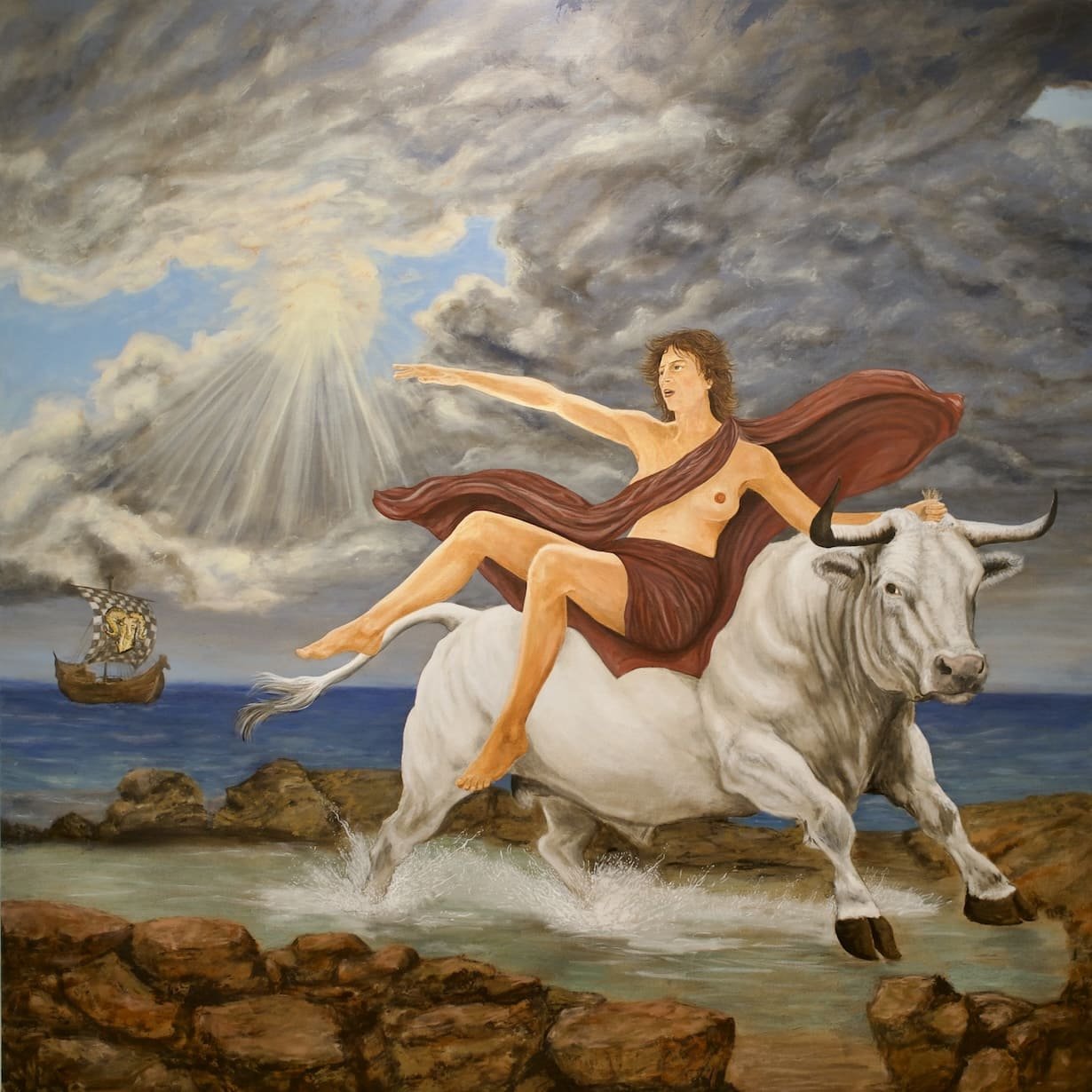
One of Hofsaess’s powerful examples of this approach is Europa, a monumental painting measuring 180 × 180 cm. Created with earth and stone pigments, oil paint, and gold leaf on a 4.5 cm deep Florentine linen canvas, the work reinterprets the classical myth of Europa and Zeus.
In the ancient story, Zeus takes the form of a white bull and abducts Europa. Hofsaess transforms this familiar myth into a psychologically charged composition. The female figure rides the powerful, surging animal across turbulent waters, while her arm reaches toward a break of light within the surrounding storm.
The monumental scale of the painting intensifies the drama. Europa is not presented within a calm or decorative mythological landscape. Instead, she appears surrounded by movement, danger, uncertainty, and overwhelming natural forces.
The turbulent waters can be read as a visual representation of emotional upheaval. The storm becomes more than a physical environment; it suggests an internal state in which identity and security are destabilized. Europa’s position on the bull places her within an experience that is simultaneously physical, psychological, and symbolic.
Identity, Violence, and the Search for Redemption
The significance of Europa extends beyond its mythological narrative. Hofsaess uses the story as an allegory for identity, origin, violence, and the fragile desire for redemption.
Europa’s journey begins through an act of violence and loss of control. By placing this figure within turbulent waters and directing her gesture toward light, Hofsaess creates an image of someone caught between vulnerability and hope.
The outstretched arm becomes especially important. Within the darkness and instability of the storm, the gesture toward light can suggest a desire for escape, recognition, healing, or transformation. Yet the light remains distant and fragile. It does not erase the violence that has already occurred.
This tension gives the painting its emotional power. Redemption is presented not as an easy resolution but as a possibility that must be reached through uncertainty.
The myth also raises questions about origin and identity. Europa is both an individual figure and a cultural symbol whose name has become associated with an entire continent. Hofsaess’s interpretation opens a space for considering how identities are formed through histories that can contain both beauty and violence.
Painting as a Process of Transformation
The layered technique used in Europa reinforces its thematic concerns. The translucent applications of earth pigments and oil create a surface in which forms seem to emerge gradually from beneath one another.
There is something inherently transformative about this process. The painting develops through accumulation, concealment, revelation, and refinement. What is visible at the end is the result of everything that came before.
This can be understood as a metaphor for personal transformation. Trauma and difficult experiences may become buried within a person, but they can continue to influence the visible self. Transformation does not necessarily mean erasing the past. Instead, it can involve acknowledging and integrating what has already happened.
In this sense, Hofsaess’s paintings operate simultaneously as images and material records of a process.
Recognition and International Exhibition
Hofsaess’s work has received recognition in Germany and Italy, where he has exhibited, as well as through international juried exhibitions in the United States and the United Kingdom. His recent distinctions include First Prize at the Premio Rotary Rivolta d’Adda and the Creative Excellence Award from the Circle Foundation for the Arts.
His paintings have also appeared in essays, exhibition catalogues, and art publications, extending the conversation around his practice beyond the gallery environment.
These recognitions reflect an artistic practice that combines material experimentation with ambitious psychological and symbolic themes. Hofsaess’s work demonstrates how contemporary painting can engage with ancient narratives while addressing deeply personal and universal questions.
Finding Light Within the Storm
Henrik Peter Hofsaess’s paintings inhabit a space between the physical and psychological. Earth, stone, linen, oil, and gold become more than materials; they form a visual vocabulary through which questions of identity, vulnerability, trauma, and transformation can be explored.
In Europa, an ancient myth becomes a contemporary meditation on violence, origin, uncertainty, and the desire to find light within darkness. The monumental figure moving through turbulent waters captures a moment in which vulnerability and hope exist side by side.
Ultimately, Hofsaess’s work asks viewers to look inward. His paintings do not offer simple answers to the complexities of human experience. Instead, they create spaces for contemplation, places where myth, memory, material, and emotion converge.
Through translucent layers of paint and pigment, Hofsaess reveals that what lies beneath the surface can be just as important as what first meets the eye. His art reminds us that identity is continually shaped, challenged, and transformed, and that even within the darkest moments, the possibility of light remains.
