


Bill Schmidt was born in Trenton, New Jersey in 1947 and is currently based in Baltimore, Maryland. Over the course of a long and sustained career, he has developed a distinctive approach to painting that emphasizes process, uncertainty, and continual adjustment. His work reflects a deep engagement with material exploration and an openness to unpredictability, where each artwork becomes a record of evolving decisions rather than a fixed concept executed in advance.
Schmidt studied at the Pennsylvania Academy of the Fine Arts, where he earned his Bachelor of Fine Arts in 1969. He further expanded his artistic development by attending the Skowhegan School of Painting and Sculpture in Maine, an influential program known for fostering experimentation and dialogue among emerging artists. Shortly after this formative experience, he moved to Baltimore in 1969, a city that would become central to his personal and professional life.
He completed his Master of Fine Arts at the Maryland Institute College of Art’s Hoffberger School of Painting in 1971. This academic foundation helped shape his long-term engagement with painting while encouraging a commitment to independent exploration. Over the years, Schmidt has remained closely connected to the Mid-Atlantic art community, exhibiting extensively in the region.
His contributions to the arts have been recognized through several awards and grants, including the Bethesda Painting Award in 2015 and the Semmes G. Walsh Award from the Baker Artist Awards in 2016. Alongside his visual art practice, Schmidt has also sustained a lifelong relationship with music, performing traditional American fiddle, banjo, and guitar music for more than fifty years.
A Painter Focused on Process and Uncertainty
At the core of Schmidt’s painting practice is a belief that art emerges through process rather than predefinition. His works are created through water soluble gouache applied to wooden panels, typically no larger than 16 by 16 inches. These modest dimensions allow for concentrated attention, where every mark carries significance and every adjustment contributes to the evolving structure of the composition.
Schmidt does not approach his paintings with a fixed outcome in mind. Instead, he allows each work to develop through a series of choices, revisions, interruptions, and discoveries. His process includes moments of clarity as well as missteps, corrections, and unexpected results. He often describes painting as something that unfolds without full knowledge of what comes next, similar to the uncertainties of lived experience.
This approach places importance on responsiveness. Each decision within the painting influences what follows, creating a layered accumulation of visual events. Rather than concealing changes or revisions, Schmidt allows them to remain visible, giving the surface a sense of memory and lived time.
The use of gouache plays a significant role in this process. Its water based properties allow for both opacity and adjustment, enabling him to build surfaces that can be revised and reworked. The material supports his interest in change and transformation, making the act of painting an ongoing dialogue between intention and accident.
Hanger (2025) and the Language of Exploration
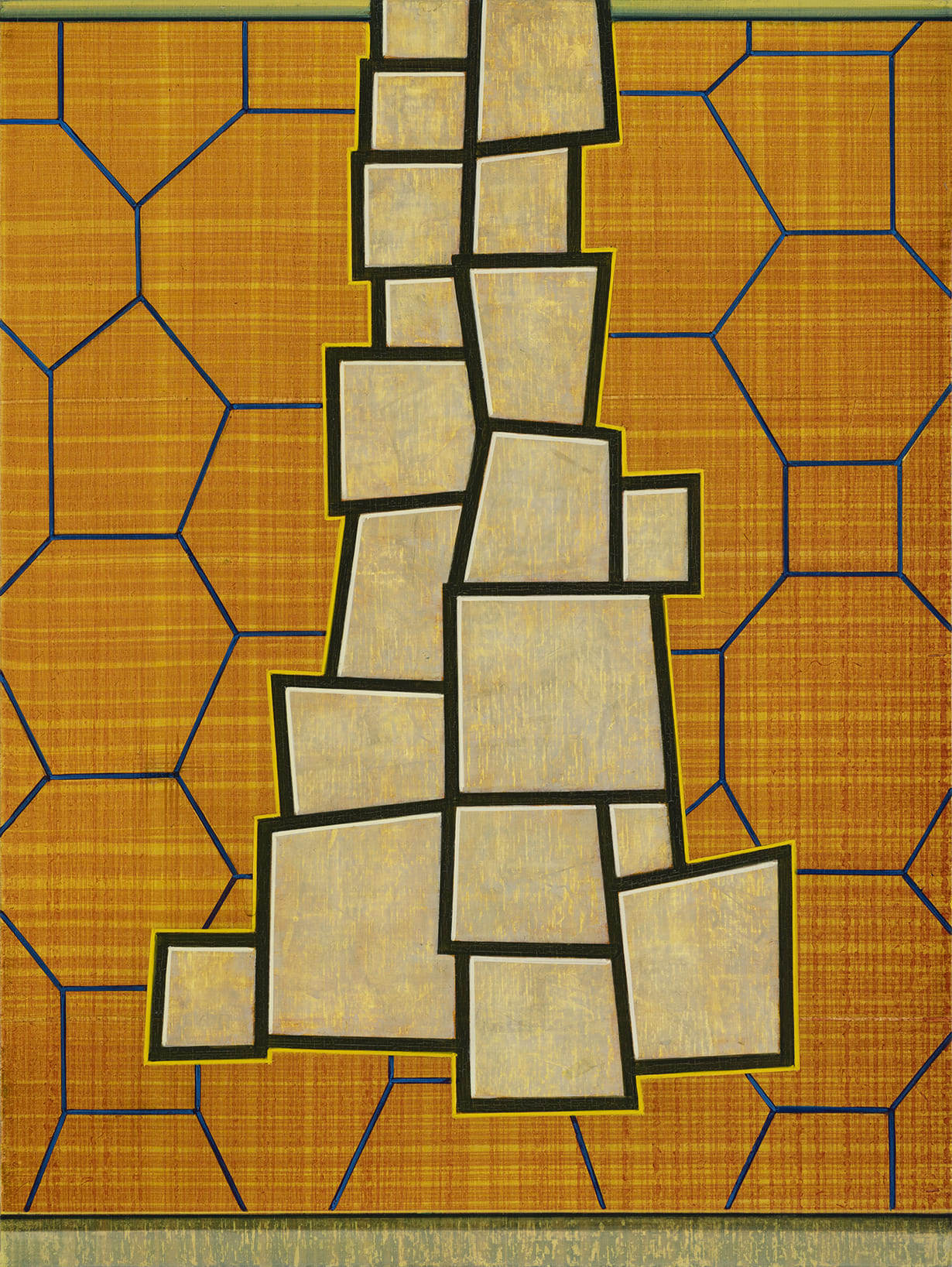
The painting titled Hanger created in 2025, measuring 12 inches by 9 inches, exemplifies Schmidt’s approach to painting as a process of discovery. While modest in scale, the work contains a complexity that unfolds through close and sustained viewing.
Rather than presenting a single resolved idea, Hanger operates as a space where forms, gestures, and color relationships interact in a state of constant negotiation. The composition suggests movement and adjustment, as if each element has been placed, reconsidered, and reinterpreted over time.
What makes the work compelling is its openness. It does not assert a singular meaning but instead invites interpretation through experience. The viewer becomes part of the unfolding process, responding to shifts in tone, structure, and rhythm. In this way, the painting reflects Schmidt’s belief that understanding develops gradually rather than immediately.
Hanger also reflects the broader rhythm of his practice, where uncertainty is not something to be resolved but something to be embraced. The painting holds traces of decision making, allowing viewers to sense the sequence of actions that contributed to its final form.
Small Scale as an Expansive Space
Although Schmidt works within relatively small formats, his paintings achieve a sense of expansiveness through complexity and depth. The limited size of the panels encourages intimacy, drawing the viewer into close proximity with the surface. This closeness reveals subtle variations in texture, layering, and color relationships that might otherwise be overlooked.
The scale also reinforces the immediacy of decision-making. Every mark is visible, every adjustment contributes directly to the composition, and every layer interacts closely with what came before it. This creates a concentrated field of activity where painting becomes both physical and reflective.
Rather than restricting expression, the smaller format intensifies it. It allows Schmidt to explore ideas in a direct and focused manner while maintaining the flexibility to revise and respond throughout the process.
Painting as a Reflection of Life
Schmidt often draws a parallel between painting and life itself. Both involve navigating uncertainty, responding to unforeseen circumstances, and making decisions without complete information. His paintings reflect this reality by preserving traces of hesitation, correction, and change.
In this sense, each artwork becomes a record of lived experience. The accumulation of marks mirrors the accumulation of moments in life, where meaning emerges not from control but from interaction and adaptation. The viewer is invited to consider the painting not as a finished object but as evidence of an ongoing process.
This perspective gives his work a deeply human quality. It acknowledges imperfection as an essential part of creation and recognizes that understanding often arises through engagement rather than certainty.
A Parallel Life in Music
In addition to his visual art practice, Schmidt has maintained a long-standing engagement with music. For over five decades, he has played traditional American music using fiddle, banjo, and guitar. This musical practice reflects many of the same values present in his painting.
Music, like painting, involves timing, improvisation, and responsiveness. It requires attentiveness to rhythm and the ability to adapt in real time. Schmidt’s dual involvement in both disciplines highlights a consistent interest in process-driven creation, where structure and spontaneity coexist.
This connection between music and painting reinforces the sense that his creative life is unified by a shared approach rather than divided into separate disciplines. Both forms of expression become ways of exploring uncertainty and discovering meaning through action.
Conclusion
Bill Schmidt’s work stands as a sustained exploration of process, material, and uncertainty. From his early education at the Pennsylvania Academy of the Fine Arts and the Skowhegan School of Painting and Sculpture to his long career in Baltimore, he has developed a practice grounded in openness and discovery.
His painting Hanger and his broader body of work demonstrate how small-scale gouache paintings can carry significant conceptual depth. Through accumulation, revision, and responsiveness, Schmidt transforms painting into an ongoing conversation between intention and chance.
In both art and music, he continues to embrace the unknown, allowing each work to emerge through engagement rather than predetermined control. His practice reminds us that creation is not only about what is planned, but also about what is discovered along the way.
