


Ted Barr is a contemporary artist and writer whose work has evolved through more than three decades of experimentation, research, and philosophical inquiry. Rather than approaching painting as a means of representation, Barr views the canvas as a living field where materials, time, and natural forces interact to shape the final image. His distinctive practice combines industrial cold tar, gesso, oil, pigments, and layered processes to create works that investigate the unseen structures underlying both the natural world and human existence. Through his paintings and writings, Barr invites viewers to explore the invisible connections between matter, consciousness, and the universe.
An Artistic Journey Driven by Research
Born in 1957 in Nevodar, Romania, Ted Barr now lives in Tel Mond, Israel, and works from The Home Front Studio in the Hefer Valley. Although his academic background includes a Bachelor’s degree in Economics and an MBA in Economics and Marketing from Tel Aviv University, his lifelong passion for creativity ultimately led him toward the visual arts. Between 1995 and 2002, he studied under Master S. Tzafrir in Old Jaffa, where he refined both his technical abilities and conceptual thinking.
Rather than following traditional artistic methods, Barr gradually moved away from representational painting in search of a deeper understanding of how images form. This shift transformed his artistic process into an ongoing investigation of perception, material behavior, and the invisible forces that influence creation. Every new body of work expands this long-term research, allowing experimentation itself to become the foundation of his practice.
Painting as a Living Process
One of the defining characteristics of Ted Barr’s work is his unconventional use of industrial cold tar. Unlike traditional painting materials, tar carries a geological history formed from ancient organic matter compressed over millions of years. Its ability to absorb light, react slowly, and interact unpredictably with surrounding materials makes it central to Barr’s creative language.
Combined with oil paint, gesso, pigments, water, and turpentine, the tar creates surfaces that continuously evolve throughout the painting process. Gravity, oxidation, absorption, sedimentation, and time become active collaborators rather than passive conditions. Layers crack, merge, collapse, and transform naturally, allowing each artwork to emerge through interaction rather than strict artistic control.
Instead of forcing a predetermined composition, Barr embraces uncertainty. The resulting paintings possess an organic quality that reflects natural processes found throughout both the microscopic and cosmic worlds.
The Philosophy Behind FLY
At the center of Barr’s artistic practice is FLY, an original research framework that extends beyond painting into philosophy, creativity, and personal transformation.
FLY examines how complex structures emerge through the interaction of opposing forces. Rather than viewing contradictions as obstacles, Barr sees them as essential components of growth. Concepts such as order and chaos, darkness and light, concealment and revelation, control and unpredictability all coexist within his work, generating visual systems that continuously evolve.
This framework has become the basis for lectures, workshops, exhibitions, and educational programs presented across numerous countries. Through FLY, Barr encourages audiences to understand that both art and life are built through accumulated experiences, layered interactions, and continuous transformation.
Centar: Understanding the Structure of Reality
A central concept within Barr’s research is Centar, a term combining the words “center” and “tar.” It represents his ongoing investigation into how structure develops through accumulation around an ever-changing core.
Barr observes this principle throughout nature. Molecules organize into cells, cells into organs, planets into solar systems, and galaxies into vast cosmic structures. Each stage builds upon previous layers while continually adapting to new conditions.
His paintings mirror this universal pattern. Every layer records the traces of earlier interactions while contributing to new formations. The center itself remains dynamic rather than fixed, constantly shifting as additional material is introduced.
Through Centar, Barr demonstrates that the same structural principles governing the universe can also be found within artistic creation.
Exploring Major Bodies of Work
Ted Barr’s extensive artistic research has resulted in several interconnected series, each exploring different dimensions of existence.
Deep Space examines celestial formations inspired by images captured by the Hubble and James Webb Space Telescopes. These works translate astronomical observations into richly layered abstract landscapes.
Human Formation investigates the earliest stages of human development, drawing inspiration from Lennart Nilsson’s groundbreaking photographic studies of embryos and fetal growth. The series reflects the miracle of life’s beginnings through Barr’s distinctive material language.
Cycles of Life explores human destiny, consciousness, and spiritual evolution, incorporating ideas influenced by the teachings of philosopher Jiddu Krishnamurti.
SuperNova serves as a powerful tribute to the victims of the Nova Music Festival, expressing collective grief while emphasizing resilience and remembrance through abstract visual expression.
Event Horizon focuses on perception itself, examining the relationship between visible surfaces and the hidden layers that determine reality.
Although each series addresses different themes, together they form a cohesive exploration of emergence, transformation, memory, and interconnectedness.
Event Horizon: Looking Beyond the Visible
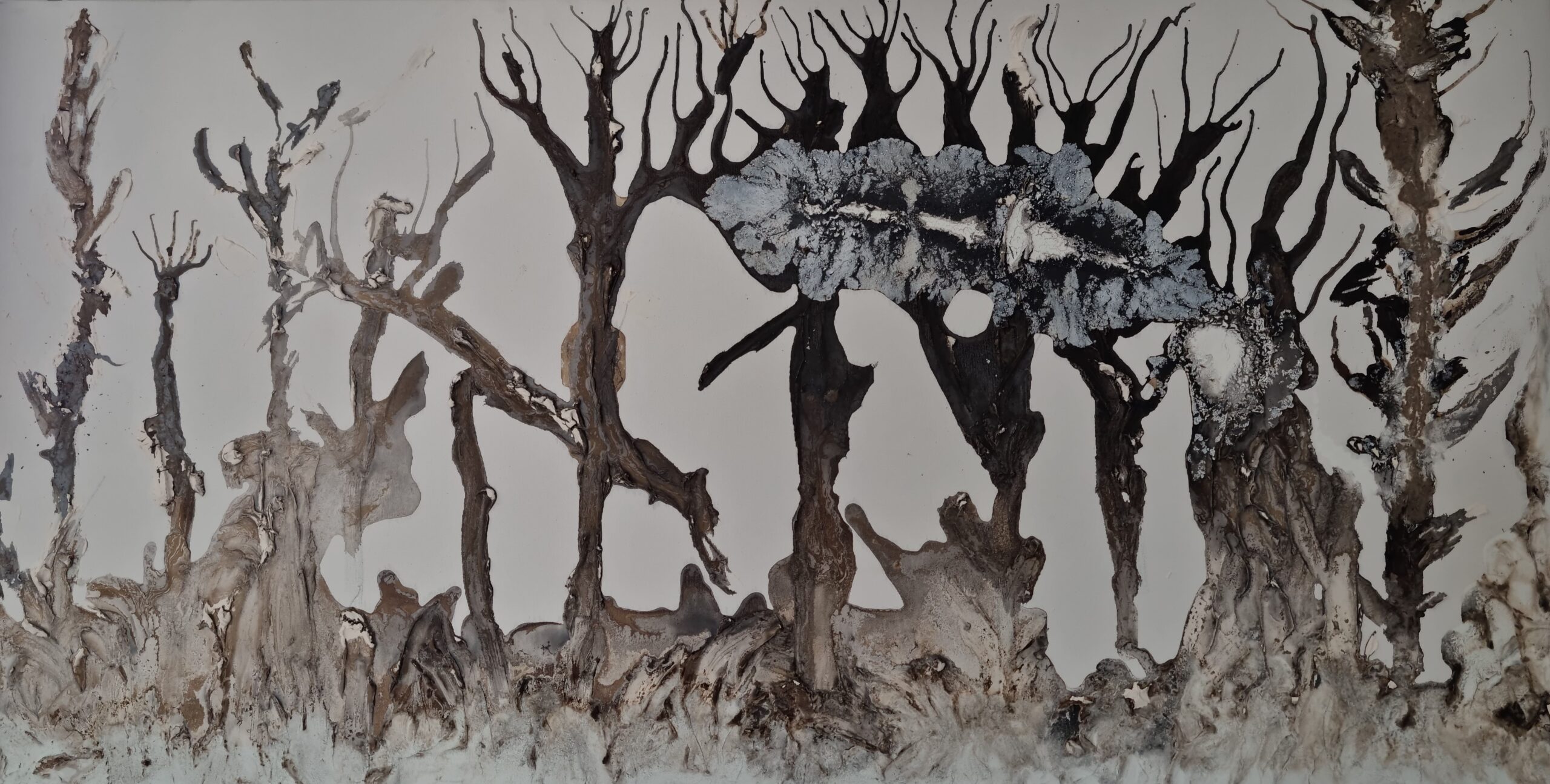
One of Barr’s most compelling works is EH Alps 11 (2024), part of the acclaimed Event Horizon series.
Measuring 100 × 180 centimeters, the painting consists of four distinct layers created using cold tar, gesso, oil paint, and acrylic-based pigments. At first glance, the work appears to depict a forest devastated by fire. However, prolonged observation gradually reveals lush green trees and vibrant meadows concealed beneath darker surfaces. What initially suggests destruction slowly transforms into a vision of renewal, demonstrating nature’s extraordinary capacity for healing and regeneration.
This shifting visual experience perfectly illustrates Barr’s central artistic philosophy. The visible image represents only the surface of deeper processes unfolding beneath it.
Borrowing the scientific term “event horizon” from astrophysics, the boundary beyond which information cannot escape a black hole, Barr redefines it as a metaphor for perception. The painted surface becomes the limit of human awareness, while hidden layers continue shaping everything that is ultimately seen.
Within this framework, layering becomes both a material process and a philosophical model. Each painting functions like the human body itself, where visible appearances reflect countless internal interactions that remain largely invisible.
Writing as an Extension of Artistic Practice
Ted Barr’s creative vision extends well beyond painting. Alongside his visual work, he has written numerous books, essays, and interviews that expand the theoretical foundations of his artistic research.
His publications include Journey in the Milky Way, The Man Who Was Almost There, FLY, Frau Gruber’s Farm, LTC – Long Term Care, and the children’s book Krombie. These works explore transformation, morality, imagination, love, personal growth, and humanity’s search for meaning.
Rather than existing separately from his paintings, Barr’s literary work complements his visual practice, offering readers another path into the philosophical ideas that shape his artistic universe.
A Global Artistic Presence
Throughout his career, Ted Barr has established an impressive international reputation through solo exhibitions, biennials, museum presentations, artist residencies, lectures, and workshops.
His work has been exhibited across Israel, the United States, Italy, France, Germany, Spain, the United Kingdom, the Netherlands, Greece, Japan, South Korea, Turkey, Romania, Finland, Canada, Mexico, Nepal, the Czech Republic, and India. His participation in prestigious events such as the Venice Biennale, London Art Biennale, Art Basel Miami, SCOPE Miami Beach, Art Palm Beach, and ArtPrize reflects the broad international recognition his work has earned.
Equally significant are his educational contributions. Through FLY workshops and lectures presented at universities, museums, design academies, and cultural institutions, Barr has shared his interdisciplinary approach with artists, students, and creative professionals around the world.
Continuing to Reveal the Invisible
Ted Barr’s work demonstrates that contemporary painting can become far more than a visual object. His canvases serve as living systems where matter records time, materials preserve memory, and invisible forces gradually reveal themselves through accumulated layers. Every painting becomes an exploration of emergence rather than illustration, inviting viewers to slow their perception and engage with what lies beyond immediate appearances.
By combining scientific curiosity, philosophical inquiry, material experimentation, and artistic intuition, Barr has created a body of work that bridges the microscopic and the cosmic, the personal and the universal. His ongoing research continues to challenge viewers to reconsider how reality is formed, reminding us that what we see is often only the visible expression of deeper processes unfolding beneath the surface.
