


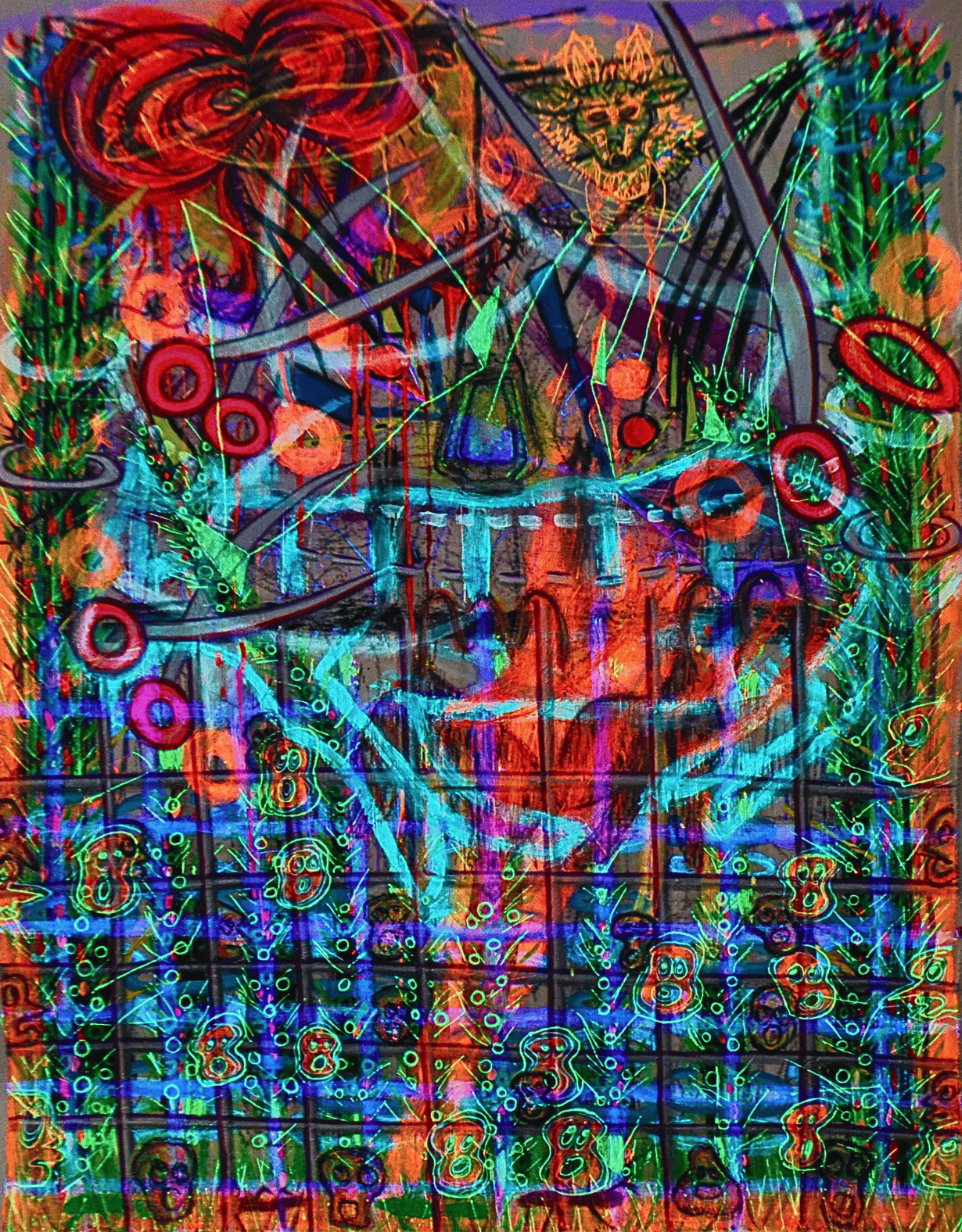
Yana Gordin creates immersive abstract works that bridge psychology, nature, grief, and human experience. Raised and based in Los Angeles, her paintings exist at the intersection of contemporary abstract expressionism and psychotherapy, transforming emotional and psychological concepts into layered visual narratives. Through shifting light conditions, symbolic imagery, and emotionally charged compositions, Yana invites viewers into experiences that mirror the complexity of the conscious and unconscious mind.
Her artistic practice is deeply rooted in transformation. Many of her works change under UV light, natural illumination, or complete darkness, allowing hidden imagery and emotional undertones to emerge gradually. This evolving visual experience reflects the shifting nature of memory, identity, perception, and emotional truth. Rather than presenting static imagery, Yana’s paintings become living psychological environments that challenge viewers to engage emotionally and introspectively.
Early Life and the Discovery of Art as Communication
Yana’s relationship with creativity began during childhood after immigrating from Moscow, Russia to Los Angeles at the age of five. Unable to speak English upon arriving in the United States, she turned to art as a way to communicate with the world around her. Shapes, colors, and visual storytelling became her first language, helping her navigate unfamiliar environments and emotional uncertainty.
This early experience established a lifelong understanding of art as a tool for connection and healing. Creativity became more than a hobby or artistic pursuit; it became a bridge between inner emotional states and external human relationships. That foundation continues to shape her artistic philosophy today.
Her work consistently explores emotional realities that are difficult to articulate verbally. Themes such as fear, grief, identity, vulnerability, trauma, and liberation emerge through abstraction and symbolism. Rather than offering direct explanations, her paintings encourage viewers to confront their own subconscious responses and emotional associations.
Grief, Psychology, and the Healing Power of Art
A major turning point in Yana’s life occurred in 2009 while she was studying psychology at California State University, Northridge. During this period, she experienced the sudden loss of her father, a deeply transformative event that reshaped both her personal and artistic journey.
Art became an essential outlet for processing grief. Through abstract painting, Yana discovered a new freedom of emotional expression, one capable of communicating experiences that language alone could not contain. Painting allowed her to externalize pain, memory, confusion, and healing simultaneously.
This period marked the beginning of her professional artistic career. Within a year, she held her first art exhibition in Downtown Los Angeles and later became a consignment artist with Artspace Warehouse in West Hollywood. She also participated in group exhibitions at California State University, Northridge and has continued exhibiting her work in numerous galleries and art shows ever since.
Inspired by the profound healing capacity of creative expression, Yana pursued advanced education in both psychology and art therapy. She earned a Master’s degree in Psychology with a focus in Marriage and Family Therapy and Art Therapy in 2014, followed by a Doctor of Psychology (PsyD) in Applied Clinical Psychology in 2017. Both her thesis and dissertation centered on grief and emotional recovery, reflecting the deeply personal motivations behind her work.
In 2020, Yana became a licensed psychotherapist, further integrating psychology into her artistic practice. Her exploration of grief extended into writing with the publication of her 2023 book, Beyond The Veil: Navigating Grief Through Spirituality, Religion, and Alternative Methods.
Returning to Abstract Expressionism
In 2024, Yana returned fully to her abstract painting roots while continuing her psychotherapy practice. This renewed focus on abstract expressionism allowed her to merge years of clinical insight with intuitive artistic exploration.
Her paintings draw from psychological concepts such as transference, free association, projection, and unconscious symbolism. The compositions often feel dreamlike and emotionally fluid, inviting viewers to interpret meaning through their own experiences and emotional histories.
The changing nature of light within her work plays a crucial role in this process. Certain forms appear or disappear depending on environmental conditions, reinforcing themes of hidden truths, shifting perception, and emotional complexity. These transformations mirror the instability and layered structure of the human psyche itself.
Rather than creating purely decorative abstraction, Yana uses painting as a form of emotional excavation. Her canvases become spaces where psychological tension, healing, fear, and liberation coexist simultaneously.
“Xenonarcpathus: The Severing”
Among Yana’s most powerful works is Xenonarcpathus: The Severing (2026), a monumental piece measuring 49 x 63 inches and created with acrylic, oil pastel, and ink on raw canvas.
The painting confronts themes of xenophobia, narcissism, psychological manipulation, and collective fear. At the center stands a towering thorn-covered cactus-like organism that symbolizes inherited paranoia, mob mentality, ritualized othering, and systems of emotional coercion.
Surrounding distorted faces appear trapped within a collective consciousness shaped by manufactured narratives and social hostility. These figures consume and perpetuate fear simultaneously, reflecting how toxic ideologies become normalized within communities and systems of power.
One of the work’s most striking elements is a gaslight-like source of illumination held by the central figure. Rather than revealing truth, the light manipulates and distorts perception, referencing the psychological tactics commonly associated with narcissistic abuse and emotional control.
Beneath the towering entity, marionette-like figures hang suspended by invisible strings, symbolizing emotional domination and manipulative dependency. Serpentine forms coil beneath them, representing instinctive hostility, predatory social behavior, and the fear of the unfamiliar.
At the emotional center of the composition lies an act of liberation. Oversized scissors sever the puppet strings, symbolizing the breaking of psychological bonds and toxic cycles of manipulation. The restrained manipulator suggests the collapse of abusive authority, while the sacrificial figures embody the painful process of reclaiming personal autonomy.
Hidden within the painting is the subtle image of a wolf in sheep’s clothing, a symbolic reference to false innocence and deceptive identity. This motif reinforces the work’s exploration of narcissism, abuse cycles, and manipulative performance.
Through its layered symbolism and emotional intensity, Xenonarcpathus: The Severing examines not only personal trauma but also the broader social construction of fear and division. The work challenges viewers to question the narratives they inherit, the systems they participate in, and the emotional forces that shape collective behavior.
Art as Psychological Exploration
What makes Yana Gordin’s work especially compelling is her ability to merge emotional vulnerability with intellectual depth. Her paintings are psychologically informed yet deeply instinctive, balancing symbolic complexity with raw emotional energy.
As both artist and psychotherapist, Yana Gordin creates work that functions as both visual experience and emotional inquiry. Her paintings encourage reflection on grief, fear, manipulation, healing, and identity while offering viewers the opportunity to confront hidden aspects of themselves.
Through abstraction, symbolism, and immersive transformation, Yana continues to expand the possibilities of contemporary expressionism. Her work reminds us that art has the power not only to represent human experience, but also to illuminate the unseen emotional landscapes that shape it.
