


Reiner Heidorn is a German painter whose practice bridges natural observation, historical excavation, and contemporary critical reflection. Known for his deep engagement with freshwater microorganisms, plant life, and the nuanced materiality of chlorophyll, Heidorn has developed a singular visual language rooted in both scientific precision and emotional introspection. His artworks sit at the intersection of botanical abstraction and historical recontextualization, revealing painting as a vessel for memory, responsibility, and transformation.
Early Influences and the Weight of History
Growing up within Germany’s layered and often fraught historical landscape, Heidorn was shaped by a cultural environment in which memory, guilt, and responsibility were ever-present. The shadows of the past, especially the legacies of the Nazi era, formed a backdrop against which national identity, personal ethics, and the transmission of history were continually negotiated. For Heidorn, these complexities were not abstract notions but formative experiences.
His work reflects a sustained inquiry into how historical narratives are constructed and how they persist in contemporary consciousness. He asks how the past is taught, remembered, contested, and sometimes erased, how images, maps, borders, and even place-names serve as repositories of collective memory. This foundation of critical awareness would later merge with his fascination for natural forms, creating a distinctive artistic vocabulary that binds together history, ecology, and visual abstraction.
A Botanical Approach to Abstraction
At the heart of Heidorn’s practice is a persistent engagement with the microscopic world. Freshwater microorganisms, delicate plant structures, and the vibrant complexities of chlorophyll serve as his muse. Using a technique he refined over years, Heidorn translates the pointillistic textures of microscope imagery into sweeping fields of abstract expressionism. What begins as a scientific reference becomes a meditative painterly environment, dense, luminous, and evocative of life’s smallest yet most essential systems.
In addition to traditional paint, Heidorn frequently integrates natural materials such as leaves, blossoms, and twigs, imprinting them onto his surfaces. This approach creates a tactile, organic dimension to his work, revealing the physical presence of the natural world in each composition. In these botanical pictorial spaces, he captures both the fragility and resilience of nature, rendering it not as a passive subject but as an active, growing force.
Reworking the Past: School Maps as Narrative Surfaces
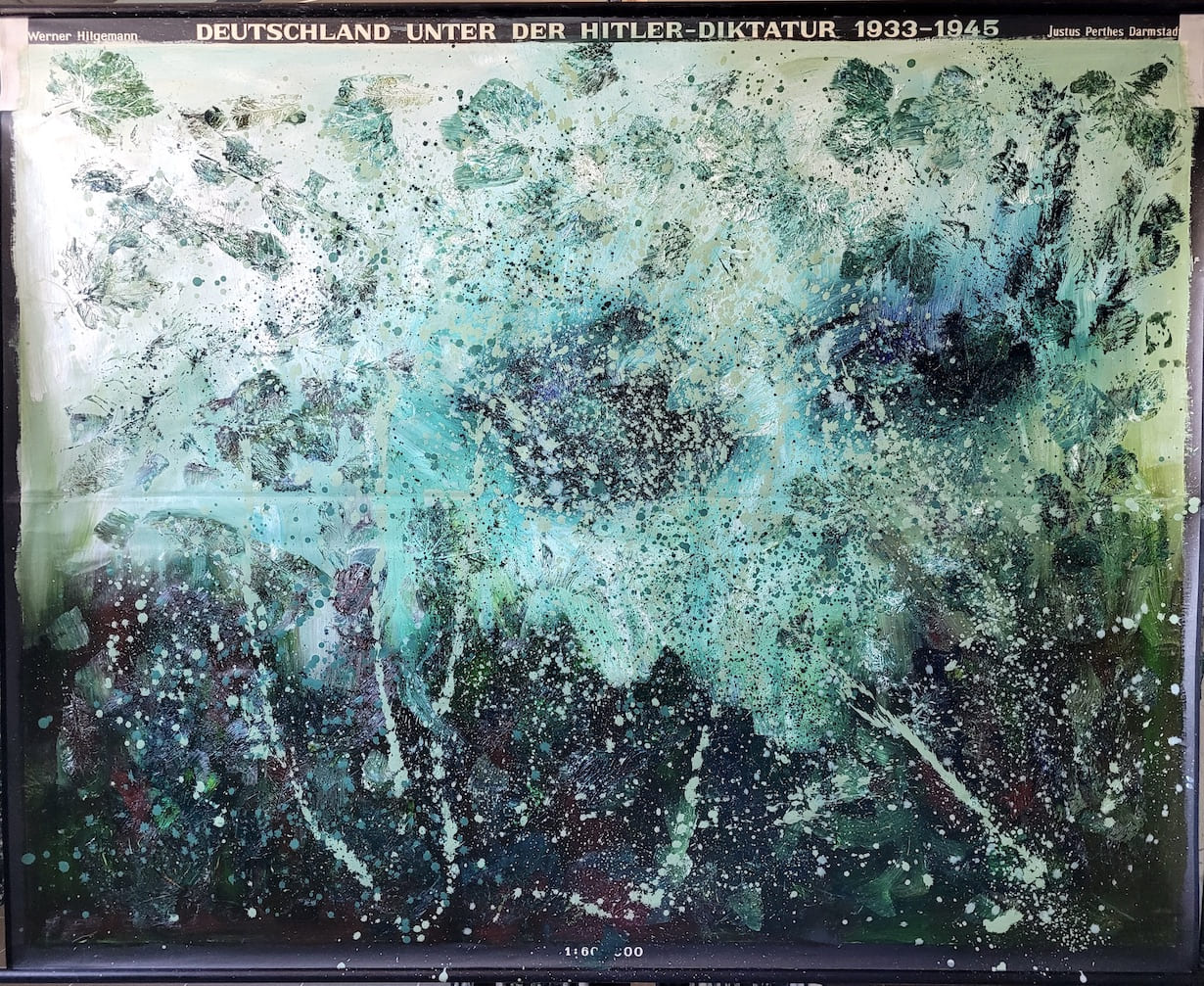
One of the most compelling elements of Heidorn’s recent work is his collection and transformation of old school maps that were produced after the war and used for educational purposes, showcasing the political and territorial situations during the Nazi regime. These maps, once used to teach national identity and geopolitical ideology, become the canvas upon which Heidorn stages his dialogue between past and present.
By painting over these maps, sometimes radically, sometimes subtly, Heidorn engages in a visual act of resistance. The original details, borders, and territories are erased, leaving only the titles as faint but powerful reminders of a dark era. These remnants become quiet anchors of memory, hovering beneath layers of new meaning.
The botanical-water motifs he overlays do more than decorate; they transform. The maps become lagoon-like surfaces, fluid spaces where history can flow, accumulate, and refract. Jurisdiction and belonging, once rigidly dictated by the maps’ original purpose, are dissolved into something more contemplative. In this reframed environment, viewers are invited to consider how easily narratives can be constructed and deconstructed through imagery.
Nature as a Counterforce and a Warning
At the conceptual core of Heidorn’s map series is the belief that nature acts as both a counterforce and a witness. Through botanical imagery, he introduces life, growth, and organic movement to surfaces historically associated with control, domination, and ideological manipulation. Nature becomes a symbol of renewal, yet it does not erase the past. Instead, it coexists with its remnants.
Heidorn’s approach highlights how memory behaves much like water or plant life, it flows, grows, recedes, and resurfaces. His overpainting does not seek to beautify history but to engage with it. The traces of the original maps remain visible in the structure of the composition, the color choices, and the ghostlike presence of titles. These subtle cues function as warnings against forgetting, against trivializing, and against the denial of historical responsibility.
In this way, Heidorn’s work embodies an ethical dimension. Painting becomes a means of processing inherited trauma, transforming it into inquiry and care rather than silence or indifference. His maps are not merely artworks but spaces of contemplation where viewers must navigate memory as a living landscape rather than a fixed narrative.
Deutschland: A New Pictorial Space of Memory
One of the central works in this series is Deutschland, a large-scale painting measuring 190 x 240 cm, executed in oil on an original school map from 2025. The work epitomizes Heidorn’s process and philosophy. The map’s historical weight is palpable, yet almost entirely submerged beneath layers of botanical abstraction. The viewer senses both presence and absence, what the map once represented and what it has now become.
Deutschland offers a vivid example of how Heidorn transforms materials into critical spaces. The painted-over surface resists its original function as a didactic tool. Instead, it becomes a place where history, memory, and responsibility converge. The botanical elements create a dynamic visual tension between growth and remembrance, illustrating the possibility of transformation without erasure.
In this work, as in the broader series, Heidorn demonstrates that painting can serve as a vessel of both critique and renewal. The past remains visible, but it is challenged and reinterpreted through the lens of the natural world, a world that persists, adapts, and ultimately outlives human constructs.
