


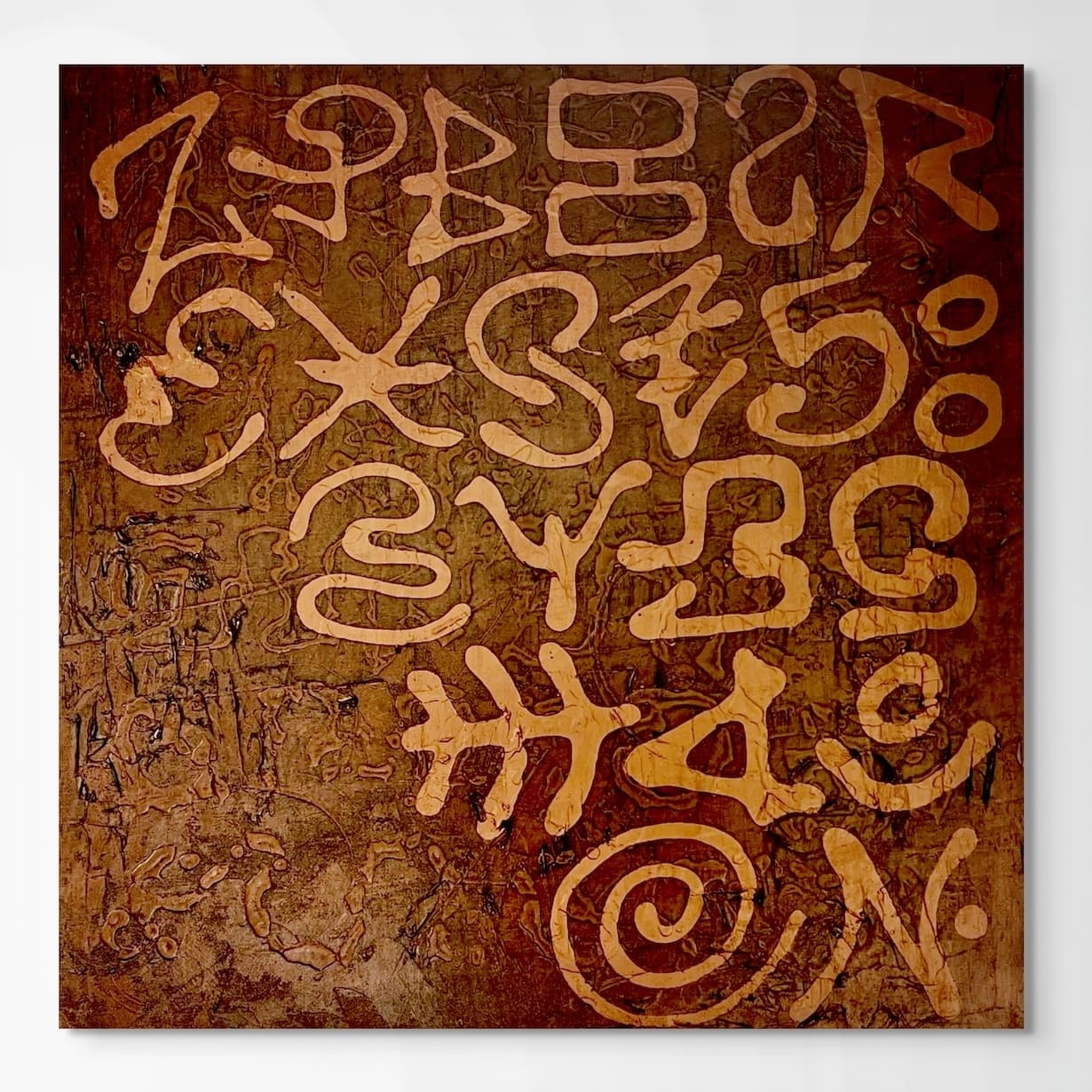
Nansi Lent is a painter and photographer whose work exists in a space where language dissolves and meaning becomes something felt rather than read. Based in Rhinebeck, New York, Lent has developed a distinctive visual vocabulary rooted in asemic writing, a form of mark-making that resembles language but resists fixed interpretation. Her work invites viewers into an experience that is at once deeply personal and universally resonant, engaging with the rhythms of thought, memory, and human connection.
At a time when communication is often fragmented and overloaded with competing narratives, Lent’s practice offers an alternative: a return to intuition, silence, and inner knowing. Through layered compositions and instinctive gestures, she constructs visual fields that function as transmissions, spaces where meaning is not dictated but discovered.
The Language Beyond Words
Asemic writing sits at the core of Lent’s artistic exploration. Unlike conventional text, asemic marks do not correspond to a specific linguistic system. Instead, they operate in a liminal zone between writing and image, evoking the presence of language without anchoring it to literal meaning.
In Lent’s work, these marks appear as gestural glyphs, fluid, rhythmic, and often repetitive. They suggest the act of writing while remaining open-ended, encouraging viewers to engage with them intuitively. This approach shifts the experience of reading into one of sensing. Rather than asking what does this say, the viewer is invited to ask what does this feel like.
Her compositions often resemble fragments of ancient scripts or forgotten alphabets, yet they are entirely contemporary. This duality creates a powerful tension: the work feels both unearthed and newly formed, as if it exists outside of linear time.
Process and Materiality
Lent’s practice is grounded in layering, both physically and conceptually. Her surfaces build over time, accumulating marks, textures, and traces of previous gestures. This process mirrors the way thoughts and experiences layer within the human mind, creating a visual parallel to inner dialogue.
The act of mark-making itself is intuitive and embodied. Rather than adhering to a predetermined plan, Lent allows the work to unfold organically. Each gesture responds to the one before it, creating a sense of movement and continuity. This approach lends her work a dynamic quality, as if the surface is alive with ongoing activity.
Photography also plays a role in her broader practice, as early roots were in darkroom photography and photomontage. In post-production she layers photographs of drawings and paintings with textures and images from the observable world, then digitally processes them, creating phantastic palimpsests, where layering and traces of previous fields yield a new vision.
A Response to Contemporary Noise
Lent’s work emerges in response to a cultural moment defined by noise, division, and information overload. In a world where language is often used to persuade, divide, or obscure, her asemic approach offers a form of resistance.
By removing language from its conventional function, she creates a space where meaning is no longer imposed but experienced. This shift encourages a slower, more reflective mode of engagement, one that prioritizes presence over interpretation.
Her work does not seek to resolve ambiguity; instead, it embraces it. In doing so, it reflects the complexity of contemporary existence while offering a sense of grounding. The viewer is invited to step outside of analytical thinking and enter a more intuitive state of awareness.
Spiritual Undercurrents
At the heart of Lent’s practice lies a deep sense of spiritual inquiry. Her work can be understood as a form of visual prayer, an attempt to connect with something beyond the immediate and tangible.
This spiritual dimension is not tied to a specific doctrine or belief system. Instead, it manifests as an openness to mystery and a willingness to engage with the unknown. The repetitive nature of her marks echoes meditative practices, suggesting a rhythm of breath, thought, and intention.
In this context, her paintings become spaces of contemplation. They invite viewers to pause, reflect, and attune to subtler forms of perception. Meaning is not delivered but revealed through presence and attention.
About the Work: A Transmission in Motion
One of Lent’s works exemplifies her approach through its sense of ongoing transmission. The surface pulses with energy, as if it is in the midst of becoming. Gestural glyphs move across the composition, hovering between artifact and signal.
These marks feel ancient, as though they have been unearthed from a distant past, yet they also carry a distinctly contemporary immediacy. This duality creates a sense of temporal fluidity, where past and present coexist within the same visual field.
The glyphs resist stable interpretation. Their meaning flickers, shifting with each glance. This instability is not a limitation but a strength, as it opens the work to multiple readings. Each viewer brings their own associations, emotions, and experiences, becoming an active participant in the creation of meaning.
The piece operates less as a static object and more as a living exchange. It suggests that communication is not always about clarity or precision, but about resonance, about the ability to feel understood without the need for explicit language.
Exhibition and Recognition
Lent’s work has been widely exhibited and is held in private collections across the United States and Europe. Her growing recognition reflects the relevance of her practice in today’s cultural landscape.
She is represented by BAU Gallery in Beacon, New York, a space known for supporting artists who push the boundaries of contemporary art. Through this representation and her exhibitions, Lent continues to reach a diverse audience, inviting viewers into her unique visual world.
Conclusion
Nansi Lent’s work challenges conventional notions of language, communication, and meaning. Through her exploration of asemic writing, she creates a space where viewers can engage with art on a deeply intuitive level.
In an era defined by noise and division, her practice offers a quiet yet powerful alternative, a return to presence, reflection, and inner knowing. Her layered compositions and gestural marks function as transmissions, bridging the gap between the seen and the felt.
Ultimately, Lent’s work reminds us that not all meaning can be articulated. Some experiences exist beyond words, accessible only through sensation, intuition, and openness. By inviting us into this space, she expands our understanding of what it means to communicate and to connect.
