


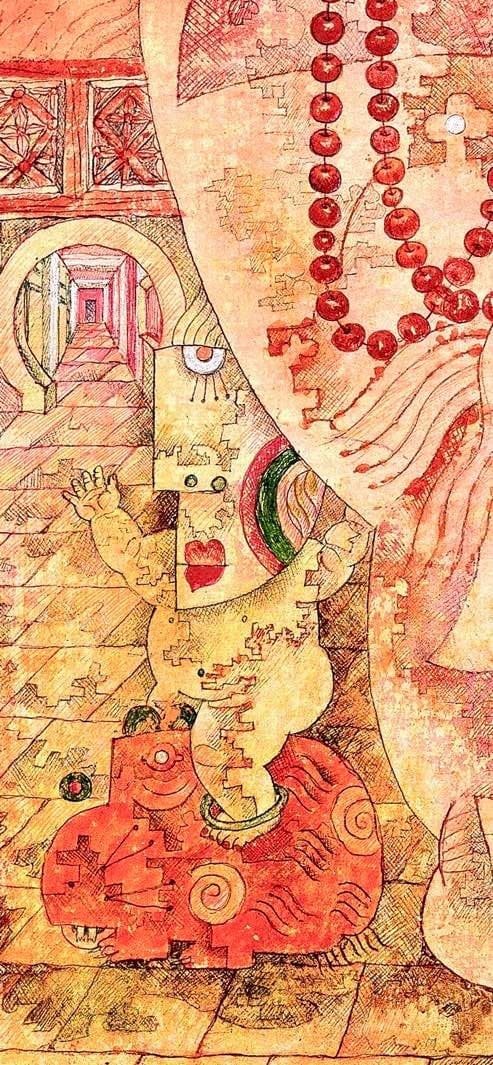
Huang Yi Min is a Chinese-born artist whose work brings traditional Chinese culture into conversation with surrealism, abstraction, and the enduring mysteries of human emotion. Born in Shanghai in 1950, Huang developed an artistic vision shaped by historical upheaval, lifelong engagement with cultural heritage, and a persistent curiosity about the complexities of human experience. Through a distinctive visual language that moves beyond recognizable figures and familiar symbols, Huang explores love as an unresolved question, drawing inspiration from one of Chinese literature’s most celebrated works, Dream of the Red Chamber.
A Life Shaped by History and Tradition
Huang’s artistic journey unfolded against a period of profound social and cultural change. At the age of sixteen, Huang experienced the Cultural Revolution, a decade-long period that interrupted formal education and challenged the place of traditional Chinese cultural practices within society. While working as a farmer in the fields, Huang continued to cultivate an interest in art, finding opportunities for observation, personal exploration, and learning beyond the classroom. This experience helped establish a lasting relationship with artistic expression and traditional culture.
After completing these formative years, Huang pursued formal studies in the Fine Arts Department at Beijing Normal University. The academic experience provided a foundation for developing technical skills while deepening an understanding of visual traditions and artistic interpretation. Following graduation, Huang worked as an art editor at China Children’s Publishing House. The position offered continued opportunities to draw character sketches and landscape paintings, strengthening an approach that gradually developed into a form of surrealism grounded in Chinese cultural references.
In 1997, Huang immigrated to the United States, beginning another chapter in an artistic life shaped by movement between cultures. This transition provided a broader context for considering how historical memory, inherited traditions, and individual imagination might coexist within a contemporary artistic practice.
Between the Forbidden City and Everyday Life
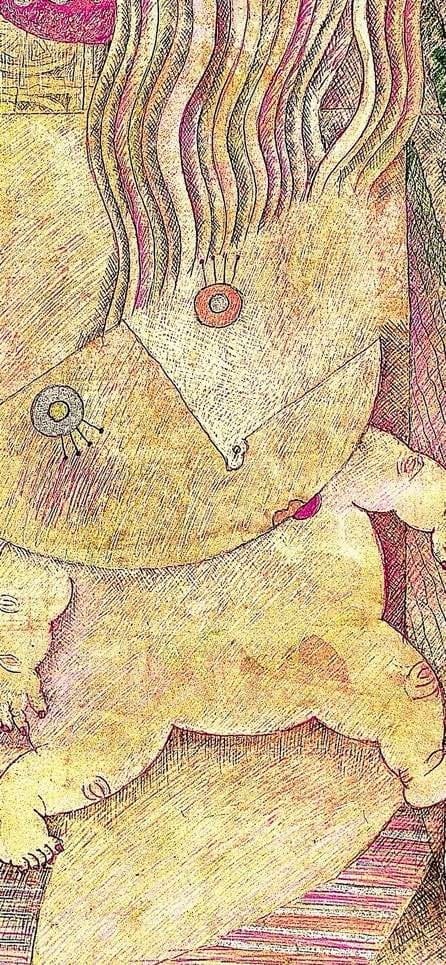
For nearly two decades, Huang has developed compositions inspired by the meeting point between Beijing’s Forbidden City, the celebrated imperial palace complex of the Ming dynasty, and the ordinary residential environments surrounding it. This juxtaposition offers more than a contrast between monumental architecture and everyday life. It creates a space in which historical grandeur and personal experience can meet, allowing imagination to transform familiar cultural references into emotionally charged visual situations.
Huang’s artistic language draws from tradition without remaining confined by its established forms. Memories of Chinese cultural life become material for reinterpretation, while surrealist elements introduce ambiguity and unexpected relationships. Rather than simply reproducing historical settings or illustrating recognizable narratives, Huang approaches cultural memory as something that can be reconsidered through individual perception.
This balance between cultural continuity and imaginative freedom also informs Huang’s exploration of human relationships. The past becomes a living presence rather than a fixed historical record, offering a foundation for examining questions that remain relevant across generations. Love, longing, uncertainty, and the search for emotional understanding emerge as subjects that cannot be fully explained through conventional images.
Painting the Red Chamber in a Dream
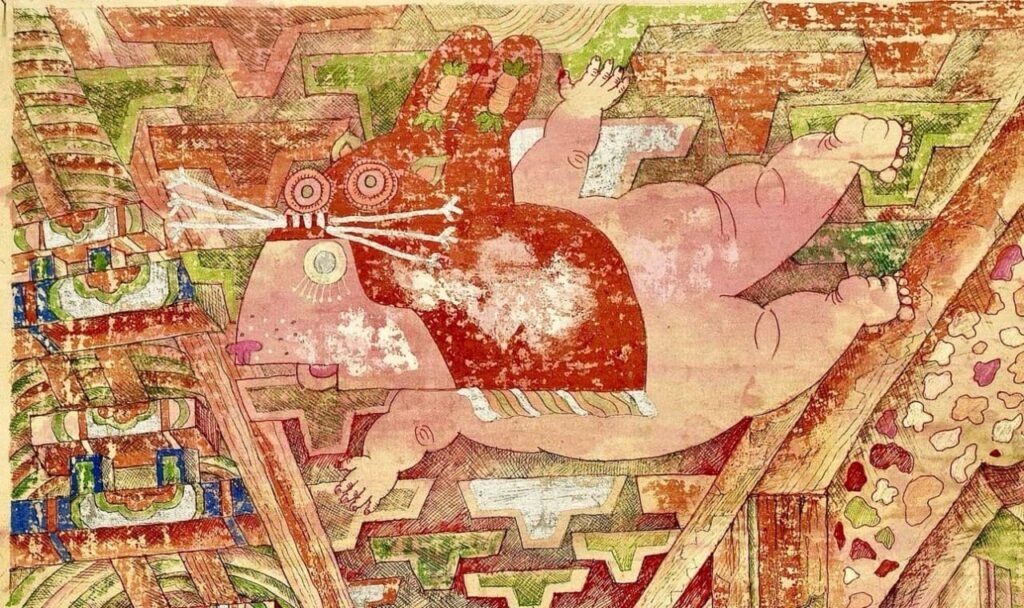
A central expression of Huang’s artistic philosophy is the series I Paint the Red Chamber in My Dream, inspired by Dream of the Red Chamber, the eighteenth-century Qing dynasty novel by Cao Xueqin. Widely celebrated for its intricate portrayal of family, desire, social relationships, and human vulnerability, the novel offers Huang a rich foundation for investigating love as an enduring mystery.
At the center of the narrative is Jia Baoyu, a young man raised within an affluent aristocratic family and surrounded by numerous women with whom he forms meaningful relationships. Yet the question of his deepest emotional connection remains difficult to resolve. The novel’s exploration of affection, desire, social expectations, and loss resists simple conclusions. Its unfinished ending, traditionally associated with the circumstances of Cao Xueqin’s death, further extends the space for interpretation and imagination.
Huang is not interested in repeating the familiar illustrations of the novel’s characters or recreating the dramatic scenes of romantic entanglement that have inspired generations of artists. Instead, the series approaches the underlying question of love through abstraction. Love becomes a subject that exceeds narrative, appearance, and conventional representation, existing somewhere between personal experience and the impossibility of complete understanding.
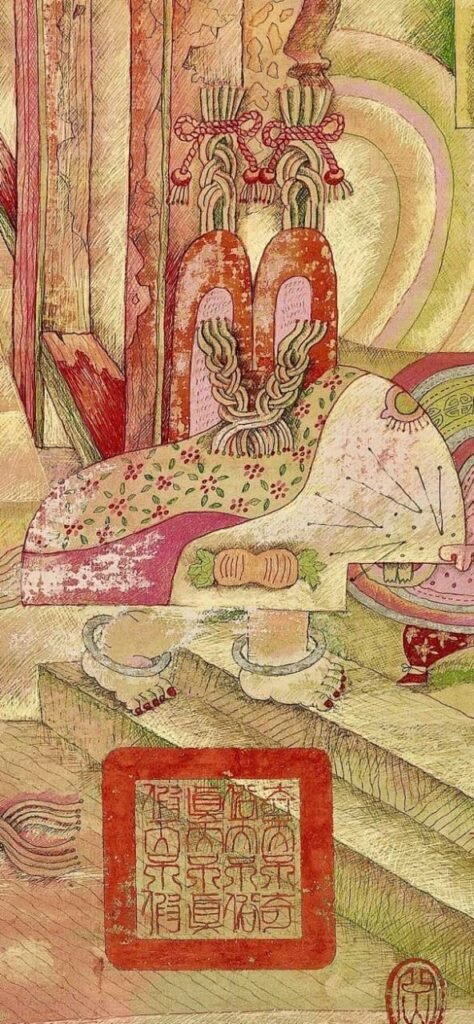
The phrase “A Pile of Absurd Words, Tears of Bitterness,” associated with Cao Xueqin’s reflections on the novel, provides an important point of departure for Huang’s interpretation. The recurring phrase “Satisfying Absurdity” expresses an attitude toward life in which its contradictions and unanswered questions are acknowledged rather than resolved. Across the nine paintings, seals bearing this phrase reinforce the series’ philosophical framework. Another seal, “Meeting, Dreaming of Returning,” evokes the longing for recognition and the possibility of encountering a true soulmate, even when such fulfillment remains elusive.
The Geometry of Human Emotion
In Huang’s abstract language of love, emotional meaning emerges through relationships between forms rather than through recognizable figures. Horizontal lines, curves, right angles, obtuse angles, circles, ellipses, and arcs become the vocabulary through which the artist explores the diversity and unpredictability of human feeling.
These elements interact in combinations that can appear accidental, dramatic, or deliberately unresolved. Their arrangements resist the expectation that love should be represented through harmonious compositions or familiar romantic imagery. Instead, forms intersect, separate, and occupy shared spaces without necessarily arriving at a stable conclusion.
The absence of the heart symbol is particularly significant. Although the heart has become one of the most familiar visual shorthand devices for love, Huang rejects it as an adequate representation of the experience itself. Love, in this interpretation, cannot be reduced to a universally recognizable emblem. It is too contradictory, elusive, and individual to be contained within a single shape.
Abstraction therefore becomes a means of approaching emotional truth without pretending to define it. The paintings invite viewers to consider their own experiences of attachment, separation, anticipation, and disappointment. Meaning develops through the encounter between the composition and the viewer’s personal memories, allowing different interpretations to coexist.
Recognition and Artistic Legacy
Huang’s work has attracted attention beyond the studio, receiving reviews in The New York Times and recognition through the Anna Walinska Academic Achievement Award in the United States. The artist’s works have also entered collections associated with the Singapore Art Museum, Hong Kong Museum of Art, Simin Art Gallery in Singapore, Crystal Art Foundation in New York, New York Chinese Gallery, and the director of the Newark Museum of Art, as well as private collections.
These achievements reflect an artistic practice that connects Chinese cultural heritage with an internationally accessible exploration of human experience. Huang’s work does not seek to settle the questions that inspire it. Instead, it transforms them into visual encounters in which tradition, memory, and imagination remain in conversation.
Through I Paint the Red Chamber in My Dream, Huang Yi Min approaches love not as a perfect ideal or a readily understood emotion, but as a continuing mystery. Lines and curves replace familiar romantic symbols, while the language of abstraction creates space for uncertainty and personal reflection. In these paintings, the absurdity of human experience becomes not a reason to abandon the search for meaning, but an invitation to continue it.
