


Moriat Gary McNamara, born in 1952, grew up in Florida, a place that offered her an early sense of light, space, and natural rhythm. While she did not begin her life directly within the visual arts, these early environmental impressions later surfaced in her abstract painting practice, where movement, flow, and atmospheric sensitivity play an important role.
Early Life and a Foundation in Movement
In her early adulthood, McNamara moved to New York City and entered the world of modern dance. This became one of the most influential phases of her life. Through dance, she developed a deep awareness of the body in space, understanding movement as a form of expression that exists between structure and spontaneity. This physical language of gesture, rhythm, and timing would later inform her painting practice, where mark-making often carries a similar sense of motion and energy.
A Shift Toward Social Work and Observation
After her time in dance, McNamara pursued academic study and earned a Master of Social Work (MSW). This marked a shift from physical performance to a profession centered on human behavior, emotion, and lived experience. Although she was not actively creating visual art during this period, she remained immersed in the art world as an observer.
Her exposure to exhibitions, art history, and creative environments, along with her marriage to an accomplished realist painter, expanded her visual understanding. She developed an appreciation for composition, structure, and artistic discipline through close proximity rather than direct practice. This long period of observation became a foundational layer in her eventual artistic development.
Beginning a New Artistic Journey in Later Life
In 2021, after relocating to Williamstown, Massachusetts, McNamara took an unexpected step by enrolling in an oil painting class despite having no prior experience in painting. This moment marked the beginning of her active artistic practice.
Without formal training, she approached painting with openness and curiosity rather than expectation. This freedom from technical constraint allowed her to explore the medium intuitively. She quickly began creating abstract works that emphasized feeling, movement, and subconscious imagery over representation.
Process as Play, Improvisation, and Meditation
McNamara approaches each artwork as an open-ended process shaped by play, improvisation, and experimentation. Rather than planning a fixed outcome, she allows the work to develop organically through response and interaction with materials.
Her background in modern dance continues to influence this approach. Just as dance relies on spontaneous yet intentional movement, her painting practice is built on intuitive gestures that respond to one another across the surface. Brushstrokes, ink lines, and layered materials behave like extensions of physical motion.
The process is also deeply meditative. Through repetition, layering, and accumulation, a sense of rhythm emerges that allows for reflection and quiet focus. In this state, she often surrenders control, trusting that the unconscious mind will guide the direction of the work. This trust frequently leads to unexpected visual discoveries.
“Most Can Fly” (2026): A Layered Visual Exploration
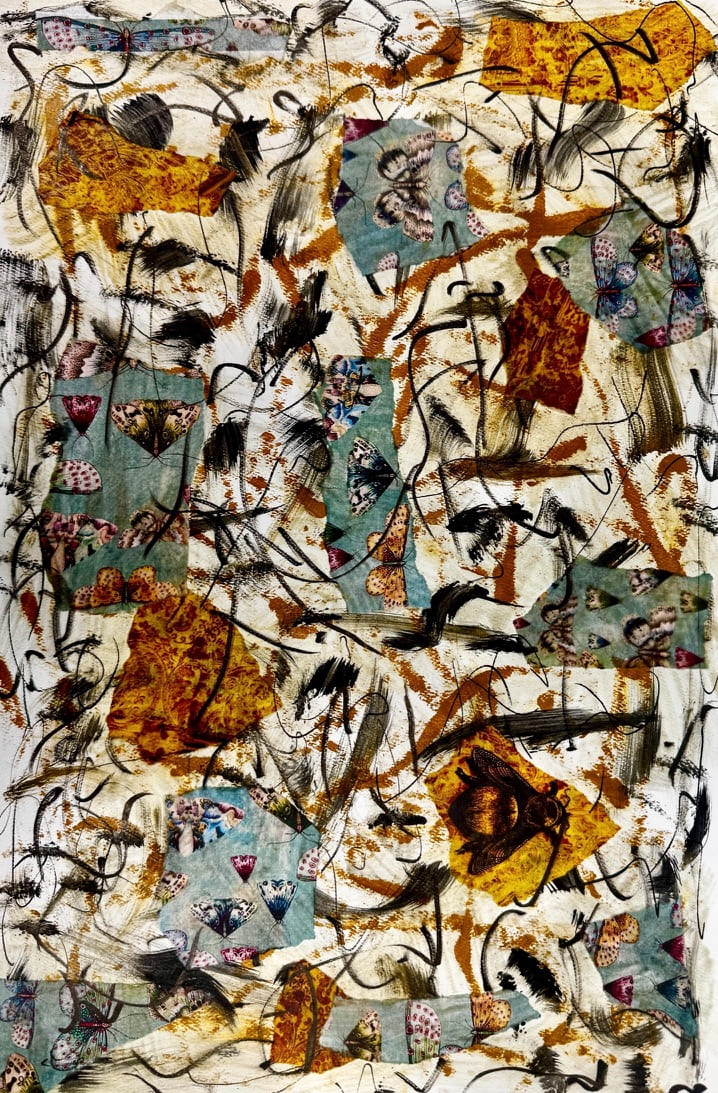
One of McNamara’s notable works, Most Can Fly (2026), is a mixed media collage on paper measuring 12″ x 18″. The piece combines ink and oil paint with collage elements, creating a dense and dynamic visual field.
At first glance, the composition appears energetic and fragmented. Ink lines scribble and wander across the surface in irregular paths, creating a sense of movement and instability. These gestural marks resemble traces of thought or motion captured in real time.
Layered within this structure are torn images of butterflies, moths, and a bumblebee. These elements are placed in a seemingly intuitive arrangement, yet they introduce strong symbolic associations with transformation, fragility, and flight. They contrast with the raw energy of the drawn marks, creating a dialogue between control and chance.
The palette of green, gold, and black further shapes the emotional tone of the work. Green evokes growth and organic life, gold suggests warmth and illumination, while black provides depth and grounding contrast. Together, they create a shifting visual atmosphere.
As viewers spend more time with the piece, additional imagery begins to emerge. Subtle human faces, birds, and hybrid forms appear within the layered surface. These elements are not explicitly drawn but discovered through close attention, reinforcing the idea that meaning unfolds gradually rather than immediately.
Most Can Fly becomes a living visual system, where perception continues to evolve with time.
Abstraction and the Unconscious Mind
McNamara’s work belongs to the tradition of abstraction but is strongly shaped by psychological depth and embodied experience. Her background in dance contributes a sense of physicality to her mark-making, while her studies in social work inform her sensitivity to emotional and internal states.
Rather than constructing images in a controlled manner, she allows them to emerge through process. Her paintings often feel discovered rather than designed, as if they reveal layers of imagery that already exist beneath the surface. This aligns with her interest in the unconscious mind, where association, memory, and intuition guide perception.
Her work invites viewers into an active experience of looking, where meaning shifts depending on attention and time.
Conclusion: A Practice Rooted in Trust and Discovery
Moriat Gary McNamara’s artistic journey reflects a life shaped by movement, observation, and transformation. From modern dance in New York City to social work, and finally to painting later in life, her path is non-linear but deeply interconnected.
Her abstract works are not fixed statements but evolving processes. They reflect a commitment to experimentation, openness, and trust in emergence. Through painting, she continues to explore movement, memory, and the unconscious in ways that are both personal and expansive.
In works such as Most Can Fly, McNamara demonstrates how abstraction can function as a space of discovery where images are not simply made but revealed through attention, time, and intuitive engagement.
