


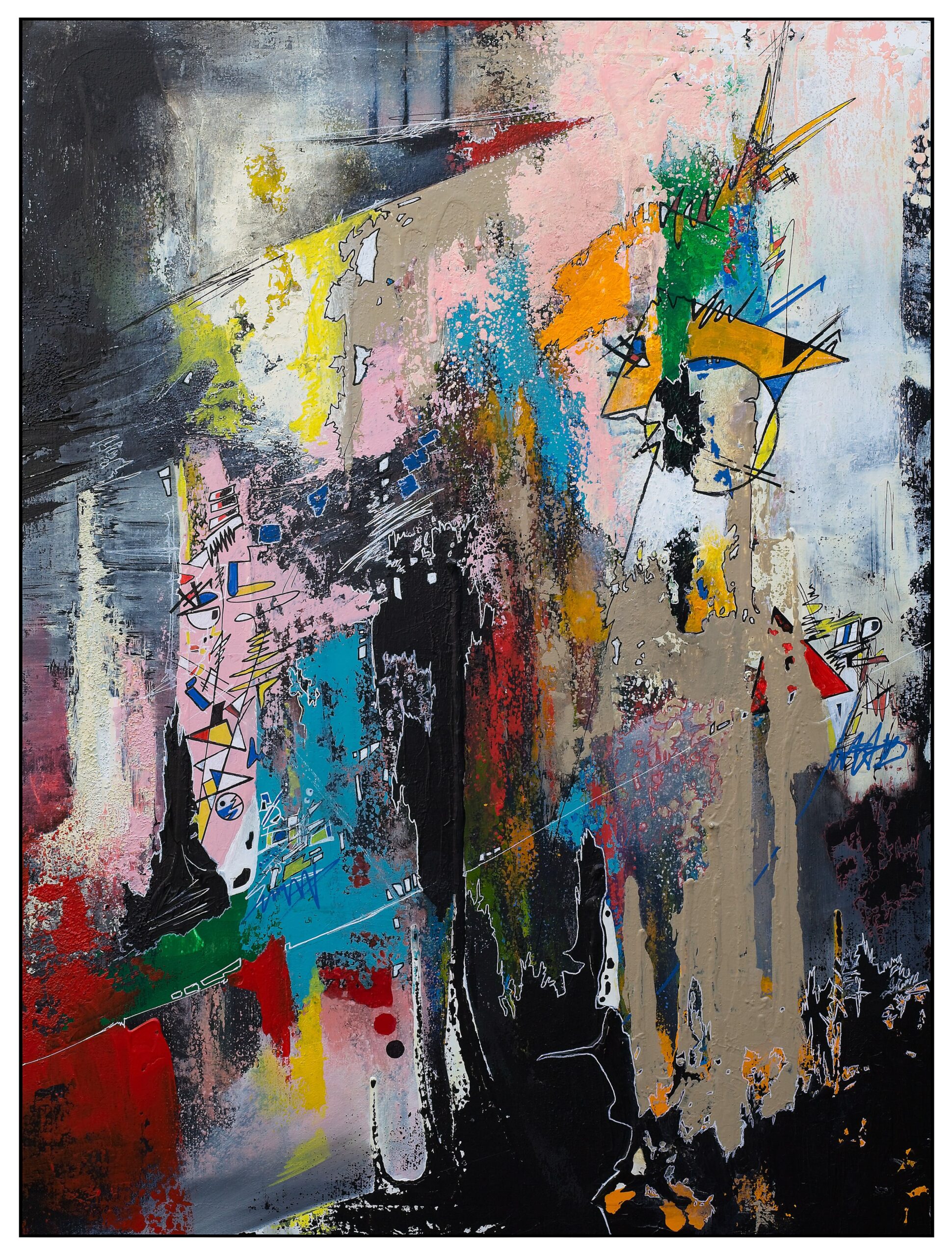
Stuart Beck was born in 1967 in Lancashire, United Kingdom, and from an early age, painting became a quiet but meaningful presence in his life. His first lessons came not from formal institutions but from his father, who introduced him to the fundamentals of painting and encouraged a creative habit that would stay with him for decades. What began as a personal exploration gradually developed into a deeply individual visual language, one that balances abstraction with observation, instinct with reflection, and emotion with atmosphere.
Today, Beck resides in the historic city of St Albans, where he continues to expand a body of work that is both visually compelling and emotionally layered. His paintings are not designed to offer easy explanations or fixed narratives. Instead, they encourage viewers to pause, observe, and feel. Through texture, colour, movement, and form, Beck creates spaces where interpretation becomes personal. His work sits in a fascinating territory between confrontation and contemplation, often revealing beauty in places where others may only notice decay, silence, or disconnection.
An Abstract Practice Rooted in Reality
Although Stuart Beck is recognised for his abstract paintings, his work is deeply connected to the real world. Nature, architecture, urban surfaces, travel experiences, memories, and fleeting moments all influence his creative process. There is an unmistakable observational quality within his compositions, even when the imagery itself resists representation. Rather than painting literal scenes, Beck distills impressions and emotional responses into layered abstract forms.
This relationship between observation and abstraction is one of the defining qualities of his work. His paintings do not attempt to recreate reality directly. Instead, they capture the emotional residue of experience, the textures of memory, the tension of modern life, and the quiet poetry hidden within ordinary surroundings. Through this approach, Beck transforms familiar influences into something entirely personal and universal at the same time.
His work often reflects contrasts: chaos and calm, destruction and beauty, movement and stillness. These dualities create a visual rhythm that draws viewers into prolonged engagement with each piece. Rather than dictating meaning, Beck allows the audience to discover their own emotional connection within the work.
The Importance of Intuition
A significant aspect of Stuart Beck’s artistic philosophy is his reliance on intuition. He describes many of his paintings as “free-flowing intuitive artworks,” created without forcing a predetermined concept or outcome. This freedom is essential to his process. By avoiding rigid expectations, Beck allows the painting to evolve naturally, guided by instinct, emotion, and the physical interaction between artist and surface.
For Beck, creativity thrives when unrestricted. The absence of forced narrative opens the possibility for discovery, both for the artist and the viewer. This intuitive method results in paintings that feel alive with spontaneity and movement. Layers emerge organically, colours interact unpredictably, and textures build through an ongoing dialogue between control and release.
At the same time, Beck acknowledges that the emotional climate of the world inevitably influences his practice. While some works remain untitled and open-ended, others receive names that reflect thoughts and feelings connected to social realities, personal reflections, or collective experiences. Even though the workflow itself may remain similar, the emotional atmosphere surrounding the creation of a piece can shape its identity and meaning.
This balance between intuition and emotional awareness gives Beck’s work its distinctive depth. His paintings are not merely aesthetic exercises in abstraction they are emotional landscapes shaped by lived experience and internal reflection.
Untitled No.17: Freedom Within Abstraction
One painting that perfectly embodies Beck’s intuitive approach is Untitled No.17 (2022), an acrylic on canvas measuring 60 cm x 80 cm. As the title suggests, the work belongs to the category of paintings Beck considers free-flowing and unrestricted by narrative intention.
Without the constraint of a defined story, Untitled No.17 becomes an exploration of pure creative energy. The painting invites viewers into an open visual conversation where texture, movement, and colour become the primary language. Rather than directing interpretation, Beck leaves space for emotional instinct and personal reflection. This openness is part of what makes the piece compelling.
The use of acrylics allows for dynamic layering and expressive mark-making, both of which contribute to the painting’s sense of immediacy. There is an organic quality to the composition, as though the work developed through a continuous process of discovery rather than calculation. The painting feels spontaneous yet intentional, balancing structure with fluidity.
What makes Untitled No.17 especially interesting is its ability to evoke emotion without relying on representation. The viewer may sense fragments of landscapes, architectural surfaces, weathered materials, or shifting environments, yet nothing becomes fully fixed. The painting exists in a space between recognition and abstraction, encouraging prolonged engagement and interpretation.
In many ways, the work reflects Beck’s broader philosophy: art should not always provide answers. Sometimes its purpose is to create a moment of reflection, uncertainty, or emotional resonance that cannot easily be explained with words.
A Growing Presence and Expanding Audience
Stuart Beck’s portfolio, showcased through his online platforms and social media presence, demonstrates the diversity and evolution of his artistic practice. His work ranges from energetic explosions of colour to more restrained compositions rich with texture and subtle detail. Across all of these variations, however, there remains a consistent sense of authenticity and emotional honesty.
Visitors to his website encounter a body of work that feels exploratory and deeply personal. Each painting appears to carry its own atmosphere and rhythm, revealing Beck’s ongoing interest in experimentation and visual storytelling through abstraction.
As his audience continues to grow, Beck is preparing to launch a new website, Stubeck Studio, which will expand access to his work for collectors and admirers worldwide. The new platform will offer prints, unseen works on paper, acrylic studies, images within paintings, original works in print form, and special edition releases throughout the year. This development represents an exciting new chapter in Beck’s career, allowing a broader audience to engage with his artistic world.
The introduction of these new formats also highlights the versatility of his practice. Whether working on large canvases or smaller works on paper, Beck maintains the same commitment to experimentation, emotional depth, and intuitive freedom.
Painting as Reflection
At the heart of Stuart Beck’s work is a commitment to reflection not only personal reflection but reflection on the environments, emotions, and experiences that shape contemporary life. His paintings challenge viewers to slow down and look more carefully at the textures of existence, even in places marked by uncertainty or fragmentation.
There is honesty in Beck’s refusal to over-explain. By leaving room for ambiguity, he creates work that remains open, evolving with each viewer’s interpretation. This openness is one of the reasons his paintings resonate so strongly. They do not impose meaning; they invite discovery.
In a world often saturated with noise and instant conclusions, Stuart Beck’s art offers something quieter yet deeply affecting. Through abstraction, intuition, and observation, he transforms fragments of experience into visual spaces where emotion and imagination can meet. His work reminds us that art does not always need to define reality to speak truthfully about it.
