


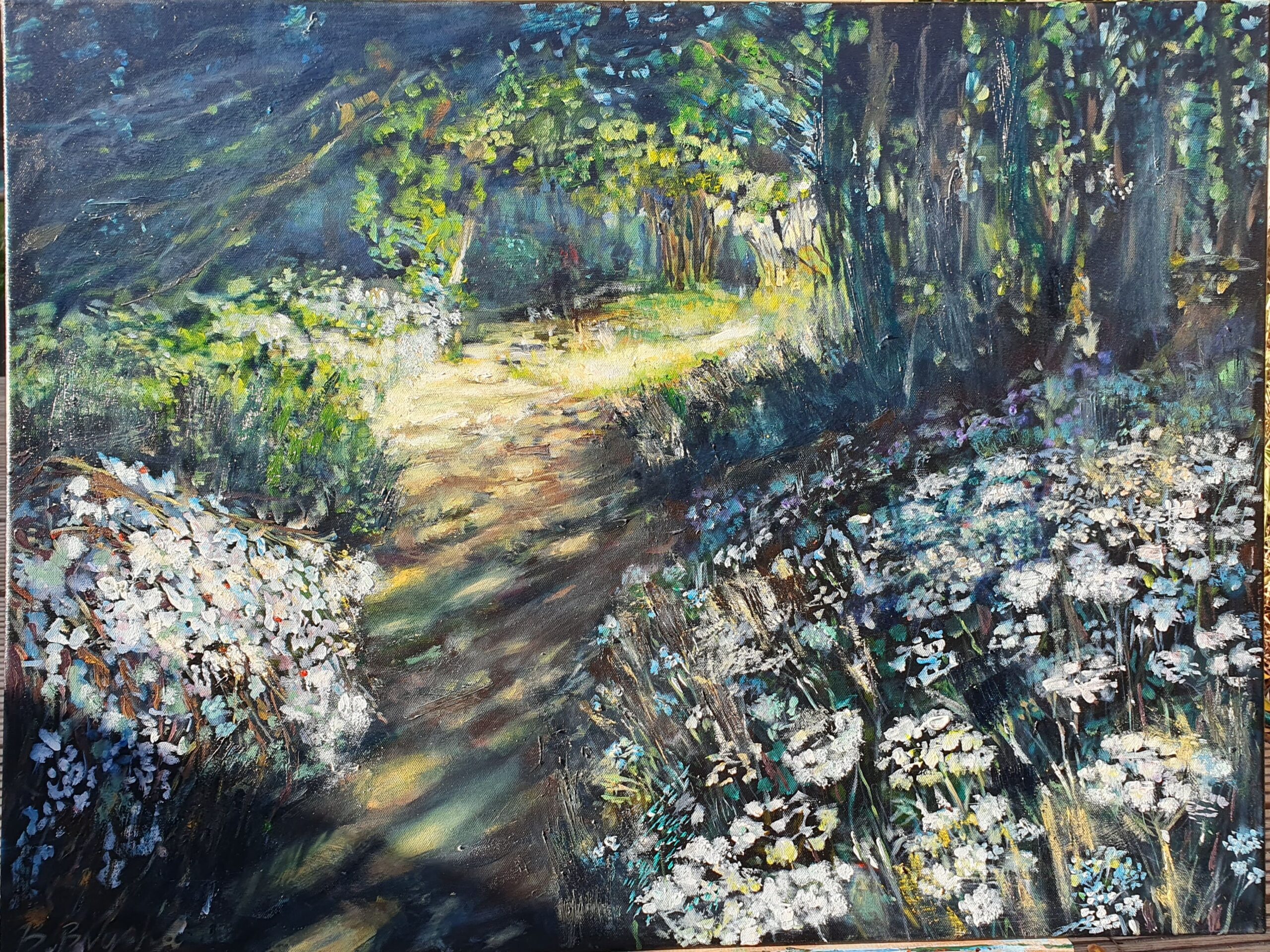
Bogusława Bryska creates atmospheric landscapes that exist somewhere between the tangible world and the realm of memory. Her paintings are not simply representations of natural environments; they are emotional interpretations of place, light, atmosphere, and the fleeting experiences that connect people to the landscapes around them.
Originally from Poland, Bryska is a contemporary artist whose practice explores the deep relationship between people and the natural world. Working with oil and mixed media, she builds luminous, textured surfaces that invite viewers to slow down and look beyond the immediate image. Her approach to landscape painting is deeply intuitive, allowing nature to become a source of feeling and reflection rather than a subject that must be documented with precision.
Mist, shifting light, deep shadows, and subtle changes in color become essential elements within her compositions, helping her transform familiar scenery into something more evocative and dreamlike. At the heart of Bryska’s artistic practice is a profound relationship with the land. Her paintings explore the ever-changing moods of nature and the way landscapes can become intertwined with personal memories.
A particular quality of light, a distant silhouette, or the atmosphere of a quiet path can recall experiences that remain with us long after the moment itself has passed. Bryska captures this emotional dimension, creating works that feel both intimate and universal.
Painting the Poetry of Quiet Moments
Bryska’s landscapes are characterized by a contemplative quality. Rather than presenting nature as a static scene, she focuses on its constant movement and transformation. The atmosphere of a landscape can change in an instant as sunlight moves across the ground, clouds alter the sky, or shadows stretch between trees. These subtle transitions provide Bryska with a rich visual language through which she explores emotion and memory.
Her use of layered paint and expressive marks gives her work a tactile presence. Surfaces appear to hold traces of movement, suggesting that the landscape is alive and continually evolving. At times, the viewer may feel as though they are looking through mist or remembering a place from the distant past. At other moments, the brightness of the composition brings a sense of immediacy, as if the scene is unfolding before their eyes.
This balance between recognition and ambiguity is an important aspect of Bryska’s work. Her landscapes offer enough visual information to establish a sense of place, yet they remain open to individual interpretation. Each viewer can bring their own memories, emotions, and experiences to the work, discovering a personal connection within the painted environment.
“Where the Dappled Light Dances”
One of Bryska’s evocative works, “Where the Dappled Light Dances,” measures 61 x 81 cm and is created as an acrylic and oil painting. The work brings together many of the qualities that define her artistic vision: atmospheric depth, expressive mark-making, rich layers of paint, and a sensitive exploration of light.
The title immediately establishes a sense of movement. Light is not simply illuminating the landscape; it appears to dance across it. This creates a feeling of natural rhythm, as though the environment itself is shifting and breathing. The painting invites the viewer to imagine the changing patterns of sunlight filtering through the landscape, creating moments of brightness that emerge from surrounding areas of shadow.
Bryska’s expressive brushstrokes contribute significantly to the energy of the composition. Rather than allowing the surface to become overly polished or rigid, she embraces the physical qualities of paint. Rich layers create texture and visual complexity, encouraging the eye to move across the canvas and discover new details.
Despite its energetic brushwork, the painting maintains a calming and welcoming presence. This contrast between movement and stillness gives the work much of its emotional power. The viewer senses that something is happening within the landscape, yet there is no urgency. Instead, the painting offers an invitation to pause, observe, and enter the scene imaginatively.
The Emotional Power of Light and Shadow
The interplay between deep shadows and radiant highlights is central to “Where the Dappled Light Dances.” Bryska uses these contrasts to guide the viewer’s gaze through the composition. Areas of darkness create depth and mystery, while illuminated passages provide visual points of focus and emotional warmth.
This relationship between light and shadow can also be understood metaphorically. In Bryska’s paintings, light often carries the possibility of discovery, renewal, and hope, while shadow suggests the unknown spaces of memory and imagination. Neither exists independently of the other. Together, they create the emotional atmosphere of the landscape.
The changing quality of light also reinforces the idea that nature is never fixed. A landscape can appear completely different depending on the time of day, the weather, or the viewer’s emotional state. Bryska responds to this instability by creating paintings that feel fluid and open-ended. Her landscapes are not frozen moments but impressions of experiences that continue to evolve in the imagination.
A Distant Figure and the Invitation to Wander
One of the most intriguing aspects of “Where the Dappled Light Dances” is the suggestion of a distant figure accompanied by a dog. The presence is subtle, almost like a memory emerging within the landscape. Rather than becoming the central subject, the figure encourages the viewer to look deeper into the scene.
This distant presence adds a human dimension to the painting while preserving its sense of mystery. The viewer may imagine someone walking peacefully through the landscape, accompanied by a loyal dog, moving along a path or exploring the quiet surroundings. The scene feels familiar yet elusive, like a moment remembered without every detail being fully preserved.
The suggestion of a figure also creates a sense of invitation. It is as though the viewer is being encouraged to follow the path into the painting, leaving the outside world behind for a moment. The landscape becomes not only something to observe but somewhere to mentally inhabit.
Between Memory and Place
Throughout Bryska’s practice, the relationship between memory and place remains deeply significant. Landscapes have the ability to preserve experiences. A particular field, forest, shoreline, or path can remain within the mind long after we have physically left it. Over time, however, our memories transform these places, altering colors, softening details, and intensifying certain emotions.
Bryska’s paintings exist within this space between reality and recollection. Her landscapes feel believable without being strictly representational. They could be places that the viewer has visited, places they remember, or places they have never seen but somehow recognize emotionally.
This quality allows her work to communicate beyond geographical boundaries. Although her artistic journey is rooted in Poland and her connection to the land is personal, the emotions within her paintings are universal. The longing for quiet, the comfort of nature, the memory of a walk, and the restorative experience of being outdoors are familiar to people everywhere.
Nature as a Source of Restoration
At a deeper level, Bryska’s art explores the restorative power of nature. Her paintings encourage viewers to step away from noise and distraction and reconnect with the quieter rhythms of the natural world. Through her sensitive treatment of atmosphere and light, she creates spaces that feel reflective and emotionally open.
In “Where the Dappled Light Dances,” this restorative quality is particularly evident. The combination of luminous highlights, deep shadows, textured paint, and the suggestion of a distant walker creates a landscape that feels both active and peaceful. It is a place where movement does not disturb stillness, but instead becomes part of it.
The painting reminds us that some of the most meaningful experiences in nature are often the simplest ones: walking beneath trees, watching sunlight move across the ground, noticing a distant figure, or simply standing still and taking in the atmosphere of a place.
The Quiet Poetry of Bogusława Bryska’s Art
Bogusława Bryska’s artistic practice demonstrates how landscape painting can move beyond physical description to become an exploration of memory, emotion, and human connection. Through oil and mixed media, she creates atmospheric environments in which light, color, texture, and shadow work together to express the emotional character of nature.
“Where the Dappled Light Dances” embodies this approach beautifully. Its expressive brushwork gives the landscape energy, while its luminous passages create a sense of calm and wonder. The subtle suggestion of a figure and dog in the distance adds a narrative thread, inviting viewers to imagine their own journey into the scene.
Ultimately, Bryska’s work offers a reminder that landscapes are never merely places. They are repositories of memory, emotion, and experience. They can comfort us, inspire us, and reconnect us with ourselves. Through her atmospheric paintings, Bogusława Bryska captures the poetry of these quiet encounters, creating works that encourage viewers to pause, wander, and rediscover the profound beauty found in nature’s ever-changing light.
