


Joanna is a contemporary ink artist from the UK whose practice explores the beauty, complexity, and mystery of the human spirit through intricate linework and fantastical imagery. Working primarily with pen and ink, she creates richly detailed compositions that invite viewers to pause, look closer, and discover visual details that may not reveal themselves at first glance.
Her artistic language is influenced by the surreal and imaginative worlds of Salvador Dalí and M.C. Escher, two artists celebrated for challenging perceptions of reality and transforming familiar forms into extraordinary visual experiences. Joanna draws from a similar spirit of curiosity, using line, geometry, organic shapes, and hidden imagery to construct artworks that exist somewhere between the recognizable and the dreamlike.
Rather than presenting a single, immediate interpretation, her work encourages viewers to explore. Each intricate mark can become part of a larger visual puzzle, while unexpected forms and concealed details create a sense of discovery. Her approach reflects a deep belief in the power of imagination and the ability of art to transport people beyond the boundaries of everyday perception.
The Language of Line
At the heart of Joanna’s practice is a love of line. Through pen and ink, she transforms simple marks into complex visual environments filled with movement, rhythm, and energy. Her detailed linework is not merely decorative; it is an essential part of how she communicates ideas and emotions.
The precision of her technique allows Joanna to build compositions that feel simultaneously controlled and alive. Lines can define architectural structures, suggest movement, create patterns, or form fantastical figures. Within these carefully constructed worlds, small details become important. A viewer may notice one element initially before discovering another hidden within the composition.
This layered approach gives her work a distinctive character. It rewards patience and encourages an active relationship between the artwork and the person viewing it. Instead of simply observing, the viewer becomes an explorer, searching for connections and meanings within the intricate visual landscape.
Inspired by Surrealism and Fantasy
The influence of Salvador Dalí and M.C. Escher can be felt in Joanna’s fascination with unusual perspectives, transformation, geometry, and visual illusion. However, her work develops these influences into a personal artistic vocabulary.
Like surrealist artists, Joanna is interested in the possibilities that emerge when imagination takes precedence over ordinary reality. Her compositions can combine recognizable objects with abstract forms, creating scenes that appear familiar while remaining impossible to fully explain.
Escher’s influence can also be seen in her appreciation for structure, repetition, pattern, and the relationship between positive and negative space. Yet Joanna’s work is not simply about mathematical precision. Organic forms and expressive details introduce a sense of fluidity, allowing her compositions to move between order and imagination.
This balance is central to the atmosphere of her work. There is structure, but there is also mystery. There is precision, but there is room for interpretation.
“Queen’s Gambit”: Strategy Transformed Into Art
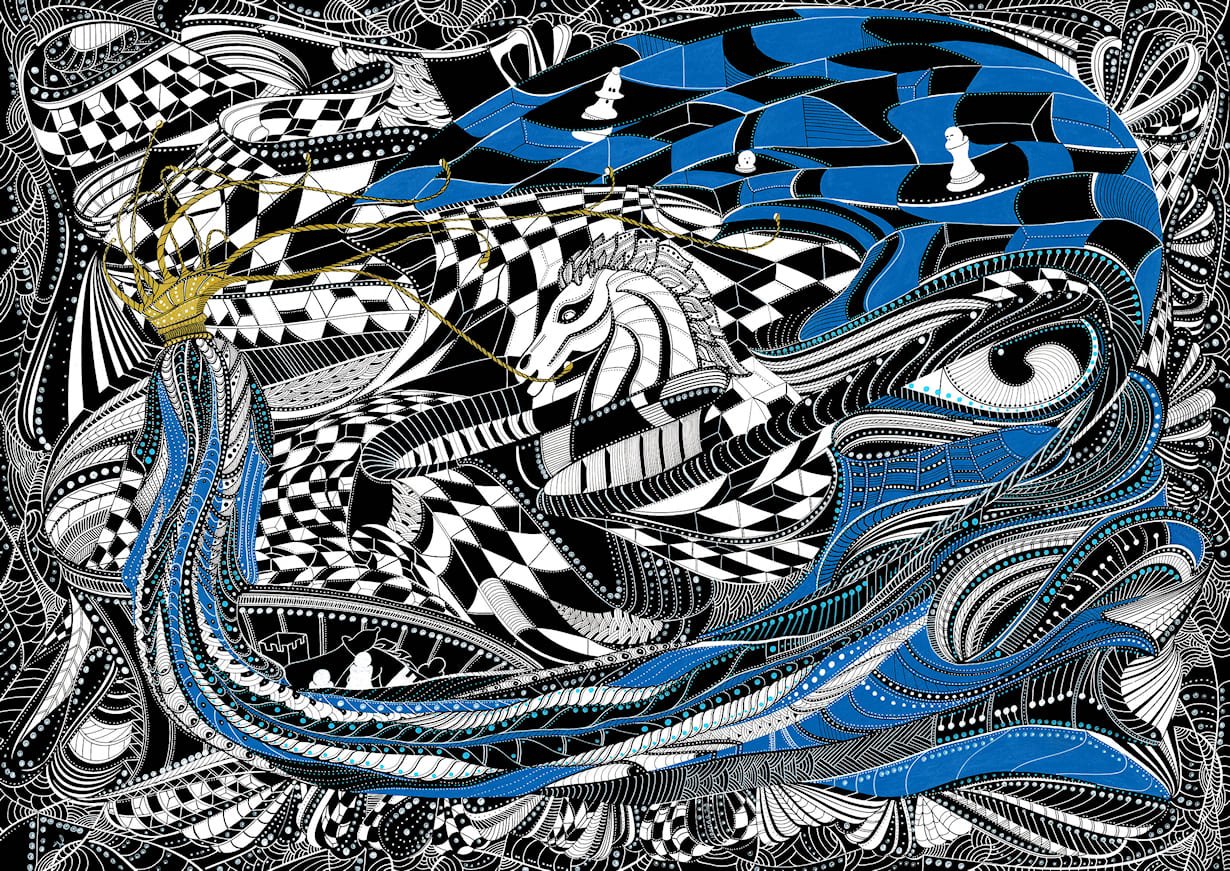
One of Joanna’s compelling works, Queen’s Gambit, measures 59.4 × 84.1 cm and combines pen and ink with Cerulean blue acrylic paint on white board. The artwork takes the familiar world of chess and transforms it into a dramatic visual exploration of strategy, power, vigilance, and imagination.
At the centre of the composition stands a crowned queen, commanding attention and establishing a powerful focal point. Emerging from the patterned depths is a vigilant knight, adding another layer of symbolism to the work. Together, these chess figures evoke the strategic tension inherent in the game while also suggesting broader ideas about decision-making, control, conflict, and power.
The visual language of Queen’s Gambit is particularly striking because of its combination of bold black-and-white geometry, fluid organic forms, and carefully placed accents of Cerulean blue and gold. The contrast between monochrome linework and selective colour creates a dynamic composition in which the eye is continually drawn between different areas of the artwork.
The use of Cerulean blue introduces an atmospheric quality, while touches of gold add a sense of importance and distinction. Against the white board, these colours become visual accents within the intricate network of black lines and patterns.
A Chessboard of Hidden Details
Although chess provides the conceptual foundation for Queen’s Gambit, Joanna moves beyond simply depicting the game. Instead, she uses its visual vocabulary as a starting point for a more imaginative exploration.
The crowned queen represents authority and strategy, while the knight emerging from the patterned depths introduces a sense of watchfulness and movement. Around these central figures, geometry and organic forms create an environment that feels both structured and unpredictable.
This duality reflects the nature of chess itself. Every move exists within a system of rules, yet within those rules lies an almost limitless number of possibilities. Joanna’s intricate composition mirrors that idea. The artwork is carefully constructed, but the abundance of details allows the viewer to make individual discoveries.
The longer one looks, the more the composition can reveal. Patterns lead the eye in unexpected directions, while forms appear to shift between abstraction and recognition. In this way, Queen’s Gambit becomes not only an image inspired by chess but also a visual meditation on complexity and possibility.
Art That Invites Discovery
A defining quality of Joanna’s work is its ability to reward close observation. Her hidden details create a sense of participation, asking viewers to slow down rather than consume the artwork at a glance.
This approach reflects her broader interest in the human spirit. Just as people contain layers of experience, emotion, memory, and imagination that cannot always be understood immediately, Joanna’s compositions contain layers waiting to be uncovered.
Her art therefore operates on several levels. At first, the viewer may respond to the overall composition, intricate technique, or striking contrast. With closer examination, individual forms and details begin to emerge. Eventually, the artwork becomes a personal experience shaped by the viewer’s own interpretation.
Expanding the Boundaries of Imagination
Joanna’s contemporary ink practice demonstrates how traditional materials can be used to create imaginative and visually expansive worlds. Pen and ink may appear simple in their basic form, but through her patient and detailed approach, they become tools for constructing complex realities.
Her work reflects a commitment to exploring what can happen when line becomes more than an outline and instead becomes a language of its own. Through line, she expresses energy, elegance, structure, and concept, building compositions that encourage curiosity.
Whether drawing inspiration from chess, surrealism, geometry, or the world around her, Joanna consistently seeks opportunities to transform familiar ideas into something unexpected. Her artworks do not provide every answer. Instead, they create spaces in which questions, interpretations, and discoveries can emerge.
Entering Joanna’s Dreamlike Visual World
Joanna’s work occupies a fascinating space between precision and imagination. Her meticulous pen-and-ink technique provides the foundation, while surreal imagery, organic forms, geometry, and carefully concealed details allow her compositions to move beyond conventional representation.
With Queen’s Gambit, she demonstrates how a familiar subject can become the starting point for something far more expansive. The crowned queen, vigilant knight, geometric patterns, organic forms, and flashes of Cerulean blue and gold come together to create a visual world filled with strategy and mystery.
Ultimately, Joanna’s art asks viewers to look more closely to move beyond the first impression and discover what lies beneath the surface. Her intricate compositions celebrate the imagination as a space without fixed boundaries, where reality can be transformed, familiar symbols can take on new meanings, and a simple line can become the beginning of an entirely new world.
