


Huang Yi Min was born in Shanghai, China, in 1950 and grew up during a period of profound social and cultural change. Her early years coincided with the Cultural Revolution, a decade-long period that began when she was 16 and dramatically disrupted education, cultural life, and traditional artistic practices across China. For Huang, however, these circumstances ultimately became part of a lifelong relationship with art, memory, and Chinese cultural traditions.
While working as a farmer in the fields during this challenging period, Huang continued to practice art and develop her understanding of the world around her. Her experiences during these years strengthened her commitment to lifelong learning and deepened her appreciation for the traditional culture that was being rejected or suppressed in wider society.
Rather than abandoning the artistic traditions of her heritage, Huang carried them with her. Calligraphy, classical painting, seal carving, decorative arts, and the visual language of ancient China would eventually become essential elements of her artistic vocabulary.
Academic Training and the Development of an Artistic Language
Huang Yi Min graduated from the Fine Arts Department of Beijing Normal University, where she received formal training in art. Her education provided a foundation through which she could further explore the relationship between traditional Chinese aesthetics and her own evolving artistic vision.
After graduating, Huang worked as an art editor at China Children’s Publishing House. The position gave her the opportunity to draw extensively, particularly character sketches and landscape paintings. Through this constant practice, she developed a distinctive visual language that gradually moved beyond straightforward representation.
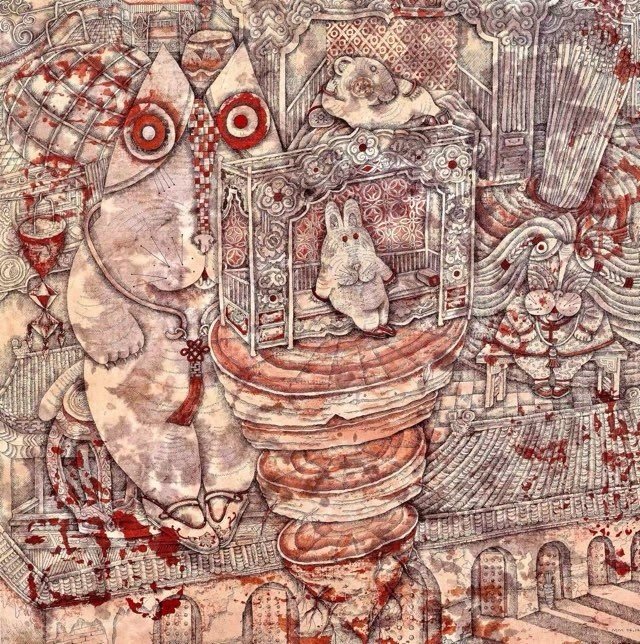
Her artistic style became increasingly surrealist while remaining deeply rooted in traditional Chinese aesthetics. Instead of simply reproducing historical imagery, Huang began transforming familiar cultural elements through imagination, color, atmosphere, and unexpected juxtapositions.
This combination of tradition and contemporary imagination would become one of the defining characteristics of her work.
A New Chapter in the United States
In 1997, Huang Yi Min immigrated to the United States as an outstanding talent. Her move marked an important chapter in her artistic development, allowing her to view her Chinese cultural heritage from a new geographical and cultural perspective.
Living between different cultural environments encouraged Huang to reconsider the memories, landscapes, objects, and traditions that had shaped her early life. Her art became a space where these memories could be reconstructed rather than simply preserved.
For nearly two decades, she has explored scenes positioned between the monumental architecture of Beijing’s Forbidden City and the ordinary residential buildings that surround everyday life. These locations provide an especially meaningful setting for her imagination because they bring together two seemingly different worlds: imperial history and contemporary human existence.
Through this intersection, Huang creates scenes that feel both familiar and dreamlike.
Surrealism Rooted in Traditional Chinese Aesthetics
Huang Yi Min’s paintings are distinguished by their ability to make the familiar appear mysterious. Her work draws from the visual vocabulary of traditional Chinese art while introducing a modern and surreal dimension.
She explains that China’s long civilization has had a profound influence on her aesthetic sensibilities. Calligraphy, painting, and seal carving have all contributed to the way she understands color, composition, texture, and atmosphere.
For Huang, the passage of time itself becomes an artistic source. The transformations that occur in color and texture as objects age inspire her to create surfaces and atmospheres that seem antique. Yet these apparently historical colors contain something unexpected.
Within these aged-looking tones, Huang introduces modern landscapes, contemporary stories, and imaginative scenes. The viewer may initially feel that they are looking at an ancient Chinese painting, only to discover something unfamiliar within it.
This tension between expectation and surprise is central to her work.
Her paintings encourage viewers to look again at ordinary environments and familiar objects. By placing them within surreal spaces and surrounding them with the atmosphere of historical Chinese art, Huang transforms everyday experiences into poetic visual narratives.
Red Embroidered Shoes: Exploring Decorative Tradition
One of Huang Yi Min’s notable works, Red Embroidered Shoes, was created in 1995, during a period when she began studying traditional Chinese furniture and decorative arts.
The work reflects her growing interest in the visual details and cultural meanings embedded within traditional objects. Rather than treating decorative arts simply as historical artifacts, Huang approaches them as sources of inspiration that can be reinterpreted through contemporary artistic imagination.
The title itself evokes a strong connection with Chinese decorative traditions. Red has long carried powerful cultural associations in Chinese visual culture, while embroidered objects can embody craftsmanship, memory, identity, and the passage of traditions between generations.
In Huang’s artistic world, such an object can move beyond its physical identity and become part of a larger imaginative landscape.
Wordless Poems and the Forbidden City
In 1997, Huang Yi Min created Wordless Poems, a work inspired by her observations of the spaces where the Forbidden City exists alongside ordinary folk dwellings.
The inspiration came from a personal memory. Huang recalled walking along the moat of the Forbidden City at dusk and seeing a flock of swifts flying back toward their nests. The birds moved across the evening sky like marks appearing across an ancient painting.
To Huang, their flight resembled the written lines of poetry, yet no actual words were present. The scene became what she describes as a “wordless poem.”
This experience also influenced her decision to incorporate the colors associated with ancient Chinese calligraphy into her work. Through these colors and the atmospheric qualities of the scene, she transformed a simple observation into a poetic meditation on history, place, memory, and movement.
The work demonstrates how Huang can begin with an ordinary moment and turn it into something symbolic and dreamlike.
The Dialogue Between Past and Present
A recurring theme throughout Huang Yi Min’s practice is the dialogue between the past and the present. Her paintings do not simply recreate traditional China, nor do they completely abandon its visual language in favor of modernism.
Instead, she creates a meeting point between the two.
Ancient-looking colors may surround modern scenes. Familiar architectural spaces may become surreal landscapes. Everyday objects may acquire the atmosphere of historical artifacts. Birds, buildings, streets, decorative objects, and human environments can become fragments of a larger visual story.
This approach allows Huang to explore how cultural memory survives through transformation. Rather than treating tradition as something fixed in the past, she presents it as something that can continue to evolve.
Her work therefore becomes both a personal reflection and a broader exploration of cultural continuity.
Recognition and Collections
Huang Yi Min’s distinctive artistic approach has attracted significant recognition. Her works have received reviews from The New York Times, and she was awarded the Anna Walinska Academic Achievement Award in the United States.
Her paintings have also entered private and institutional collections connected with the international art world. These include collections associated with directors and private collectors of the Singapore Art Museum, Hong Kong Museum of Art, Simin Art Gallery in Singapore, Crystal Art Foundation in New York, Chinese Gallery in New York, and the Newark Museum of Art.
Such recognition reflects the ability of Huang’s work to communicate across cultural boundaries while retaining a strong connection to Chinese artistic heritage.
An Art of Memory, Transformation, and Discovery
Huang Yi Min’s artistic journey is ultimately a story of preservation through transformation. Her experiences during a period of enormous cultural change, her formal education, her years of drawing and painting, and her later life in the United States have all contributed to an artistic practice grounded in memory and imagination.
Her paintings invite viewers to reconsider what they think they know. A familiar landscape can become strange. An ancient color palette can reveal a modern story. An everyday object can become a doorway into cultural memory.
By combining the visual traditions of Chinese calligraphy, painting, seal carving, and decorative arts with surrealist imagination, Huang creates works that exist between historical memory and contemporary experience.
Her art reminds us that tradition does not have to remain frozen in time. It can be remembered, transformed, questioned, and reinvented. In Huang Yi Min’s world, the past becomes the foundation for something new a surreal space where history, everyday life, imagination, and poetry exist together.
